
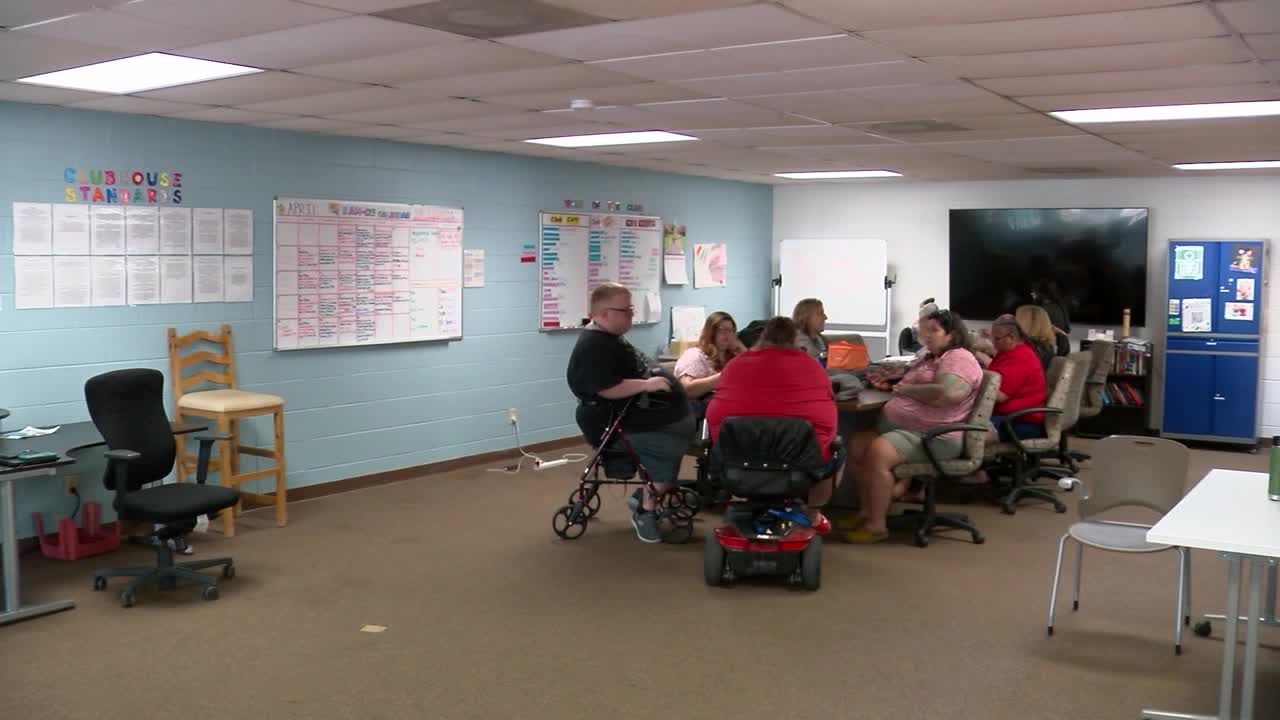
Two Vail Communities Clubhouses may close after state funding ends, leaving members living with serious mental health challenges without a similar program.
Vail Communities said funding for its St. Paul and Minneapolis clubhouses will stop at the end of June, per a notice from the Minnesota Department of Human Services (DHS). The group said 500-600 active members use those locations, and there are no other clubhouse-model programs in Minnesota without its services.
“It really has turned out to be a lifesaver for me… It’s got me from living in my bed, literally living in my bed, out back into the world where now I’m able to work as a peer support specialist part-time, and at 71, I’ve gone back to college at Metro State University,” Margaret Humphrey, a member who frequents the St. Paul location, said.
“You know, I’ve watched my life transform. I mean, not that I haven’t struggled… But because of the clubhouse, I don’t feel alone anymore,” another member, Nishanth Peters, said.
Senior Director of Clubhouse Programs & Public Policy for Vail Communities, Chad Bolstrom, said Vail Communities’ 40-year-old Hopkins location will continue to receive county funding. He said the state money that allowed the expansion of a St. Paul clubhouse and supports the Minneapolis site will end on June 30.
In a March notice to Vail Communities, DHS wrote, “We remain committed to continued work together…”
“However, after a thorough review, DHS is unable to extend Vail Communities’ single-source contract after its current conclusion on June 30th, 2026,” the letter continued.
DHS said this year’s findings from the Minnesota Office of the Legislative Auditor (OLA), “placed significant scrutiny on the use of sole-source contracts across the state.”
Sole-source, or single-source, funding means money was awarded without a request for proposal (or RFP) process, which allows other organizations to apply.
Bolstrom said the two clubhouses are at risk of closure without that funding, given the timing of the notice.
“We hope that it doesn’t,” Bolstrom said. “But I think given the late nature and the amount that this support has helped to kind of sustain, it’s going to be really challenging for us to find a solution otherwise.”
“I think one of the reasons why we were identified as the sole-source contract provider is because we are the only accredited clubhouse system providing services in the state of Minnesota,” Bolstrom continued.
“We believe in, you know, the process of, kind of a selective process of fairness. But there wasn’t one offered.”
DHS said in its letter and in response to emails from 5 EYEWITNESS NEWS that it is planning to issue an RFP to support clubhouse-type programming. However, that funding “…is slated to be available at the beginning of 2027.”
In the meantime, 5 EYEWITNESS NEWS asked DHS what it’s doing to ensure continued care for members without other similar programs.
A spokesperson said, “The department works to ensure continuity of care for the participants of programs that face a disruption, including Vail Communities.” However, they did not provide specifics.
Vail Communities leadership said they are unaware of any efforts beyond plans for an RFP and said requests for bridge funding were denied.
“It’s in our kind of short and long-term plan to not have to rely on this funding in the same way,” Bolstrom said.
“But we really didn’t have any notice or identification that that switch was happening now, in part because we’re trying to find county funds, we’re trying to find a Medicaid benefit, we’re trying to find other solutions that would make these clubhouses sustainable without this grant funding, or at least with less of it. But the reality is, we’re not there yet… And that’s the part that feels kind of incongruent,” he said.
“Whatever happens, it’s not going to be easy for myself and any number of people,” Peters said.
“This is like a lifeline. I want them to consider that.”
DHS said it warned Vail Communities a year ago that the contract and grant funding would not be extended. Vail Communities disputed that, saying they knew the funding would need annual renewal and had been asking about it since the fall.
5 EYEWITNESS NEWS also contacted the Minnesota Office of the Legislative Auditor (OLA) after DHS cited its report in the March notice letter. Legislative Auditor Judy Randall said OLA could not speak it because OLA “has not audited DHS’s contract with Vail Communities.”
Referencing that January 2026 report, Randall added that OLA’s recommendation “…is not that DHS should not use single source grants; rather, the recommendation is that DHS should follow required state policies when using single source grants.”
See the full responses to 5 EYEWITNESS NEWS’ questions attributed to DHS:
Why has the Medicaid benefit analysis not been completed? When is it expected to be completed?
“The study has not yet been completed, as the department ensures that the proper program integrity elements are considered before finalizing our recommendations for a potential new Medicaid program. It is in process.”
Has that $1.2 million allocated to it been used? For what?
“The most recent award to Vail Communities used funds from the federal mental health block grant, which was a temporary source of funding. The recipient was told a year ago that the grant would not be extended.”
Does DHS plan on an RFP for Clubhouse-type programming? If so, when?
“We are planning to issue an RFP in this space, with funding slated to be available at the beginning of 2027.“
Without a sole-source contract or an RFP, are there other options for the Clubhouses to be funded?
“Competitive RFPs are the process for awarding state contracts. We can award a grant in a noncompetitive manner (“single source”) when, after a search to validate, only one entity is determined to be reasonably able and available to meet the intended purpose and objectives of the grant. The preference for the RFP process was further reinforced by the release of the OLA report in January of 2026.“
Does DHS have reason to believe the program is high risk for fraud?Is Vail Community Services under investigation for any allegations of fraud? (They say they are not.)
“We don’t share information about which specific providers are under investigation, but, again, this organization was told a year ago that the single-source contract would not be extended.”
Is there anything DHS is doing/could do to ensure continuity of care for program clients without other programs like it?
“The department works to ensure continuity of care for the participants of programs that face a disruption, including Vail Communities.“
See Legislative Auditor Judy Randall’s full response to 5 EYEWITNESS NEWS’ inquiry:
“The Office of the Legislative Auditor (OLA) has not audited DHS’s contract with Vail Communities; as a result, we are not able to speak to whether DHS properly handled its contract with that organization.
In OLA’s January 2026 performance audit, Department of Human Services: Behavioral Health Administration Grants, we discussed concerns about how DHS has used single source grants. OLA’s recommendation in this section of the report is not that DHS should not use single source grants; rather, the recommendation is that DHS should follow required state policies when using single source grants.
The finding on page 13 states:
The Behavioral Health Administration used single source grants when they were not justified and did not always sufficiently document its reasons for using single source grants.
The recommendations on page 15 state:
• The Behavioral Health Administration should use single source grants only when just one entity is reasonably able to meet the grant’s purpose and objective, as required by Office of Grants Management policy.
• The Behavioral Health Administration should sufficiently document the reasons for using single source grants.
• The Behavioral Health Administration should implement effective internal controls to ensure that when it uses single source grants, it does so in compliance with Office of Grants Management policy.“
For Related Stories: Funding Mental Health Renée Cooper