
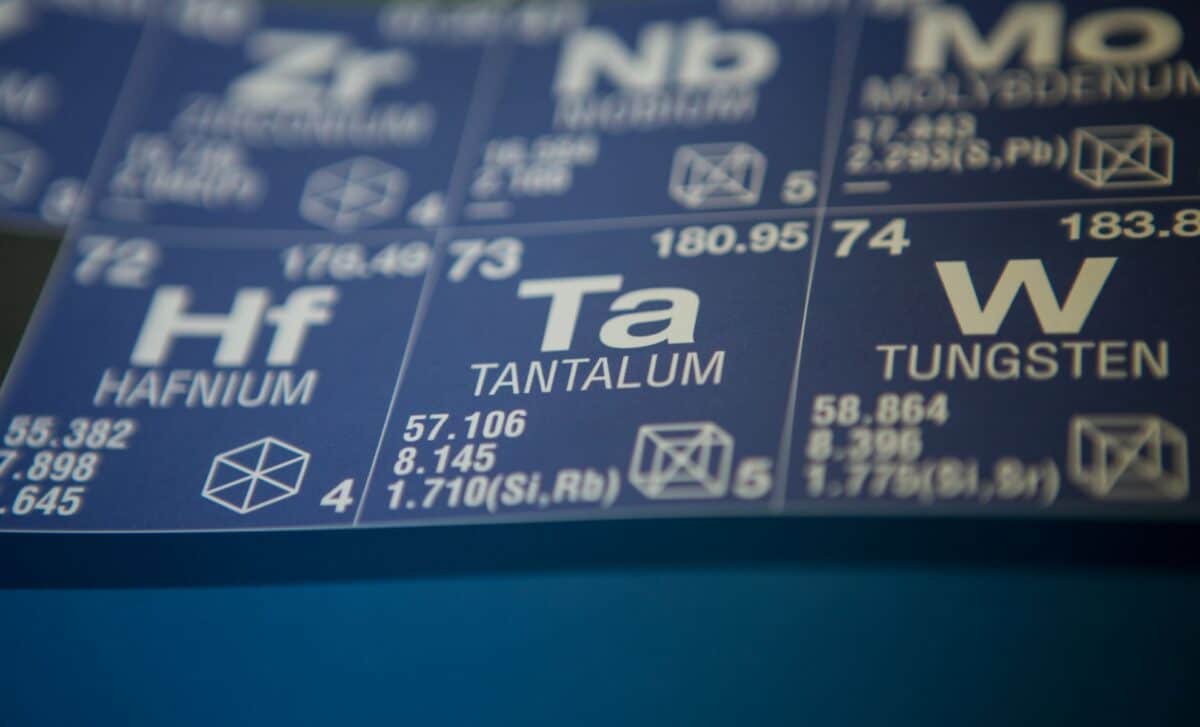
The material, metallic theta-phase tantalum nitride (θ-TaN), was developed by a multi-institution team led by Yongjie Hu, a professor of mechanical and aerospace engineering at the UCLA Samueli School of Engineering.
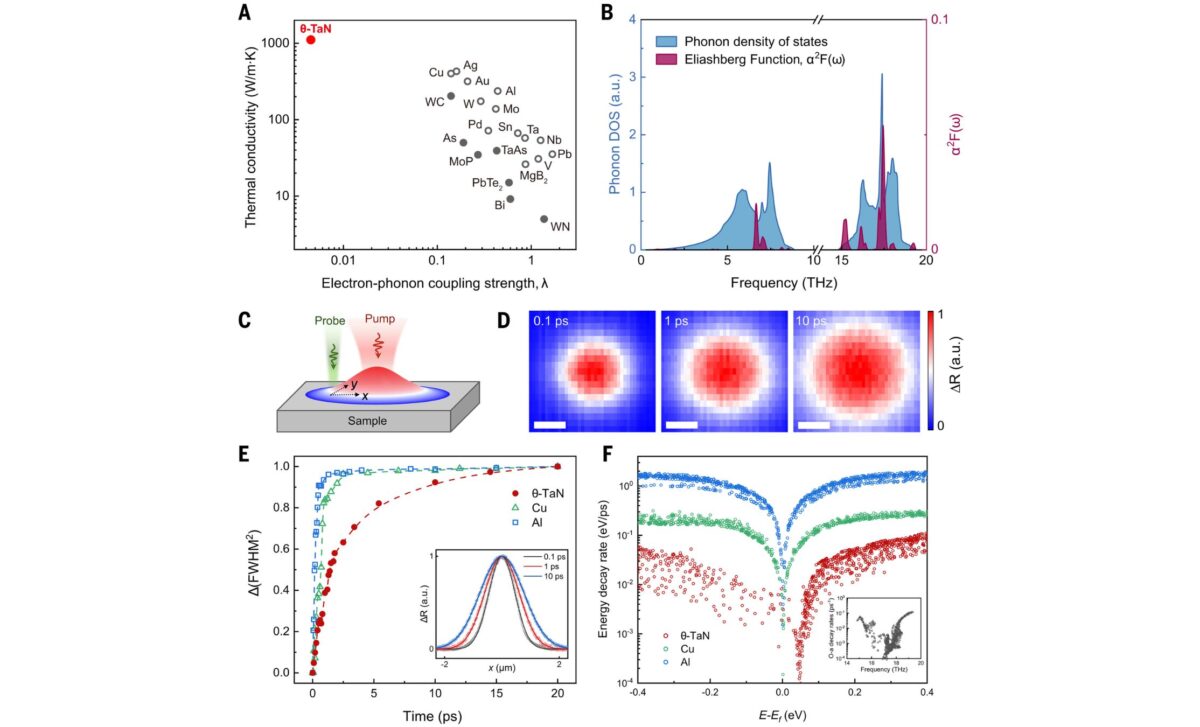
Copper has long been the dominant material for thermal management. It accounts for roughly 30 percent of commercial thermal-management materials globally, owing to its thermal conductivity of approximately 400 watts per meter-kelvin. The newly characterized material was measured at around 1,100 watts per meter-kelvin at room temperature, nearly three times that figure, setting a record for metallic materials.
“Our result breaks the historic ceiling for heat transport in metallic materials,” Hu said, according to Scientific American. “Given [this conductor’s] superior performance, it has the potential to complement or even replace copper.“
An Unusual Atomic Structure Explains the Performance
In conventional metals, heat travels through two primary mechanisms: freely moving electrons and atomic vibrations known as phonons. The efficiency of this process is constrained by interactions between electrons and phonons, collisions that impede heat flow and impose an effective ceiling on thermal conductivity.
Theta-phase tantalum nitride appears to sidestep this limitation through its atomic structure. The material forms as a continuous, highly ordered crystal lattice, and theoretical modeling by the research team suggested this configuration produces unusually weak phonon-electron interactions. In most metals, phonons are also disrupted by collisions with one another. In this material, that form of interference is suppressed as well, allowing phonons to travel longer distances with minimal resistance.
 How θ-TaN Breaks the Metallic Heat Barrier ©Science
To verify these predictions experimentally, the team used the Advanced Photon Source (APS) at Argonne National Laboratory, specifically the upgraded 30-ID beamline, following a comprehensive transformation of the facility. High-resolution inelastic X-ray scattering confirmed the extremely weak electron-phonon coupling. “The enhanced capabilities of the upgraded APS made these precise measurements possible,” said Argonne scientist Ahmet Alatas. “Together, experiment and theory provide a microscopic explanation for the record-high thermal conductivity.”
The team also used ultrafast optical spectroscopy and time-domain thermoreflectance to independently validate their measurements, according to the Science paper. Xiaojia Wang, a mechanical engineer at the University of Minnesota who was not involved in the research, told Scientific American that the team had rigorously verified its findings, describing them as “both exceptional and conceptually important.”
Implications for Electronics and Future Research
The timing of the discovery coincides with growing pressure on existing thermal materials. As artificial intelligence applications expand, data centers and AI accelerators are generating heat at a scale that conventional metals are increasingly hard-pressed to manage. Copper’s role in chips and AI hardware has made its thermal limitations a point of concern among engineers.
“As AI technologies advance rapidly, heat-dissipation demands are pushing conventional metals like copper to their performance limits,” Hu said in a statement issued by UCLA. Beyond computing, the researchers suggest the material could find application in aerospace systems and emerging quantum platforms.
Whether those applications prove practical depends largely on manufacturing. Wang noted that if theta-phase tantalum nitride can be produced at scale, it could have a substantial impact on thermal management across multiple industries. The material is described as metastable, a phase that exists in a stable configuration under specific conditions but is not the lowest-energy form of the compound. Scaling production of such materials presents an engineering challenge that the current research does not address.
For materials scientists, the work raises a broader question about assumed limits. “Do we truly understand where the real limits lie, or do the boundaries assumed for decades to be fundamental simply reflect our current tools and understanding?” Hu asked, according to Scientific American. The finding, he suggested, opens the possibility that other long-standing constraints in materials physics may be similarly amenable to revision, not through speculation, but through precise measurement and theory working in tandem.