
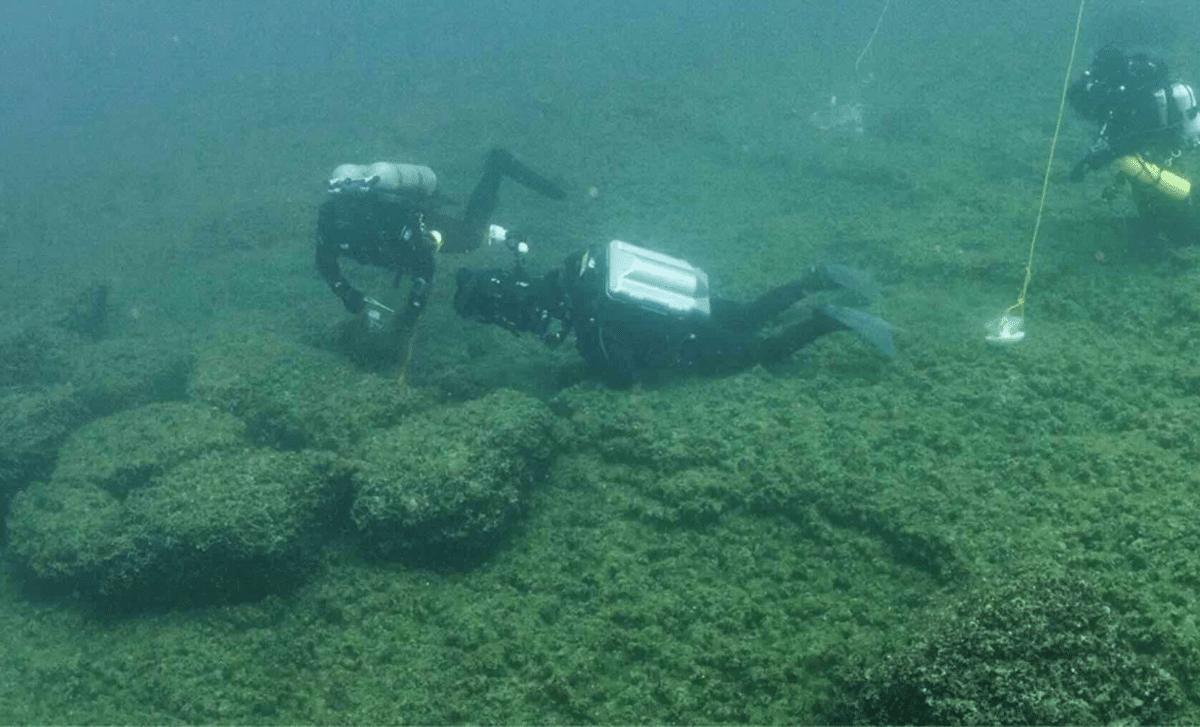
Deep beneath the surface of Lake Huron lies a world frozen in time, offering unprecedented insight into a lost chapter of North America’s prehistory. A groundbreaking study published in Proceedings of the National Academy of Sciences (PNAS) reveals a series of remarkable 9,000-year-old stone structures, buried under hundreds of feet of water. These findings, which have uncovered a hidden world of ancient caribou hunters, provide the earliest known evidence of human activity at the bottom of the Great Lakes. The structures, including hunting pits, drive lanes, and stone caches, tell a story of ingenuity and survival from a time long before the region was submerged by rising glacial meltwaters.
The Discovery of Sunken Stone Structures: A Window into Ancient Life
The discovery of these ancient structures beneath Lake Huron began in 2008 when underwater researchers detected unusual features more than 100 feet below the surface. The submerged site has since become the focal point of an ongoing archaeological investigation. According to John O’Shea, a prominent archaeologist at the University of Michigan, these stone constructions are “the earliest evidence of human activity ever discovered at the bottom of the Great Lakes.” The findings not only reveal evidence of ancient human settlements but also offer a glimpse into the complex systems of hunting and survival used by Paleoindian groups long before the rise of modern civilizations.
To date, the research has identified a total of 80 locations containing stone structures, most of which are associated with caribou hunting. These structures include drive lanes, corridors where animals were funneled into specific areas, and hunting blinds, as well as caches of stones likely used to fashion tools. O’Shea’s team has painstakingly mapped out these ancient features, painting a vivid picture of a thriving hunting community that once inhabited a land bridge now lost beneath the waters of Lake Huron.
The discovery is a testament to the persistence and resourcefulness of early humans. “Without the archaeological sites from this intermediate time period, you can’t tell how they got from point A to point B, or Paleo-Indian to Archaic,” O’Shea explains. These sites offer a rare opportunity to study how humans adapted to their environment, utilizing the region’s natural resources in ways that have only recently come to light.
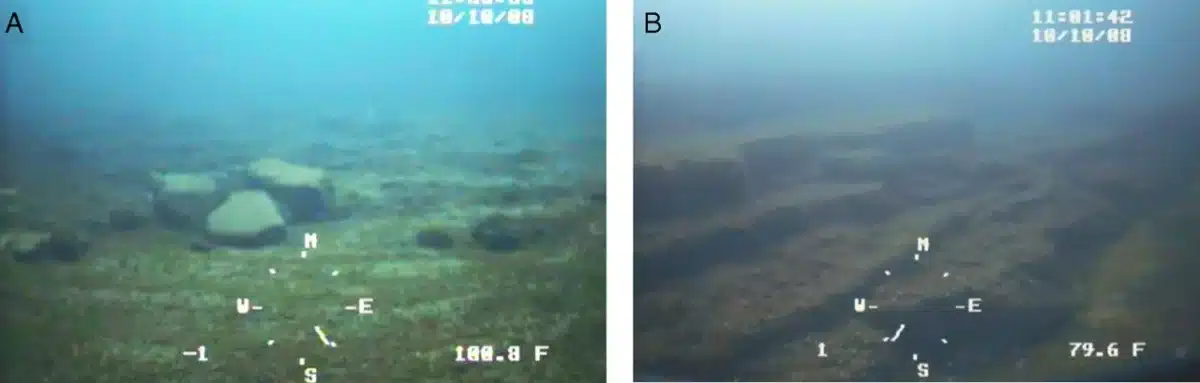 Images captured from ROV video examination of the lake bottom. (A) View of a potential stone hunting blind (see Fig. 2B) that is approximately 3.5 m across. (B) Bedrock outcrop showing massive limestone blocks and thinner bedded layers, which may include chert deposits. Exposure is approximately 250 m long. The direction of view and camera depth (in feet) is recorded in the foreground of each image.
Credit: Proceedings of the National Academy of Sciences (PNAS)
A Land Bridge Lost to Time: The Alpena-Amberley Ridge
The submerged features discovered in Lake Huron are located on an ancient ridge known as the Alpena-Amberley Ridge. Once a land bridge stretching more than 100 miles between Michigan and Ontario, this geological feature was exposed during the final stages of the last Ice Age. Over 10,000 years ago, as glaciers began to melt and water levels rose, the ridge was slowly consumed by what is now Lake Huron.
The Alpena-Amberley Ridge provided a unique environment for ancient hunters, offering a natural corridor across the region. O’Shea and his team utilized sonar technology to pinpoint likely archaeological sites along the ridge, a process that ultimately led to the discovery of the stone structures. The preservation of these features under the lake’s relatively sediment-free waters has allowed researchers to study them in unprecedented detail, offering insights that would otherwise be lost to time.
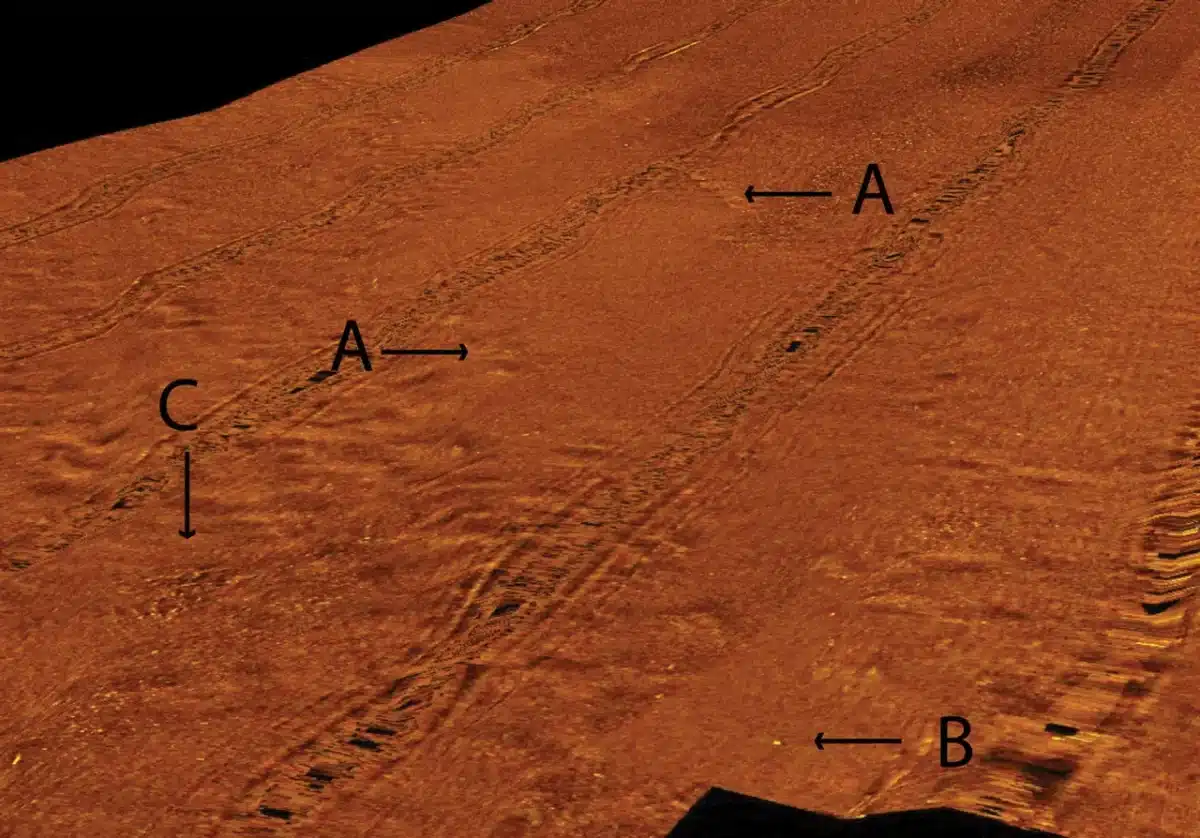 Mosaic of acoustic images draped over the bottom contours showing a Lake Stanley-age watercourse with associated possible hunting structures and camp site. The banks of the watercourse are indicated by A. A potential hunting feature is at B, and the potential camp site at C. Distance between the dark bands in the image is 200 m. Credit: Proceedings of the National Academy of Sciences (PNAS)
Unraveling the Mystery of Ancient Caribou Hunters
At the heart of this discovery is the identification of ancient caribou hunting techniques. The stone drive lanes and hunting pits found beneath Lake Huron reveal a well-organized system of animal management, one that echoes modern methods used by reindeer herders in Siberia. O’Shea recalls a key moment that sparked his curiosity: “In that book they were talking about how do these very small groups of families manage a herd of thousands of semi-domesticated reindeer?” He noted that these herders used simple brush and rock formations to guide the animals from one pasture to another, a technique that may have been mirrored by the ancient hunters of Lake Huron.
Combining this knowledge with his observations of the underwater structures, O’Shea theorized that the early caribou hunters may have used similar techniques, using the natural stone resources of the region to direct the movement of game. This theory, supported by the ongoing discoveries, highlights the ingenuity of early human societies and their ability to adapt to their environment.
The Significance of Preservation: A Peek into Prehistoric America
What makes these discoveries so significant is not just the age of the structures, but the exceptional preservation of the site. Unlike many ancient sites, which have been altered or destroyed by farming, development, or the passage of time, these underwater features remain largely undisturbed. O’Shea describes this preservation as a rare opportunity, saying, “That has implications for ecology, archaeology, and environmental modeling.” The clear, sediment-free waters of Lake Huron have created an ideal environment for preserving these ancient remnants, providing a rare window into a past that was previously unknown.
This pristine preservation is a testament to the accuracy of modern archaeological methods and the potential for new discoveries in other underwater locations around the world. O’Shea’s team is already looking to expand their search, and further studies are likely to yield even more insights into the ancient world beneath the Great Lakes.
The Road Ahead: Ongoing Research and New Discoveries
The ongoing research in Lake Huron is far from over. O’Shea and his colleagues plan to continue their investigations, with a renewed focus on understanding the broader implications of these discoveries. “We have been working continuously out in Lake Huron since 2008, and will be continuing the work this summer,” O’Shea states. Their findings are chronicled in the Museum of Anthropology Memoir series, with the latest research presented at the Society for Historical Archaeology meetings in January 2023.
As new locations are identified and explored, these studies will provide invaluable data on the early human occupation of North America. By piecing together the evidence from Lake Huron and similar sites, archaeologists hope to unlock even more secrets about the ancient societies that once thrived in what is now submerged under the Great Lakes.