
1942-46
Peggy Guggenheim opens the Art of This Century gallery near New York’s Museum of Modern Art and begins showing Jackson Pollock — soon to be followed by Mark Rothko and Clyfford Still. With the emergence of these artists, and others Guggenheim exhibits (Robert Motherwell, Ad Reinhardt), New York effectively replaces Paris as the center of the art business.
1948-49
A cover story in Life magazine argues that Pollock is the greatest living painter in the United States, and that his work is a new phenomenon in American art. Some critics begin referring to Pollock and several of his peers as Abstract Expressionists. He starts becoming wealthy from the sale of his paintings and buys an Oldsmobile convertible — which he’ll crash, while drunk, in 1956, dying at 44.
1957
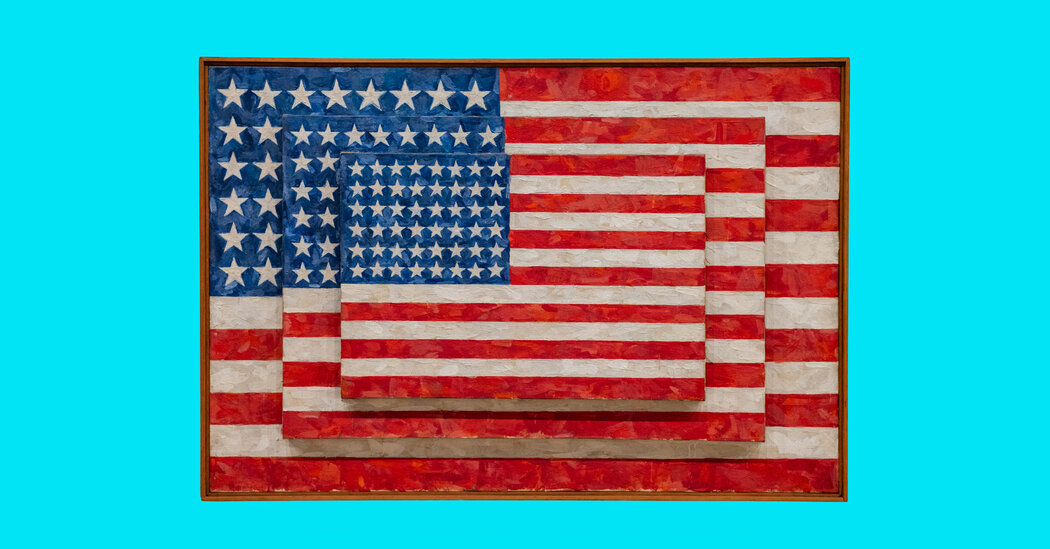
Leo Castelli, a Hungarian Jew who fled to the U.S. during World War II, opens a gallery on East 77th Street in Manhattan. Initially focusing on European Surrealism and Abstract Expressionist painting, Castelli changes course within a year, showing Robert Rauschenberg and Jasper Johns, who are experimenting with a detached, vaguely ironic style that seems to chart a new course in American art.
1962
A gallery in West Hollywood called Ferus mounts an exhibition by an unknown artist named Andy Warhol — 32 canvases, each a hand-painted rendering of a Campbell’s Soup can. Only a handful sell, for $100 each, but the exhibit helps establish the genre of Pop Art.
1967
A group of artists known as the Organization of Black American Culture, led by the painter William Walker, create a mural, known as the “Wall of Respect,” on the facade of an abandoned building in Chicago, commemorating figures from Nat Turner to Aretha Franklin. A foundational work in the Black Arts Movement, which the poet Larry Neal will describe as “the aesthetic and spiritual sister of Black Power,” the mural will be destroyed when the building is torn down in 1972. But it spawns a tradition of community murals across the U.S. that will continue to the present.
1968
A young art dealer named Paula Cooper opens what’s widely considered to be the first gallery in a Lower Manhattan neighborhood that will come to be known as SoHo. Her first show is a “Benefit for the Student Mobilization Committee to End the War in Vietnam” and includes works by Dan Flavin, Donald Judd and Sol LeWitt.
1969-70
The gallerist and collector Virginia Dwan finances two early works of land art: Michael Heizer’s “Double Negative,” for which the artist uses dynamite to create two enormous trenches at the edge of a Nevada mesa, and Robert Smithson’s “Spiral Jetty,” a 1,500-foot-long sculpture of mud, salt crystals and basalt rocks on the shore of Utah’s Great Salt Lake.
1971
Castelli moves his business to SoHo.
1972
In a dilapidated house in Los Angeles, a group of artists led by Judy Chicago and Miriam Shapiro install a show called “Womanhouse.” Featuring only women artists and centering on the theme of female empowerment, it’s the first of its kind.
1973
Robert and Ethel Scull, New York-based collectors who made a fortune from their taxi business, sell works from their collection by more than 25 living artists at the auction house Sotheby Parke-Bernet. Up to now, the secondary art market has been dominated by Impressionists, old masters and early 20th-century work. The flipping of works by living artists — like Rauschenberg and Johns — is unheard-of, but the sale is largely successful, paving the way for the increasing commercialization of contemporary art.
1974
The sculptor Lynda Benglis takes out an ad in Artforum for a show at Paula Cooper that features her fully nude, except for a pair of sunglasses, and holding a double-sided dildo. Benglis becomes a figurehead for second-wave feminism and what New York magazine will describe as “the new sexual frankness.”
Linda Goode Bryant opens Just Above Midtown (JAM) on West 57th Street, becoming the first Black art dealer to open a major gallery in New York. (She’s preceded in Los Angeles in the late 1960s by Alonzo and Dale Brockman Davis’s Brockman Gallery, and the painter Suzanne Jackson’s Gallery 32.) She champions artists of color, including David Hammons, Senga Nengudi, Lorraine O’Grady and Howardena Pindell.
1977-79
Mary Boone and Larry Gagosian open galleries in SoHo and begin showing a new generation of painters that includes David Salle and Julian Schnabel — called Neo-Expressionists by some critics.
1981
Jean-Michel Basquiat, 21, who spent his teenage years as a graffiti artist, makes his first sale of a painting — to the Blondie frontwoman, Debbie Harry, for $200. He soon starts showing with Gagosian and will later move to Boone.
1987
Six years after the C.D.C.’s report of a rare skin cancer among gay men, there have been about 40,000 deaths related to AIDS complications. A group of New Yorkers, including many artists, form the AIDS Coalition to Unleash Power, or ACT UP, and paste a poster all over the city designed by Avram Finkelstein. The pink triangle above the slogan “Silence = Death” becomes an icon of queer activism.
Warhol dies at 58 following gallbladder surgery.
1988
The minimalist sculptor Carl Andre is acquitted of second-degree murder charges in the death of his wife, the conceptual artist Ana Mendieta — who “went out the window” of the couple’s 34th-floor Greenwich Village apartment, as Andre put it in a 911 call, following a fight between the two.
Basquiat dies of a heroin overdose at 27.
1993
The Whitney Biennial in New York explores American racial politics. Daniel Joseph Martinez makes admission tags that read, “I Can’t Imagine Ever Wanting to Be White.” Glenn Ligon shows a work critiquing Robert Mapplethorpe’s photographs of Black men. Footage of Los Angeles police officers beating Rodney King is on display. “I hate the show,” writes a critic for The New York Times, echoing a sentiment shared by many about an exhibition that will later be reappraised as one of the most important of its time.
1996
Cooper moves to a depopulated block in West Chelsea. Most other major SoHo dealers will eventually join her, including Gagosian and Boone.
MoMA acquires the full set of Warhol’s “Campbell’s Soup Can” paintings for a reported $15 million.
2002
A year after the Sept. 11 attacks, at ACE Gallery on Hudson Street, about a mile from ground zero, David Hammons exhibits “Concerto in Black and Blue,” a kind of requiem for Lower Manhattan in which the artist completely empties out the gallery space, turns off all the lights and gives visitors blue-tinted flashlights to help them navigate.
2008-09
Markets crash in the biggest financial crisis since the Great Depression — but the art market will bounce back much faster than the rest, as contemporary art becomes a safer bet than stocks for wealthy investors.
2010
The Serbian artist Marina Abramović stages “The Artist Is Present” at MoMA — sitting silently for hours as audience members line up to sit across from her. The show is a surprise hit, and “performance art” will soon be used to describe everything from musicians’ stagecraft to the public antics of some of our more perplexing celebrities.
2014
The painter Walter Robinson describes a new crop of abstract painters, most fresh out of art school, as Zombie Formalists, artists making inoffensive, decorative and aesthetically uniform works. Practically the only interesting thing about their art, he says, is how much collectors are willing to spend on it.
In Brooklyn, at the former Domino Sugar Factory, Kara Walker installs her sculpture “A Subtlety”: a sphinx with Black features that is 75 feet tall, 35 feet long and made of more than 30 tons of white sugar, among other materials.
2016-17
A solo exhibition by the painter Kerry James Marshall at the Metropolitan Museum’s temporary Breuer Building outpost in New York, the first at the Met by a living Black artist, becomes a critical and commercial sensation and a symbol for a larger reckoning among arts institutions about how Black artists have been underrepresented.
A 1982 untitled Basquiat painting sells for $110.5 million at Sotheby’s, breaking the record for the most expensive work ever sold at auction by an American artist.
2019
Art institutions begin to cut ties with prominent philanthropists, including the Sackler family, owners of Purdue Pharma, the makers of OxyContin. Warren B. Kanders, the chairman of the Whitney and the owner of a company that manufactures tear gas, resigns following protests; Leon Black, a friend of Jeffrey Epstein, who also dies this year in a New York jail, will step down as chairman of MoMA’s board of trustees two years later. In subsequent years, museums will face increasing political pressure from artists, audiences and employees — whether over charges of censoring art about the war in Gaza or, in the words of one activist group, “for contributions to colonial looting and gentrification.”
2020
The Covid-19 pandemic shuts down most cultural venues, some for good.
The murder of George Floyd by a white police officer in Minneapolis sparks nationwide protests. Artists respond, including with a Black Lives Matter mural painted on 16th Street in Washington.
2025
Donald Trump begins his second term. The Black Lives Matter street mural is paved over following Congress’s threat to withhold federal funding for the city. Trump pressures Washington’s arts institutions — with more threats of funding cuts — to stop mounting exhibitions that promote what his administration deems “divisive, race-centered ideology.” Amy Sherald, who painted the official portrait of Michelle Obama in 2017, cancels her exhibit at the National Portrait Gallery.