
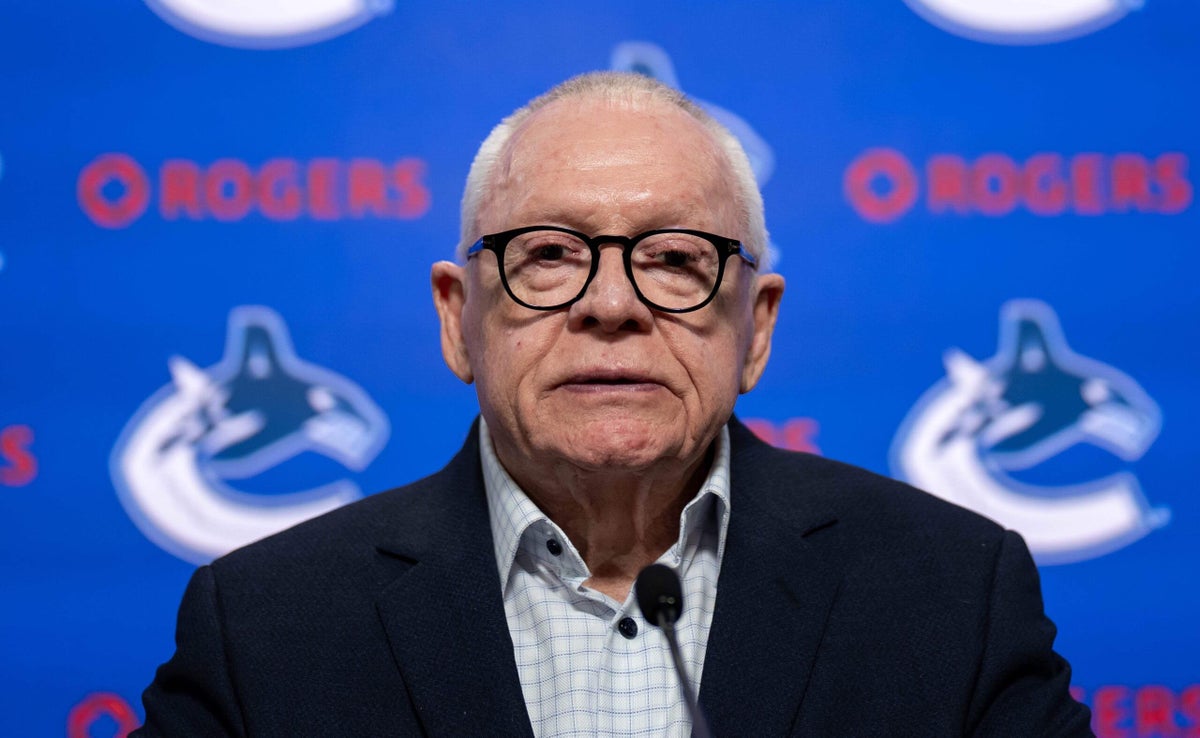
The Vancouver Canucks formally concluded the worst season in the mostly sordid history of the franchise on Friday morning.
For the players, it was garbage bag day, an opportunity to put an optimistic spin on the learning experiences of a miserable campaign, and the improved vibe around the team — including, as forward Max Sasson put it, a suddenly buzzing group chat — in the closing weeks of the regular season.
For management, however, Friday felt more unsettled than we might have expected.
Officially, the Canucks dismissed general manager Patrik Allvin and made no further changes. President of hockey operations Jim Rutherford detailed Friday how he’d extended Allvin an invitation to remain with the organization in a different role with reduced responsibility.
“We felt it was time to make a change and have somebody else sitting in the general manager’s chair,” Rutherford said. “I have offered Patrik the opportunity to stay in the organization and do some of the things he’s really good at in terms of development and amateur scouting, and I’ll give him some time to make that decision. It’s really emotional now.”
A league source told The Athletic that Allvin was offered a vice president job. The Canucks’ preference was for Allvin to stay on, contribute to the search process in naming his successor and run the 2026 NHL Draft, which he’s worked extremely hard to prepare for, touring the world to see the top draft-eligible prospects in Europe, the NCAA and the CHL play games live.
To this point, Allvin has declined to take the job and continue working for an organization that has reduced his responsibility and no longer believes in his leadership atop the hockey operations department. My understanding is that’s unlikely to change.
A team source told The Athletic on Friday that Allvin’s dismissal was largely the result of two primary perceived shortcomings.
The first is that Allvin’s relationship and alignment with head coach Adam Foote broke down over the course of the season. Allvin wanted more developmental minutes for young players, and Foote was a bit too slow to lean into the team’s plight at the bottom of the NHL standings and invest in improving those players by utilizing them in roles above what they were prepared for. It became a source of friction, and while the organization generally sided with Allvin’s point of view, his lack of tact in managing the relationship was viewed as a mark against him.
The second is that while Rutherford is deeply involved in all aspects of this team’s operation, Allvin always had the responsibility — except, very notably, on the Quinn Hughes file — for manning the phones and exploring trades.
As the club considered its performance this season, one obvious and unaddressed deficiency in the roster lingered significantly in the thinking of ownership and with Rutherford: the inability to address its obvious need for a second-line centre. It was roster deficiency that was exposed and exacerbated by injuries to both Teddy Blueger and Filip Chytil early on in the campaign, and which the club believed was the major reason for Vancouver’s face plant this season.
“We will have a search for a new general manager,” Rutherford said Friday, noting that the team has “a good candidate within the organization in Ryan Johnson, who I have a lot of time and respect for.”
Johnson, who played for the Canucks for two years during the Mike Gillis era, has been with the organization in an executive capacity for more than a decade now. He’s served as the general manager of Vancouver’s AHL affiliates in Utica and Abbotsford since the summer of 2015 and won the Calder Cup with Abbotsford in 2025.
Johnson is an exceptional communicator, carries weight with active players and has some experience managing or working with just about every level of a hockey operations department. When the Rutherford era began, and a variety of first-time assistant general managers and a first-time general manager with an amateur scouting background were hired, it was Johnson’s efforts which held things together down the stretch of the 2021-22 season.
Johnson will be a strong candidate for the job, and was thought around the industry to be the heir apparent as the regular season wound down. On Friday, however, a league source suggested to The Athletic that Canucks ownership wasn’t exactly sold on Johnson as a successor to Allvin as general manager. A Canucks source, who spoke with The Athletic on the condition of anonymity in order to speak openly about the GM search, denied this suggestion.
“We also felt it was important not to limit (our search),” Rutherford said. “We’re going to go out of the market and talk to a lot of people … We’ll start to do Zoom calls next week and hopefully get somebody in place here sooner than later.”
There have been reports from CHEK TV’s Rick Dhaliwal and Sportsnet’s Elliotte Friedman about the Canucks declining permission to teams — most notably the Nashville Predators — seeking to interview Johnson for their general manager positions, but those reports have been denied by the team, a stance that Rutherford backed up on Friday.
Rutherford clarified, however, that while the Canucks’ search for a general manager is ongoing, any future requests to interview Johnson for other vacant general manager jobs will be denied.
Meanwhile, Foote didn’t meet with the media on Friday and remains in place as the team’s head coach.
Rutherford indicated that the next GM will make a decision on whether to retain or move on from Foote.
Vancouver’s somewhat surprising decision to slow-play its decision on Foote is rooted in something of a delicate balancing act, with two primary motivating factors.
The first is that there is a feeling internally that Foote was dealt an unworkable situation between injuries and off-ice drama, which submarined his first season as an NHL head coach.
“I think, respectfully, we should give our coach that chance,” Rutherford said. “We can talk about different things about what happened with the team, but as long as I’ve been in this game, this coach has been dealt the hardest hand to deal with, and this was a very difficult year. So that’s why I want to be respectful and give both the new GM and the coach the chance to see what they think of each other.”
The second is an interesting one, and pertains to the timing of the draft lottery.
At the top of the 2026 draft class is a pair of NHL-ready wingers with franchise-altering offensive potential. If the Canucks pick first or second, it would be a development with the potential to electrify this market and accelerate Vancouver’s rebuilding trajectory.
However, if the Canucks end up in their statistically most likely draft slot at third, one of the chief considerations may be whether or not they should select Caleb Malhotra, a big centre with a high floor and a ton of admirers in amateur scouting circles around the league, including those in Vancouver.
If Canucks had replaced Foote on an expedited timeline, there’s really no question that their choice to take over from Foote behind the bench would’ve been Caleb’s father, Vancouver’s AHL head coach Manny Malhotra.
Therein lies the rub. Rushing to hire Manny Malhotra and then ending up with the third pick, where the club would find itself strongly considering making his son a signature addition to the rebuilding effort, would create an awkward set of organizational decisions.
Such awkwardness, however, can be avoided entirely by simply waiting three to four weeks to work through Vancouver’s options behind the bench.
All of which brings us back to this cacophonous moment in Canucks history, and the sense of deep-seated uncertainty at the helm of the hockey operations department.
We know that Allvin will no longer be the general manager.
We know that a search for a new general manager will be guided by Rutherford, although to what extent he’ll be making the final hiring decision — as opposed to vetting candidates for ownership to select — remained unclear in the wake of his year-end availability.
We also know that the Canucks are rebuilding, and Rutherford indicated that “no shortcuts” would be a vital stance for any GM candidate to harbour.
Rutherford, however, also suggested that Vancouver wouldn’t be comfortable courting or accepting additional pain next season. And Rutherford made a case that the Canucks’ foundation to be an exciting young team is already set and in place, and that the team intends to begin to improve as soon as next season.
Friday, if anything, just posed additional questions for the franchise, chief among them Rutherford’s future with the organization.
“When I made the commitment to come here,” Rutherford said, “I think I told Francesco (Aquilini) I’d come for two years (if you) think I can help.
“I had a lot of thoughts this year about my future,” Rutherford added, “but right now, my focus is on getting a GM and getting through the draft. And when I do that, then I will think a lot more seriously about what makes sense. I’m at least at that stage where I’m thinking about it.”
Rutherford, 77, made this declaration while standing and conducting an energetic media availability from a podium in Vancouver’s make-shift video/media room at Rogers Arena. Age, of course, can just be a number, and outliers do exist. In terms of his energy levels, his mobility and his facility with technology, it’s absolutely fair to note that Rutherford is not your typical 77-year-old.
He is, nonetheless, on the back nine of his storied career, and he’s beginning to think about his future. Will he continue to work at the rate that he has for Vancouver for the past few years beyond this campaign? Beyond the draft? Beyond the search for the next Canucks general manager?
As Rutherford held court on Friday, there was a certain discordance to the concept of having him guide a far-sighted rebuilding process while being noncommittal about what his Canucks future may look like by midsummer of this year.
And on a day during which the Canucks’ actions and words posed more critical questions than they provided direct answers, whether Rutherford’s hand will remain on the wheel by the start of next season is the question that looms largest.