
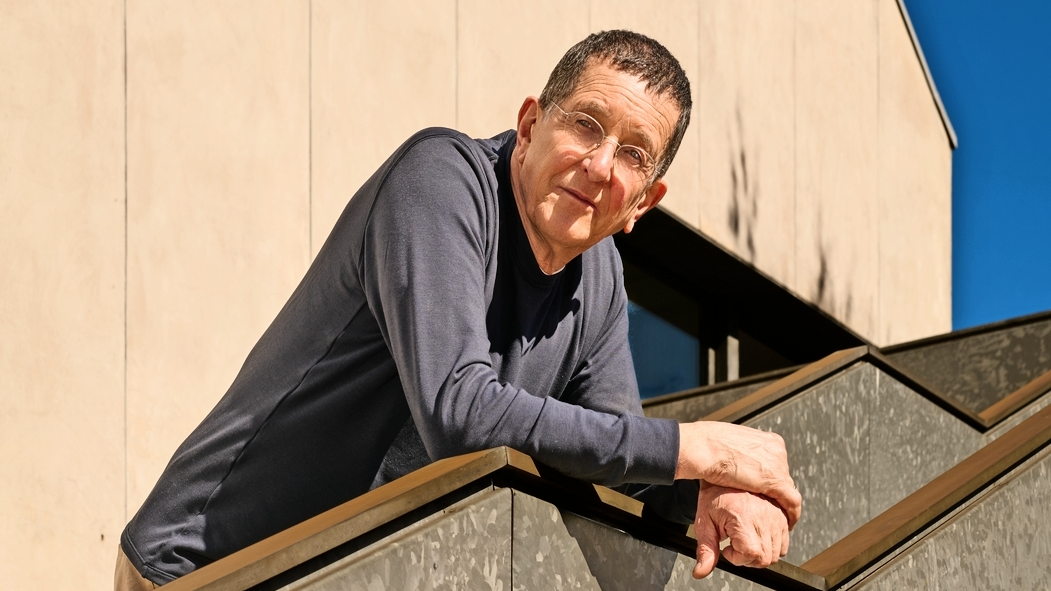
It’s disconcerting meeting Antony Gormley. Shouldn’t he be waist-deep in the waves or at the edge of a precipice or buried up to his neck in the earth? Yet here he is, flesh and blood, sitting on a spinning office chair replying to his emails.
“I don’t like getting very involved with all of this.” He waves his hands at a computer screen open at his inbox. New messages ping throughout our interview. After a few interrupted days, he says, “my fingers get a bit itchy. This is my escape and also my playground.” Here he makes drawings and models away from the factory-like space downstairs.
Gormley’s King’s Cross headquarters, designed by the architect David Chipperfield, is an otherworldly place. When the sliding gate shuts, you wouldn’t know London was there. At the heart of the studio is a hangar where bodies are trussed from the rafters and new forms take shape on the ground. I’m allowed to crawl inside a work-in-progress: a compact labyrinth of stacked and misaligned boxes. Two external staircases take you up to offices on the right and studios on the left.
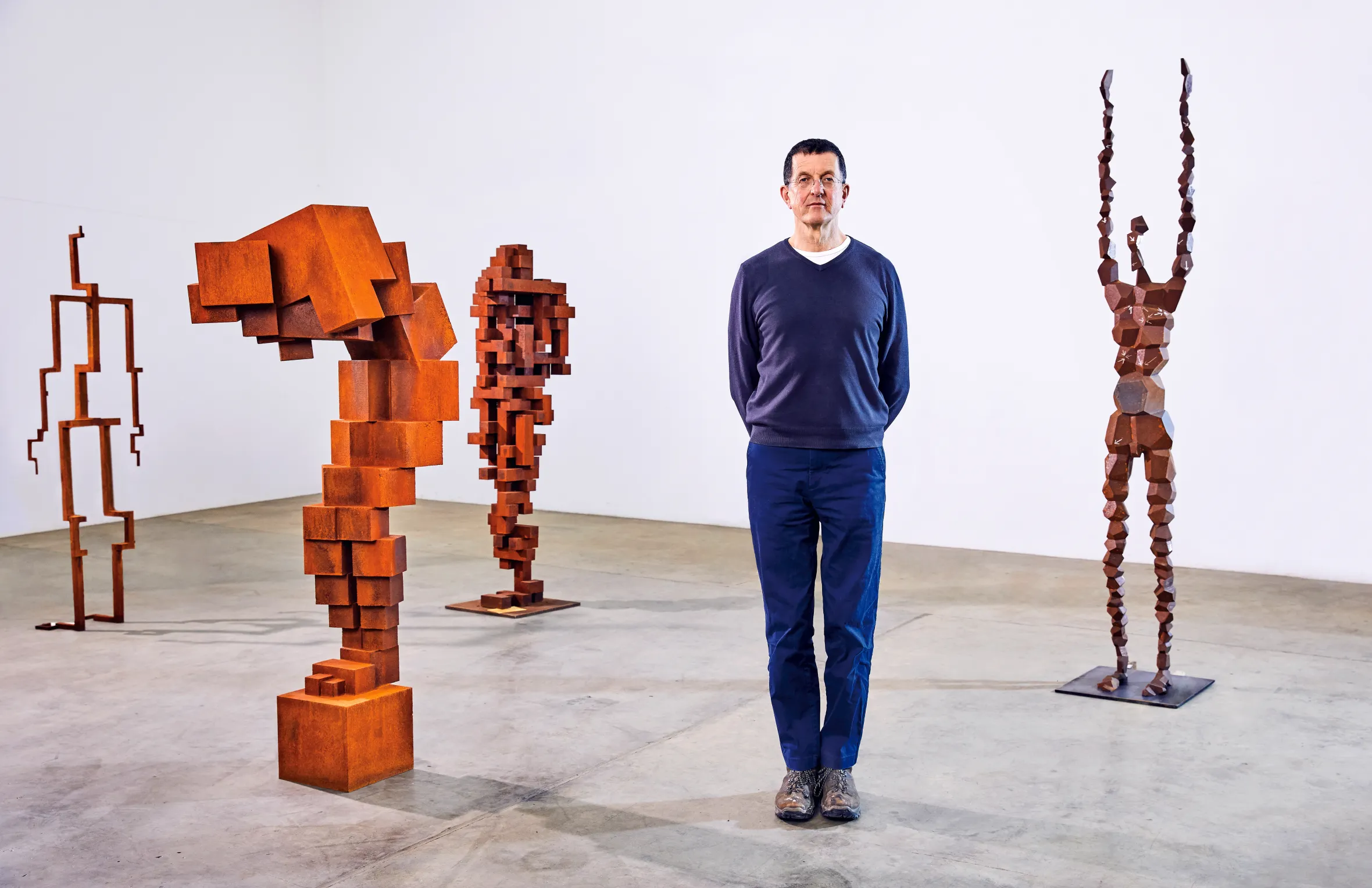 Gormley at his King’s Cross studioRobert Wilson for The Times
Gormley is “tuning” two exhibitions due to open within weeks of each other. The first is Geestgrond at the Royal Museum of Fine Arts in Antwerp, curated by Carolyn Christov-Bakargiev. The second is What Holds Us at the Galleria Continua in San Gimignano. A book of Gormley’s drawings will be published next week by Thames & Hudson. The book opens with a call to arms: “A day passed without drawing is a day lost.”
Antwerp seems an incongruous setting. I can’t quite see Gormley’s lean, reticent sculpture among the Flemish masters of the Antwerp collection, not least Rubens and his double-cream fleshiness.
“Yes,” Gormley admits, “Rubens’s canvases are not my cup of tea.” Gormley read anthropology, archaeology and history of art at Cambridge with a special subject in Flemish art of the 17th century. “I did Jacob Jordaens, Duquesnoy, Rubens and Van Dyck.” Nice to imagine the ascetic young Gormley writing essays about Rubens’s portrait of Hélène Fourment. “There’s something about the flesh and the fur…” Even Iron Man Gormley is not insensible to such things.
Gormley was born in 1950, the youngest of seven children. His father was a pharmaceuticals manufacturer and the Gormleys were prosperous, with high expectations of their children. The family were Catholic — the artist Antony Mark David’s initials were meant to call to mind the Latin ad majorem dei gloriam (“to the greater glory of God”) and Gormley went to Ampleforth College, a Catholic boarding school. After graduating from Cambridge in 1971, he spent three years in India and Sri Lanka seriously considering becoming a Buddhist monk. (Above his desk is a sign that reads “Keep calm and attain moksha.”) It was while painting in Darjeeling that he thought he might become an artist instead.
He studied at the Central School of Art and Design in London, then Goldsmiths and the Slade, where he met his wife, the artist Vicken Parsons. He won the Turner prize in 1994 and The Angel of the North spread its wings over Gateshead in 1998. His body, in lead, iron and concrete, even imprinted into Mother’s Pride bread, has been the starting point for much of this work.
 Angel of the North, Gateshead, 1998alamy
One of the words Gormley uses often is “attention”. Works of art ask for our attention and give us something in return. Focus, however, is hard to find. “We’re in a time of distraction. People, perhaps, do look for art for a kind of thrill. But I think that’s not what it does best. I think that art can relink you with first-hand being.”
One of my beefs is with art “experiences” that promise to bring paintings “alive” when they are plenty alive already if you’ll only stop and look. “I guess the danger of the art of our times,” Gormley says, “is that it’s a competitor in the attention economy, and that rather than saying actually we need to look for the world in a grain of sand, we want the world in lights and sound and movement all around us. Now. Now. Now.”
That doesn’t mean you have to stand stiffly in front of a work of art sombrely stroking your chin. Certainly not if it’s a sculpture. Gormley reels off a checklist. Move around it. Maybe touch it. Smell it. “We want to know: is it hollow? Is it solid? How does it sit? Is it sitting kind of resistantly? Or is it sitting precariously?”
Could visitors touch the works in the Antwerp show? He pauses. “The lead work is poisonous, so that’s probably not such a good idea. The iron work is very fragile.” But by the time you get to the big installations, you can touch them all you like.
Would he consider banning phones? He did it with Horizon Field in Hamburg. “I asked people to leave their shoes and their socks and their phones — in fact, anything that they didn’t really need — before they went up on to this platform that was held by eight cables about seven and a quarter metres from the ground.” People danced, people lay on the surface of this strange “flying carpet”, people looked at the sky or out at the city. No one scrolled or took a selfie.
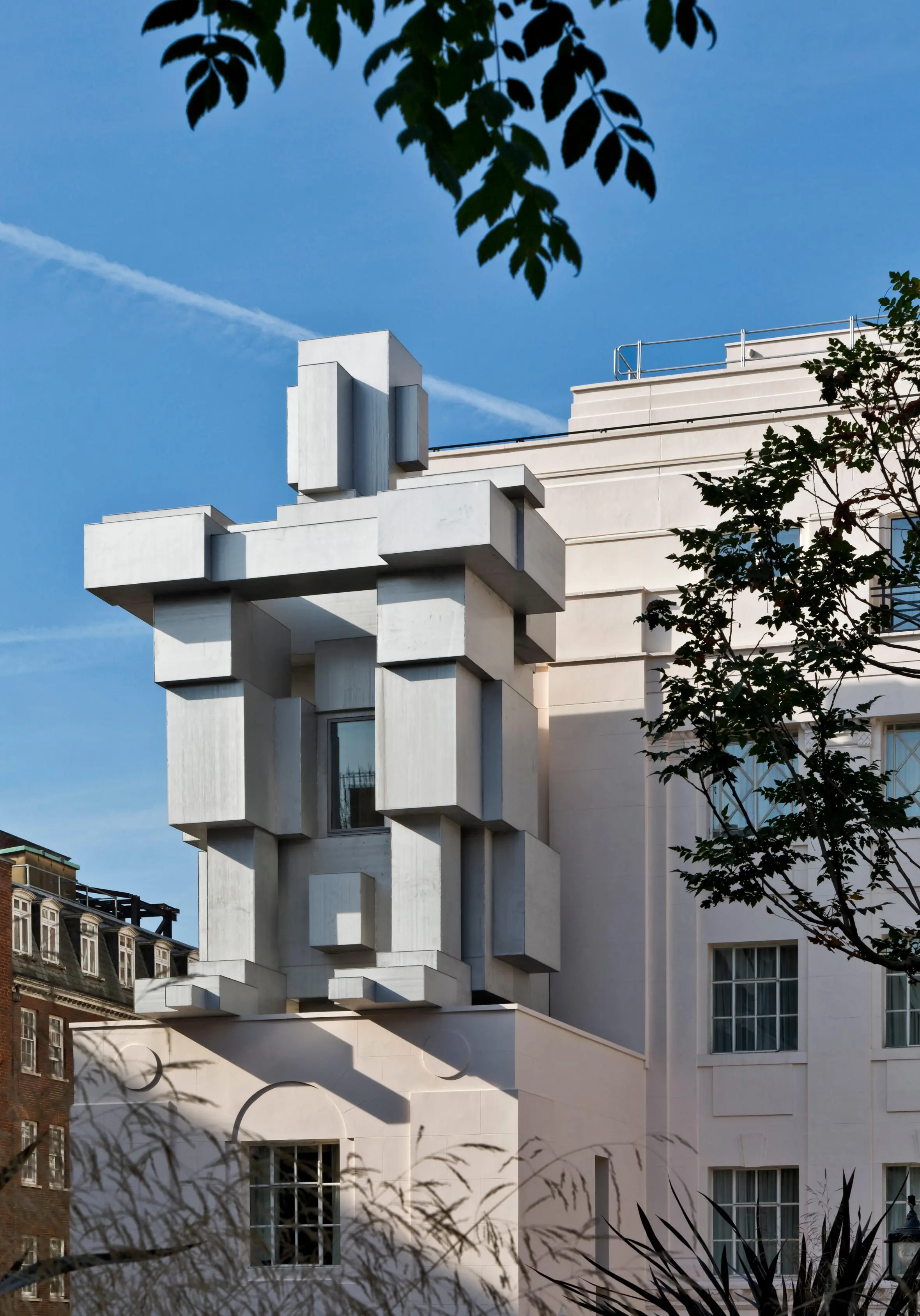 Room, London, 2014Alamy
I have young children and while I worry about what the modern world does to our ability to concentrate, I worry more about whether they will ever write longhand or throw a pot or stitch a seam. How are we going to foster an interest in making and materials in the age of AI? Gormley sits up at this.
“You’ve got to have a bag of clay as part of your monthly if not weekly shopping list. There’s got to be in your home somewhere devoted to making mess.” (All of it, Antony.) “I think it’s really, really, really important. We’re being deskilled by the fact that we’ve been constantly sucked into a virtual world and through our external brain instruments.”
He will sit at the kitchen table with his five grandchildren and say: “‘Make a creature. It doesn’t matter whether it exists or it’s just coming into existence in your hands.’ It doesn’t take long before there are lots of creatures talking to each other on the table.” That’s what the Drawing book is about. “The thing I want it to produce is not awe and admiration, but the idea that ‘I could do this’ and encouraging people to do so, because there’s nothing like it.”
At school he had a two-hour drawing lesson each week from the age of 12 to 17. “I can remember them so clearly.” He would sit on a “horse” (a traditional drawing bench, also sometimes called a “donkey”) with a T-square and a drawing board. The still life set up by the art master may not have been all that exciting — “a gingham cloth, the head of Dante and a bunch of daffodils”, he recalls — “but all you could hear was a scratching of pencils on paper and that time of attention and the smell of freshly sharpened cedar pencils”.
Last year Gormley was part of a group of artists and musicians who lobbied the education department over the devaluing of arts subjects in the curriculum. The English Baccalaureate, introduced by the previous coalition government, has steered pupils towards taking eight core academic subjects while excluding arts and vocational subjects. “The art room should be the liveliest place of any school. You’re invited to make things that have never been made before.”
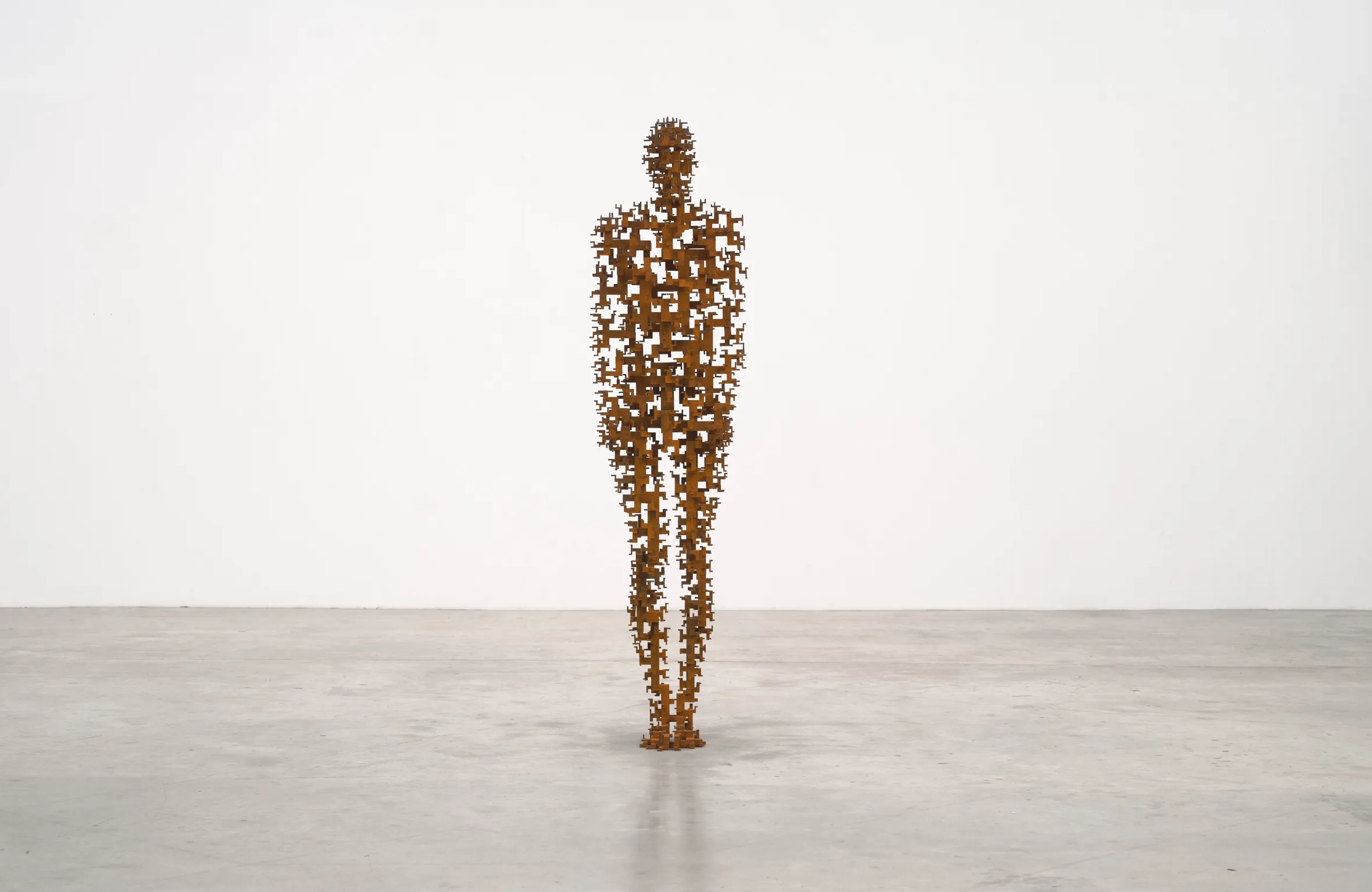 Attend, 2025Stephen White
There are Gormleys all over the world. In piazzas and on parapets, in rivers and out at sea. (Naughty Nicky Haslam has included “Antony Gormley sculptures” on his Christmas tea towel lists of “Things Nicky Haslam finds ‘common’”.)
Would he accept a commission — for the technical challenge if nothing else — to put a Gorm on the moon? “No, no, no. I think that would be a bad idea.” What he is excited about is a work he is making for Sinan in South Korea “that uses the highest level of engineering fabrication possible to us as a species”. A figure made up of 38 cubes will appear to be washed up on the beach. At high tide it will be entirely submerged, at low tide revealed.
He is gloomy about the “climate emergency”. So I wonder — couldn’t the art world do its bit? There is something obscene about the climate pieties and champagne receptions of the international biennale circuit. “I think it is a real problem: the art world fuelled by just thousands and millions of air miles that take off with the same crowd, to see often the same artists but in different contexts.
“My resistance to all of that is a wish to spend whatever time is left to me making situated works that are hopefully about a dialogue with a particular place, particular environment, particular community.”
Gormley is in some respects a tricky interviewee. Grayson Perry gives you a quip a minute. Gilbert and George do a vaudeville routine. There’s no difficulty getting Gormley going; it’s following along that’s difficult. “Proprioceptive instrument”? “Reflexive space”? “Materialised dialogues”?
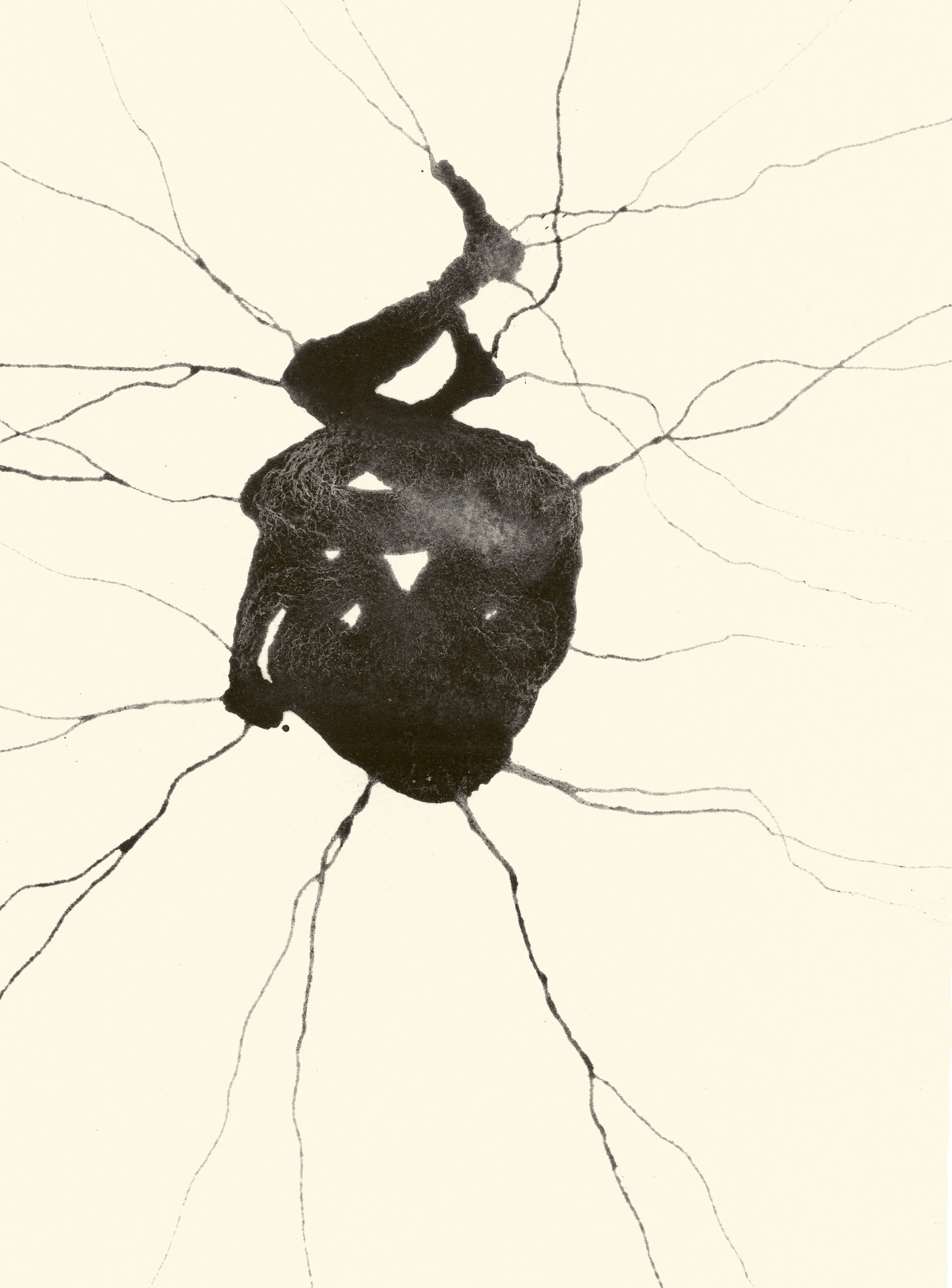 Hold I, 2022, from Gormley’s Inkcap Drawings series
But he isn’t always like this. Three years ago, dropping into Gormley’s Body Politic exhibition at White Cube Bermondsey, I found the artist giving a tour to teenagers from a local school. He stretched, he crouched, he challenged the students to work out where the supports were hidden. He didn’t mention Socrates once. It was just about the best lesson in how to look at sculpture I’ve heard. The students were rapt. A similar thing happens when I stop recording. Gnomic Gormley is gone. Normal Gormley is warm, amused and human.
His wife has the studio next door. Does he ever knock on the wall and say: “Elevenses?” “Yeah, I go in there for my breaks. There is always a certain amount of… It’s kind of like a Tesla coil, a certain amount of cracking and popping in here, and you go next door into her studio, which is the same size as this one, and it’s just contemplative peace.” We go round after the interview — Parsons is preparing for an exhibition at Magdalene College Library in Cambridge — and it is indeed peaceful, with birthday tulips in vases and work in progress on the walls.
Gormley has a photograph of Parsons above his desk; she has a picture of the two of them together. Often when you read habits-of-highly-successful-people-type articles, alongside the usual stuff about getting up at 4am and wearing the same outfit every day, the highly successful person will say that it helps to marry the right partner. Gormley’s golems are often intensely solitary, yet he seems so contentedly paired.
“I just think that artists should spend time with artists… It has been an amazing journey having this companion that I think understands the vocation. And even though my work is so, so different, I think we share a lot of attitudes to what art can be in terms of a place of reflexivity.”
I still don’t understand what a place of reflexivity is, but the next time I spot a Gormley marooned in the ocean, it won’t seem lonely any more.
Geestgrond is at the Royal Museum of Fine Arts in Antwerp from May 23 to Sep 20 (kmska.be). Drawing by Antony Gormley (Thames & Hudson £50 pp320) is published on Apr 23. To order a copy go to timesbookshop.co.uk. Free UK standard P&P on orders over £25. Special discount available for Times+ members
Where to see Gormley around the UK
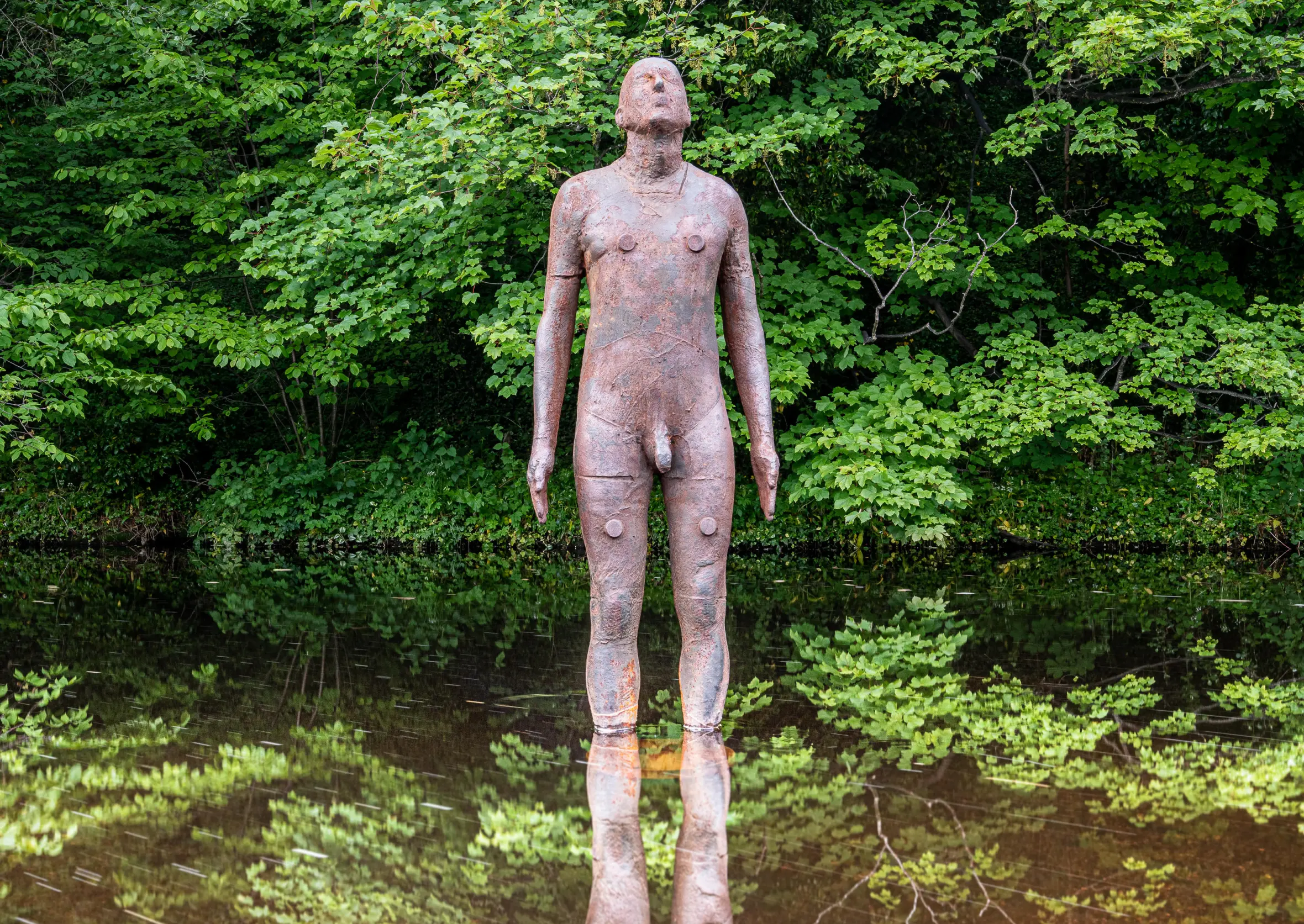 6 Times, Edinburgh, 2010Alamy
Another Place, Crosby beach, Merseyside, 1997
Another Place — 100 life-size, cast-iron figures staring out to sea — was supposed to stand on Crosby Beach for only 16 months. Three decades later, they are still there. (Half have been dug out of the mud and set upright again.) Sooner or later, Gormley has said, they will “slowly turn into Giacomettis” worn thinner and thinner by the tides. Visit Margate in Kent and you will spot another submarine man in the waves below Turner Contemporary.
Angel of the North, Gateshead, 1998
Is there a more artistic stretch of motorway in Britain than the junction of the A1 and the A167? The Angel of the North, with its mighty 54m wings, is seen by an estimated 33 million people each year. When first approached, Gormley said, “I don’t do roundabout art,” but after visiting the site he was persuaded. In a twist that would intrigue Gormley the anthropologist, a copse at the foot of the Angel has become a memorial site to lost babies and children.
Sound II, Winchester Cathedral crypt, 1986
Head bowed, solitary and silent, Gormley’s Sound II stands in the crypt of Winchester Cathedral. When the crypt floods — very biblical — the lead figure is as isolated as a hermit or a stylite. As the water rises, a channel inside the body of the sculpture draws up water to pool in his cupped hands. In Canterbury Cathedral, Gormley’s Transport, constructed from iron nails removed from the roof of the southeast transept, hangs above the first tomb of Thomas Becket.
Room, London, 2014
Clamped to the back of a Mayfair hotel, Room is a crouching figure from the outside and a luxury, if sombre, hotel suite on the inside. A night with Sir Antony Gormley RA at the Beaumont hotel is about £2,425 — or you can see Room from the street on the way to the RA, where exhibition tickets are about £25. Look out for Gormley’s stainless-steel figure Cinch on the roof of the Burlington Arcade.
True, for Alan Turing, Cambridge, 2024
Against the pointed arches and ogee windows of King’s College, Gormley’s monument to the mathematician and codebreaker Alan Turing, all blocks and right angles, stands apart. Cast in Cor-Ten steel, which contains 1 per cent copper, the statue will oxidise over time and turn a rich rust red.
6 Times, Edinburgh, 2010
Set off from the Scottish National Gallery of Modern Art and wind your way along the waters of the Leith to the docks and you will encounter Gormley six times, sunken to the shoulders, paddling in the shallows and, finally, out on a jetty, spattered by seagulls. In winter you may find yourself doing a double-take. Surely no flesh-and-blood man would be brave enough — or mad enough — to take a dip?