
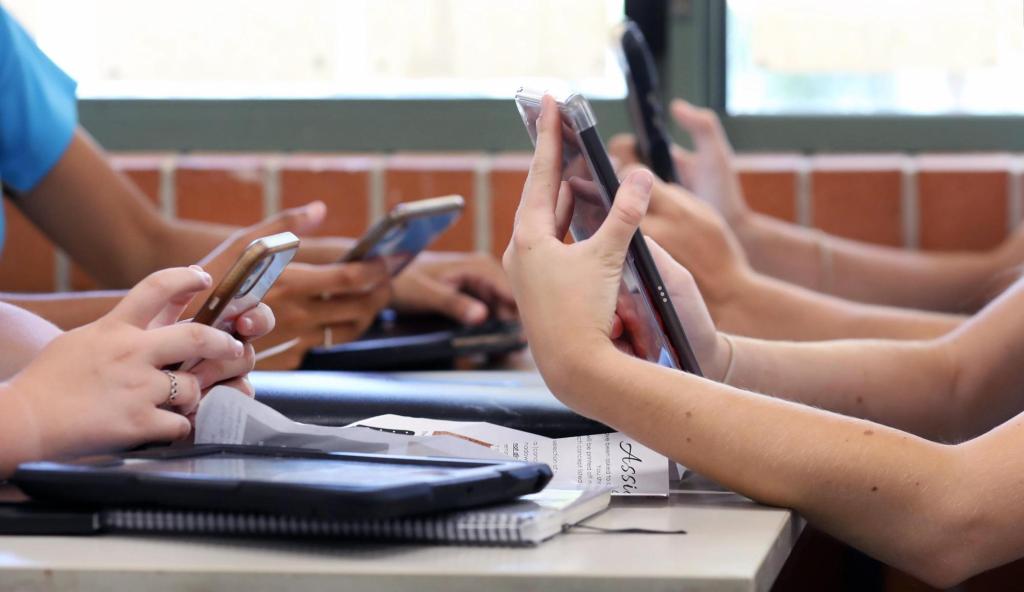
A statewide ban on students using cellphones in school could come as early as next summer under newly proposed legislation that would replace a more flexible mandate signed by Gov. Gavin Newsom in 2024.
The bipartisan bill, AB 1644, introduced this week, would require all TK-12 public schools and charter schools to adopt “bell-to-bell” policies prohibiting student smartphone use from the first bell in the morning until the final bell at the end of the day. Exceptions would be made for safety, health and educational purposes, including teacher permission.
The bill was authored by Assemblymembers Josh Hoover, a Republican representing Folsom; Al Muratsuchi, a Democrat representing Torrance; Josh Lowenthal, a Democrat representing Long Beach; and Buffy Wicks, a Democrat representing Oakland.
“Smartphones are incredible devices that can be helpful in so many ways. But they are also incredibly disruptive, distracting and addictive — and we know that children’s mental health, attention span and social well-being are being impacted,” said Assemblymember Wicks in a statement Wednesday. “AB 1644 simply reaffirms that school time is for learning and requires that local education agencies develop policies to prohibit smartphone use during those critical hours.”
If passed, California would join at least 10 other states that have recently passed bell-to-bell phone bans in schools, including Texas, New York, Virginia, Oregon, Arkansas, North Dakota, Nebraska, Alabama, Louisiana and Georgia.
“Research clearly shows that excessive smartphone use leads to negative academic and mental health outcomes, including reduced focus, increased depression and anxiety and lower overall social and emotional well-being,” said Muratsuchi in a statement Wednesday. “Schools that have adopted bell-to-bell smartphone bans report improved academic outcomes, especially in disadvantaged communities, as well as a reduction in cyberbullying and other disciplinary problems.”
The bill comes as school districts across the state prepare to adopt policies limiting smartphone use on school campuses by July 1, under Assembly Bill 3216 — also known as the Phone-Free School Act.
Newsom signed the legislation in 2024, making California the sixth state to restrict cellphone use in schools. The law provided flexibility to districts to craft their own policies, leaving decisions about enforcement and exemptions — such as for medical needs or emergencies — to local leaders.
But if passed, the new bipartisan AB 1644 would replace AB 3216, calling for a stricter, mandated statewide ban on phone use in schools by July 1, 2027.
Since 2024, Newsom has encouraged districts to implement smartphone bans or restrictions, citing concerns that excessive phone use among young people can lead to increased anxiety, depression and other mental health issues.
Bay Area districts, however, have remained split on the issue, with some adopting bans and others arguing the decision should remain local.
The California Teachers Association did not respond to a request for comment and has not yet taken a public stance on the proposed legislation, but was an avid supporter of the bill signed by Newsom in 2024.
“Mobile device use in the classroom can be both distracting and harmful based on students’ urge to text or check notifications as they pop up on the screen, off-task behaviors or academic dishonesty,” the teachers union said in support of the 2024 bill, AB 3216. “There is a lack of evidence supporting the use of mobile devices for increasing grades or enhancing student academic goals; however, there is a correlation between mobile device use in the classroom and poorer grades.”
But the California School Boards Association, which represents about 1,000 school districts and county boards of education across the state, staunchly opposed that legislation, arguing the bill stifled local decision-making.
“These decisions are best made at the local level by people who understand, reside, are invested in and accountable in the communities they serve,” the California School Boards Association said in opposition to AB 3216. “This legislation goes against the precepts of local control by taking the decision-making process out of the hands of the duly elected local governing board and requiring them to adopt a policy.”
The California School Boards Association said Thursday it also opposes AB 1644 as the bill applies a “one-size-fits-all” mandate rather than accounting for differences in local communities.
“The prevalence of cellphones, specifically smartphones, in schools and classrooms is a pressing issue, impacting student attention, learning, academic achievement and social interactions, both on and off school grounds,” Chris Reefe, the legislative director for CSBA, said Thursday in an opposition letter to the bill. “Although we appreciate and understand the intent behind this effort, this bill effectively eliminates local control and the ability of school districts and county boards of education to determine the best policy that meets the needs of their students, their families and the greater school community.”
Reefe also cited research from UCLA, which cautioned local and state leaders last year that uniform bans on school smartphone use can cause more harm than good and deepen existing inequities among students.
“There’s no one-size-fits-all answer, and the goal shouldn’t be just about restriction, but helping young people build those balanced, digital habits,” Kathy Do, lead author of the research, has stated. “Restriction alone is not going to teach adults or young people how to use their phones in responsible and balanced ways.”
AB 1644 now heads to the Assembly Education Committee, where it will be heard on April 22.