
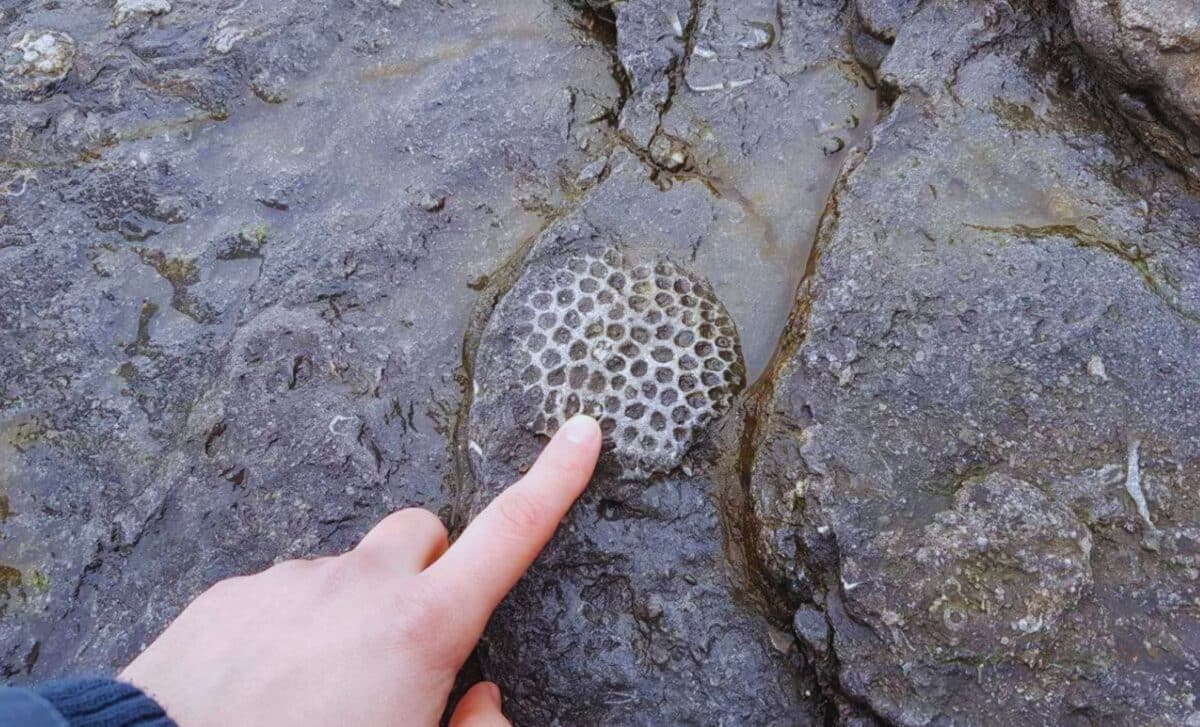
Tiny structures found in ancient Canadian rocks could be the oldest traces of animal life ever identified, dating back nearly 890 million years. The discovery is still being debated, but it could push the appearance of animals much further back in time than previously confirmed.
The research comes from the Northwest Territories, where geologist Elizabeth Turner has been working for decades in a remote, mountainous area. As reported in a study, the rocks formed in what used to be a prehistoric marine environment, a setting that helped preserve these unusual structures.
Figuring out when animal life first appeared has always been difficult. Fossils from such an early period are rare, and scientists have often relied on genetic estimates instead.
Microscopic Structures That Look Like Sponges
When researchers examined thin slices of the rock, they found complex networks of organic filaments. These structures strongly resemble the internal skeletons of modern sponges, which are among the simplest known animals. Research, published in Nature, highlights that Joachim Reitner from the University of Göttingen explained this kind of filament network is typical of sponges and not seen in other organisms.
“I believe these are ancient sponges—only this type of organism has this type of network of organic filaments.”
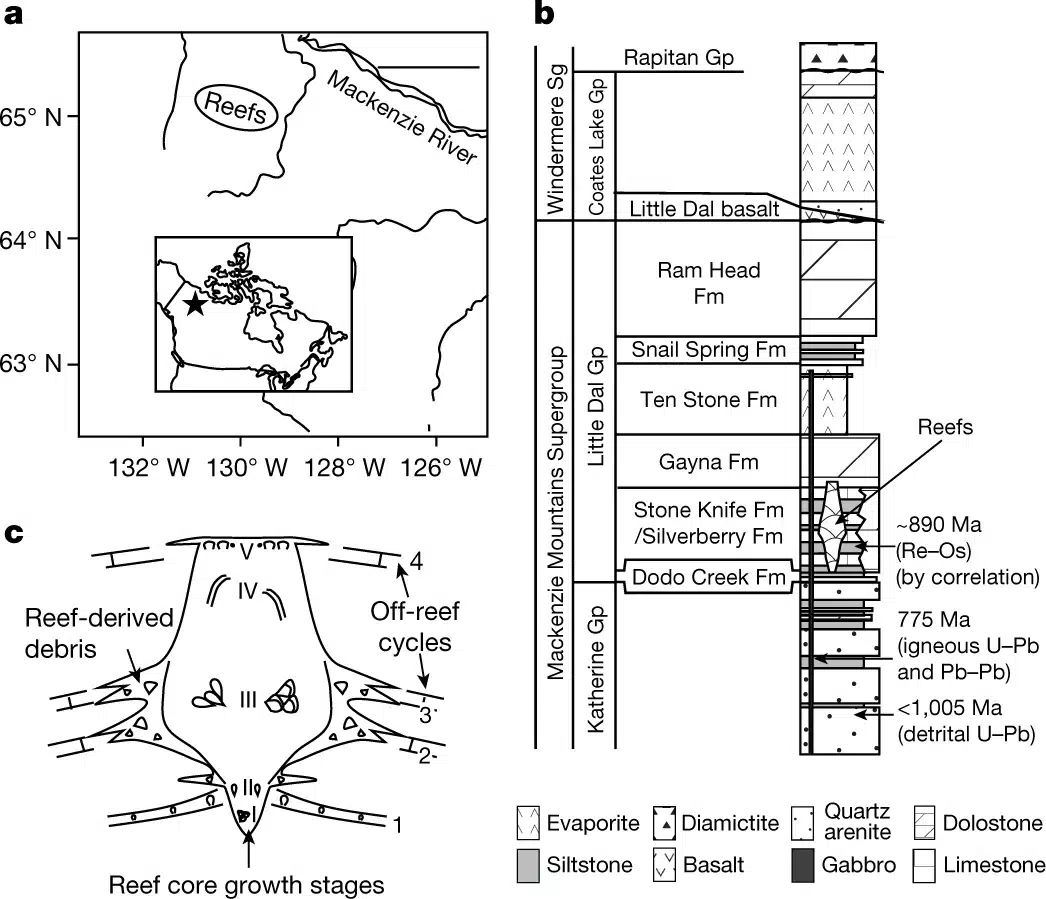 The geographic and stratigraphic location of the study material is indicated on the map below. Credit: Nature
While he was not part of the study, his assessment supports Elizabeth Turner’s interpretation. The location itself is extremely isolated and can only be reached by helicopter, which partly explains why such evidence has not been found earlier.
A 350-Million-Year Gap Suddenly Filled
If these fossils are confirmed, they would be about 350 million years older than the oldest undisputed sponge fossils. Until now, the earliest clear examples dated back to the Cambrian period, around 540 million years ago. Findings relayed by the study show this lines up with molecular clock studies, which suggest that sponges may have appeared close to 1 billion years ago. For years, there was no fossil proof to match those estimates.
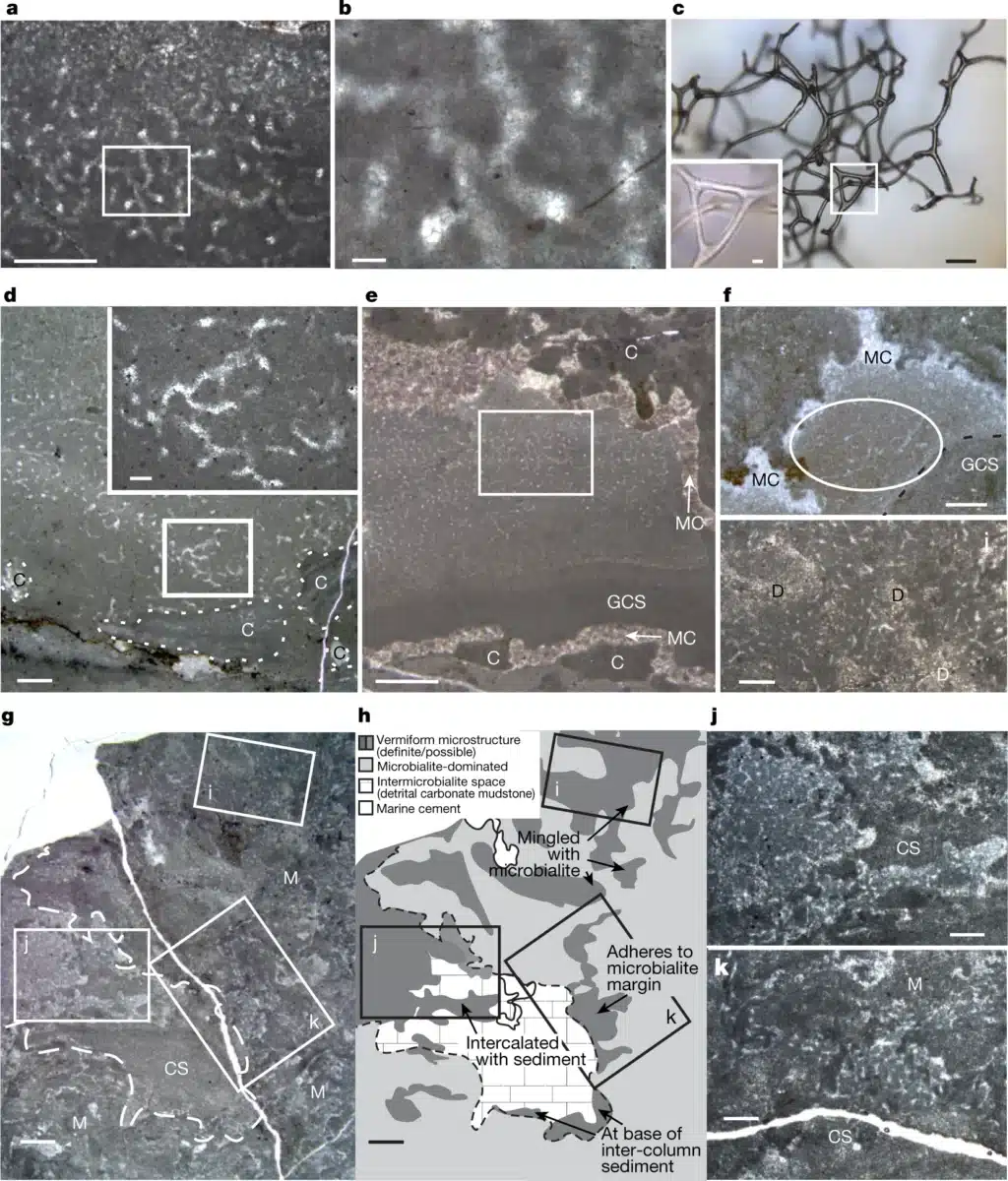 Microscopic views of ancient rocks showing possible sponge-like fossil structures. Credit: Nature
Paco Cardenas from Uppsala University, who took no part in the study, noted that such a discovery could improve understanding of early animal evolution, even if more work is needed to confirm it.
“What’s most stunning is the timing,” he said. “To have discovered sponge fossils from close to 900 million years ago will greatly improve our understanding of early animal evolution.”
Life In A Low-Oxygen World
These possible sponges lived at a time when oxygen levels were much lower than today. That detail matters because scientists once thought higher oxygen levels were needed for animal life to exist.
The reported data indicate that some modern sponges can survive with very little oxygen, suggesting that early animals may have been more adaptable than expected.
“Those kinds of fossils belong to more complicated animals — obviously there has to be a back history,” said Turner, the author of the paper.
She also pointed out that early animals did not have hard skeletons, which makes them much harder to find in the fossil record. These structures might be part of that missing chapter, a time when life was still simple and left only faint traces behind.
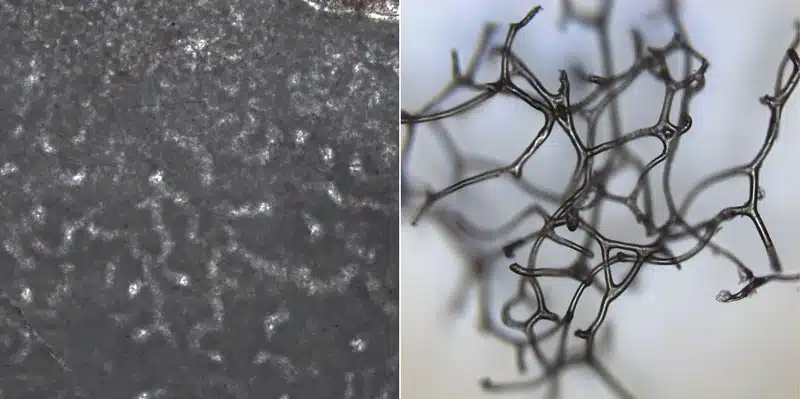 Ancient rock tubes may be fossilized remains of a sponge from 890 million years ago. Credit: Elizabeth C. Turner