

A Sylvester Comprehensive Cancer Center analysis of more than 4 million cancer cases across 12 states discovered that unmarried adults, especially men, have significantly higher rates of several cancers. The researchers said the findings of this large-scale analysis do not mean that getting married prevents cancer or that people need to get married.
“It means that if you’re not married, you should be paying extra attention to cancer risk factors, getting any screenings you may need and staying up to date on health care,” said Frank Penedo, Ph.D., associate director for population sciences and director of the Sylvester Survivorship and Supportive Care Institute.
Men who were never married were about 70% more likely to develop cancer than married men.
Women who never married were about 85% more likely to develop cancer than women who were or had been married.
Associations between marriage and cancer were stronger in adults older than 50, suggesting that, as people age and accumulate cancer risk exposures, the benefits associated with marriage may become more pronounced.
Black men who were never married had the highest overall cancer rates.
Researchers believe social factors and lifestyle may play a role. Adult men who were never married had approximately five times the rate of anal cancer compared with married men. Adult women who were never married had nearly three times the rate of cervical cancer compared with women who were or had been married. People who smoke less, drink less, take better care of themselves, and are more socially integrated may also be more likely to get married.
Overall, getting married does not magically prevent cancer, stressed Sylvester researcher Paulo Pinheiro. “But the association between marriage status and cancer risk is an interesting, new observation that deserves more research,” Pinheiro said.
The primary care doctor dilemma
If you feel as if every time you find a primary care doctor you like, he or she shifts to a concierge medicine model, you are not alone.
Concierge medicine, or membership medicine, is taking off in South Florida. In Fort Lauderdale, doctors Cristina Savu and Kira Fenton have adopted this model, in which physicians charge a monthly or annual fee to be a patient of the practice.
Savu and Fenton were medical students together at Nova Southeastern University and jointly purchased an existing primary care practice in Fort Lauderdale. After five years of running Prestige Physicians, the duo found the primary care model was not working for them.
“Unfortunately, these days the primary care model is not built around patient care anymore, which is a shame,” said Savu, a Fort Lauderdale internist. “Because of what happens with reimbursements, we were having to see 30 patients a day … sometimes you end up stressing yourself throughout the whole day because the last thing we want is to fall behind and for patients to wait in the waiting room a long time.”
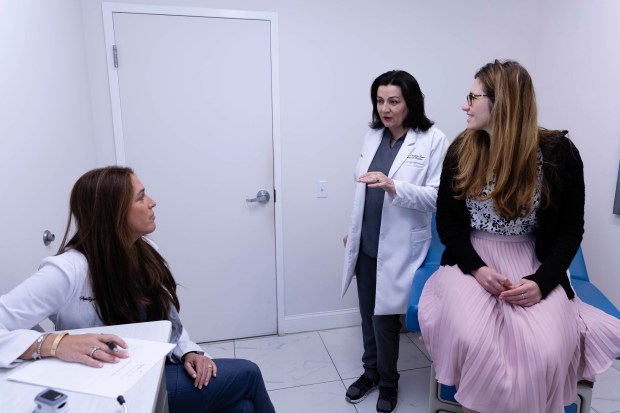 Dr. Kira Fenton and Dr. Cristina Savu with patient, Catalina Alexuc at their Fort Lauderdale office. (MDVIP/Courtesy)
They knew they needed a change. “We started looking at other avenues and were looking at concierge medicine, but then we stumbled upon MDVIP,” Savu said.
With the MDVIP concept, patients pay a membership fee for access to doctors, guaranteeing little or no wait time for appointments. Costs can range from $2,000 to $10,000 a year, a fee that is not covered by insurance. However, insurance often covers tests, imaging, and prescribed medication when seeing a concierge doctor.
This type of medicine aims to provide patients with quick access to their doctor and more time with them, while easing providers’ workloads. Industry analysts estimate that between 1,200 and 1,500 doctors in Florida now practice some form of concierge or membership-based medicine. South Florida hospitals are betting on the model, too, offering their own versions of concierge medicine.
Fenton says part of the annual fee at her office goes toward a patient’s preventive wellness exams, which insurance typically wouldn’t cover unless patients were having symptoms.
“When they come in, they actually spend around an hour, an hour and a half doing testing. We’re screening for things that patients may or may not know that they’re at high risk for and the goal is to catch it before they become symptomatic,” she said. “Two weeks later, we will see the patient with all the results, and they will spend another hour with us going over all of them … it’s extensive data that we’re looking at.”
In contrast, patients who can’t afford the fee and remain in the traditional primary care system are facing fewer physicians and longer wait times to get in. They often can’t access the same type of preventive care because insurance won’t cover it.
Savu and Fenton have decided to help Broward County low-income residents access some of the tests they offer their patients. They have partnered with Light of the World, an Oakland Park clinic for uninsured individuals living below the poverty line. The doctors have agreed to cover all laboratory testing fees for all clinic patients throughout April. They also established an Emergency Diagnostic Fund to help patients afford critical tests like CT scans and colonoscopies.
” A simple blood test can mean the difference between catching a condition early or a late-stage diagnosis,” Fenton said. ” So that’s why this is very important to us.”
The headphones and hearing loss link
Cellphones, iPads, and other portable audio devices can reach sound levels comparable to those at a rock concert. So it’s no wonder hearing loss linked to headphone usage is increasing.
Cleveland Clinic experts say some precautions can help.
When listening to music or voices through headphones, damage can be caused not only by how loud you listen, but also by how long you listen, said Dr. Valerie Pavlovich Ruff, a Cleveland Clinic audiologist.
“You can listen through headphones safely, but you definitely have to learn how to do that,” she said. She recommends following the 60-60 rule: Set your headphone volume to 60% (the equivalent of typical human speech) for 60 minutes. “After that it’s best to take a break for 10 or 15 minutes,” she said.
Pavlovich Ruff said even at lower volumes, it can be harmful to block your ear canals for long periods.
Early warning signs of shingles
Because more people are suffering from shingles, AARP wants Floridians to know the early warning signs.
In its early stages, shingles likes to masquerade as any number of lesser offenders. For example, symptoms can present as a pulled muscle, back pain, kidney stones, sciatica, or unusual skin sensitivity. The rash associated with shingles often comes later.
“The sooner treatment begins, the faster and less painful the recovery,” AARP experts said.
Shingles is caused by a reactivation of the same virus that causes chickenpox. If you had chickenpox when younger, you are at risk, and the risk increases with age. Several antivirals can be used to treat shingles. To prevent it, though, the shingles vaccine is recommended for everyone 50 and older and for immunocompromised adults 19 years and over.
Local clinical trial for pancreatic cancer treatment
Doctors at Baptist Health South Florida are participating in a multi-site, clinical trial of a new treatment for advanced pancreatic cancer, one of the deadliest cancers.
The treatment being tested, TAMP therapy, uses a specialized medical device called RenovoCath to deliver chemotherapy directly into the artery that feeds the tumor, rather than through a standard IV drip that circulates medication through the entire body. The treatment is designed to help patients live longer while experiencing fewer chemotherapy side effects. The trial, called TIGeR-PaC, is currently enrolling patients. Visit clinicaltrials.gov for details.
Promising Parkinson’s treatments
Scientists at Florida International University have developed a promising new compound that could slow the progression of Parkinson’s disease and protect against life-threatening lung injury by targeting a key process inside cells.
“Unlike current treatments that simply replace the missing chemical to relieve symptoms, this compound has the potential to actually protect brain cells and slow down how Parkinson’s disease progresses,” Tieu said.
The team has secured a patent and is now working to refine the compound for safe use in humans. Additional studies are underway, including testing in larger animals to meet FDA requirements. Clinical trials could begin within a year.
Can a tropical bean help treat Parkinson’s tremors?
 UF researchers are studying whether the velvet bean can help treat Parkinson’s tremors. (UF/Courtesy)
University of Florida’s Institute of Food and Agricultural Sciences researchers have just launched a study of velvet beans as a potential plant-based Parkinson’s disease treatment.
A major challenge with Parkinson’s disease is managing tremors. Velvet beans naturally produce compounds that are used in medications to treat symptoms of Parkinson’s disease, such as tremors.
Specifically, the bean contains L-DOPA, the primary active ingredient of the medication Levodopa. In a newly funded study, researchers are identifying new velvet bean cultivars with higher L-DOPA levels. This will help researchers understand how the plants create the compound and how it can be used as a potential Parkinson’s treatment.
FAU recruiting for Alzheimer’s study
Researchers at Florida Atlantic University’s Charles E. Schmidt College of Medicine are recruiting participants for a new research study aimed at improving the understanding and treatment of Alzheimer’s disease.
The observational study will examine changes in brain levels of nicotinamide adenine dinucleotide (NAD), a molecule essential for cellular energy, to determine whether it may serve as a biomarker for Alzheimer’s progression.
The study will enroll 20 participants: 10 individuals with Alzheimer’s and 10 cognitively healthy volunteers. All participants must be between 65 and 80 years old. Volunteers will be asked to dedicate two mornings to the study, with visits occurring approximately eight months apart.
Experimental brain cancer treatment
Mayo Clinic researchers in Jacksonville have developed an experimental nanotherapy that delivers two cancer drugs directly to brain tumors, according to a study published in Nature Communications Medicine. The strategy extended survival in people with glioblastoma, the most aggressive form of brain cancer and difficult to treat.
The nanotechnology-based approach packages two existing cancer drugs into tiny particles engineered to cross the blood-brain barrier and target tumor cells. Patients who combined the treatment with radiation more than doubled survival compared with untreated controls.
 Nova Southeastern University Chief Medical Officer Dr. Chad Perlyn, left, and NSU President Dr. Harry Moon, right, join U.S. Rep. Debbie Wasserman Schultz, D-Fla., on the Davie campus on April 8, 2026. Wasserman Schultz announced more than $1 million in federal investment she secured to improve the treatment of brain cancer. (Joe Cavaretta/South Florida Sun Sentinel)
Big money grants and donations make South Florida a better place to get medical care
Holy Cross Health (Fort Lauderdale): Celebrated raising over $20 million in 2025/2026, including a $6.5 million gift for emergency room advancements and a $5 million gift for surgical suites.
Nova Southeastern University (Davie): Landed a $1 million grant to acquire advanced technology to accelerate research and expand noninvasive options for pediatric and adult brain cancer patients. Brain tumors remain one of the most difficult cancers to treat, particularly when surgery is not an option. Congresswoman Debbie Wasserman Schultz presented the grant to Dr. Regina Graham, who will oversee the research to develop an innovative drug-delivery system.
Boca Raton Regional Hospital (Boca Raton): Secured a $250,000 research grant from the Alzheimer’s Foundation of America to support cutting-edge research at the hospital’s Marcus Neurosciences Institute Memory Disorder Center. The grant will help advance understanding, diagnosis, and treatment of cognitive disorders.
Florida International University Medical School: Secured a $30 million donation from philanthropists Helen and Jacob Shaham, the largest gift in the college’s 20-year history. The money will be used to expand and improve medical education, research, and patient care by building a new center to house academic learning spaces and outpatient multi-specialty services, including same-day surgery, diagnostic imaging, infusion services, and a pharmacy. It will serve as the academic medical hub for the FIU-Baptist partnership.
Hospital news
Memorial has opened a new heart and vascular center at Memorial Hospital West. It has been redesigned into a 20,000-square-foot space that brings physician visits, imaging, diagnostic testing and treatment into one place. One of the more notable additions is a new cardiac CT imaging program using photon-counting technology, the first of its kind in Broward County. It gives physicians a clearer picture earlier in the process, which can help guide care decisions before moving to more invasive procedures. The space also expands capacity, with more exam rooms, additional diagnostic services and on-site support like lab and registration designed to help move patients through care more efficiently.
Holy Cross Health is holding the ribbon-cutting for its Holy Cross Health Center & Emergency Care in Deerfield Beach on May 8.
Inspiring women of health
The Health Foundation of South Florida recently honored 10 Inspiring Women of Health. All lead innovative health-related businesses or organizations that improve the health of South Florida communities. The 2026 Honorees include:
Dr. Diane Amado-Tate, vice president and chief nursing officer, Baptist Health Doctors Hospital.
Mandy Bartle, president and CEO, South Florida Community Land Trust.
Dr. Carol Biggs, senior vice president and chief nursing executive, Jackson Health System
Berlinda Faye Dixon, complex case manager, Dade County Street Response
Emmanuella Fleurimont, founder, president and CEO, MJD Wellness and Community Center Inc.
Mary Mayhew, CEO, Florida Hospital Association
Dr. Mariela Perez, medical director, Open Door Health Center.
Catherine Toms, president, Green Cars for Kids.
Morgan Tracey, CEO, Star of the Sea Foundation.
Zeina Zein-Wolland, founder and president, Mobile School Pantry.
South Florida Sun Sentinel health reporter Cindy Goodman can be reached at cgoodman@sunsentinel.com.