
The Best Garmin WatchesHearst Owned
“Hearst Magazines and AOL may earn commission or revenue on some items through these links.”
The wearables and fit tech market is a saturated one. But even with countless watches, Oura rings, bracelets, and other cutting-edge fitness trackers on the market, I always notice as a personal trainer and fitness coach that Garmin remains a cult-favorite brand for everyday exercisers, whether they’re diehard runners, dedicated strength trainers, or somewhere in between.
Best Garmin Watches
A Garmin watch is a high-performance smartwatch that’s designed for health tracking, activity metrics, and more. Leveraging features like GPS technology, heart rate monitoring, and sleep tracking, these watches are built to meet the needs of anyone and everyone who is interested in gathering data that reflects their overall well-being.
When it comes to fitness trackers, the winner for you will always be the one that meets your individual needs. If you’re like me, those needs are tracking sleep and workouts, and keeping me motivated to move. I was happy to discover that a Garmin watch provides more than just data tracking—it also coaches me and tracks my recovery, so I can perform my best whether that’s at the gym or in a meeting.
My favorite feature—and the main reason I would recommend a Garmin watch—is Garmin’s Body Battery Energy Monitor which provides a real-time energy score of 1 to 100 that’s dependent on your heart rate variability, stress levels, physical activity, and sleep quality. Each of those variables is tracked down to the minute so that you can see what is draining your energy and what is recharging it. I have not experienced a feature quite like this on other wearables I’ve tried. (To get the most out of a Garmin watch, I suggest wearing it day and night since the sleep data is an integral part of Garmin’s Body Battery Energy Monitor.) If you’re interested in finding the best Garmin watch for you, I’ve gathered all the fitness tracking tea below.
How We Selected
We tested around 10 of the most talked about Garmin models (in fitness circles and on social media and online retailers) for at least three days each, 24 hours a day. During this time, we ran, cycled, strength trained, and wore the watches during everyday activities to assess their performance in real-world conditions.
Our testing focused on the following factors:
How accurately the watches track fitness metrics
Design and fit for daily wear
Durability against sweat, and wear and tear
Readability of the screen in different lighting conditions
As we tested each watch, we also compared features across different Garmin models like user interface intuitiveness, durability, and functionality for both casual fitness enthusiasts and more serious athletes.
By wearing (and having WH editors) each watch across a variety of activities and day-to-day situations, I was able to thoroughly evaluate which Garmin watches truly stand out in terms of performance, style, and overall value.
What to Consider
With many Garmin watch models available, you should first ask yourself:
What are your main activities or fitness goals?
What health features are important to you?
Where will you wear the watch?
Once you’ve answered those questions, here are a few things you should look for when researching different Garmin models yourself.
Activity Tracking
A Garmin watch can track a variety of activities, including walking, running, cycling, cardio, strength, breathwork, and more. One thing I appreciate is that Garmin makes training easier since it tracks all of your data on the Garmin Connect App. You can search for workouts to download or create your own workouts to add to a compatible Garmin watch.
Generally, all Garmin watches track steps, calories, and active minutes. For runners, Garmins offer metrics on pace, distance, and cadence, and certain models will track stride length and ground contact. Cycling tracking provides GPS tracking, ascent, and speed. Swimmers can use the watch to track laps, strokes, and distance. When you’re outdoors, some of the Garmin watch models utilize GPS navigation and elevation tracking. When strength training, all of the Garmin watches I tested can track sets, reps, and weight.
Rep tracking during workouts is done automatically (or you can change it to manual in the settings), and then you simply press the main button to indicate you’ve finished your set. The Garmin watch then tracks rest between sets until the button is pressed to indicate a new set. After each set, the watch allows you to enter the weight you used. I found the rep-set tracking features to be a really impressive and robust way to keep track of your progress in the gym. Within the watch, you can edit the data afterward to include the exercise name and make any necessary adjustments to the workout.
If you’re someone who loves to keep track of your progress and document how you felt during a workout, the Garmin Connect App allows you to add comments to completed activities to refer back to how you felt, and anything you may want to reference later.
It’s worth noting that different Garmin models focus more on specific types of training than others—for example, the Forerunner line is generally endurance-focused. So be sure you’re reading up on the specific workout/activity modes when choosing the watch that’s right for your training.
Health Data
There are health stats on the Garmin Connect App that leverage the data from your watch so that you can understand your overall well-being better. These stats include:
Training Readiness gauges your fitness and recovery levels to help you determine whether you’re ready for a challenging workout or need rest.
Race predictor allows you to see a prediction of your race times for various distances (this feature uses a variety of metrics to provide the estimates).
FTP (Functional Threshold Power) gives you an idea of your performance ability by providing a snapshot of your highest power level that can be sustained for one hour.
The power curve gives you an understanding of the maximum power you used for a given time interval.
Lactate threshold measures the specific level of effort or pace when fatigue accelerates.
Critical swim speed is Garmin’s theoretical measure of the fastest pace that a swimmer can maintain continuously without exhaustion.
Endurance score reflects changes in your endurance, this number uses every activity that is measured by your heart rate to help determine it. Higher scores reflect more capacity for longer activity.
Hill score is a 1-100 rating that indicates how skilled your uphill running is. Garmin watches with this feature analyze all of your running, walking, or hiking activity with uphill segments graded more than 2% percent.
HRV stress (for this you’ll need a Garmin chest heart rate monitor) measures how well you manage stress on challenging terrain.
Beyond performance stats, Garmin watches also provide comprehensive health stats for daily well-being. These include sleep tracking, which gives insights into sleep quality and recovery, and the Garmin Body Battery (as mentioned above).
Key health markers like respiration, heart rate, blood pressure, and stress tracking allow for ongoing health monitoring, while Pulse Ox measures blood oxygen levels and adapts to altitude with Pulse Ox acclimation features. For those tracking nutrition and hydration, Garmin watches offer calorie tracking (by pairing the watch with MyFitnessPal), hydration tracking, and menstrual cycle tracking. Additionally, the fitness age and health snapshot provides an interesting look into your health.
Size and Fit
There’s a range of models to suit different preferences. From smallest to biggest:
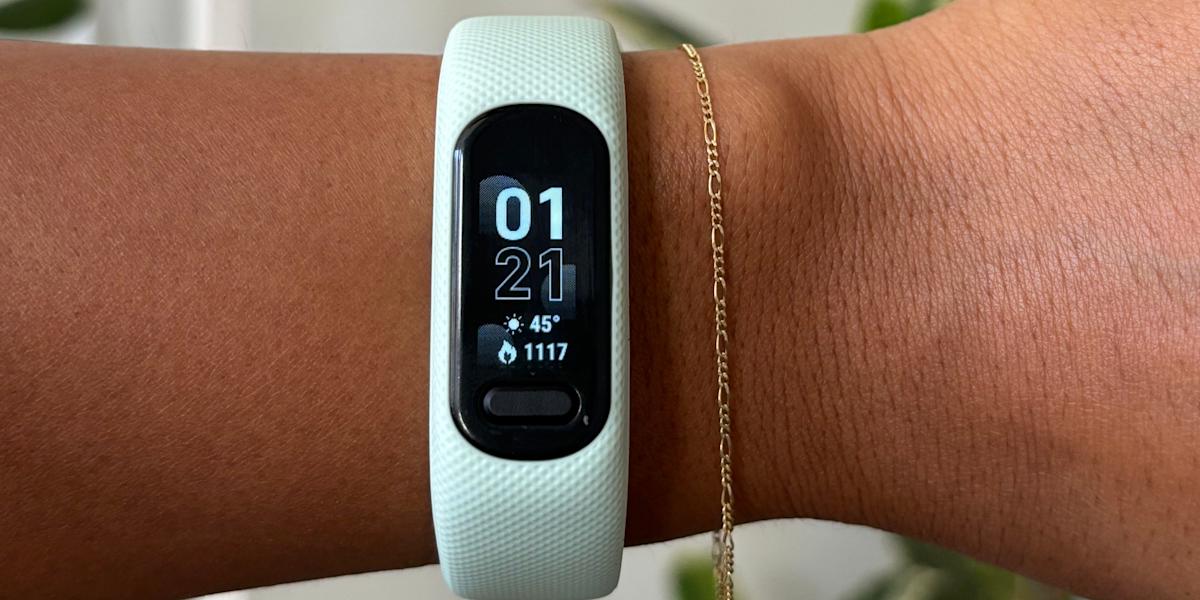
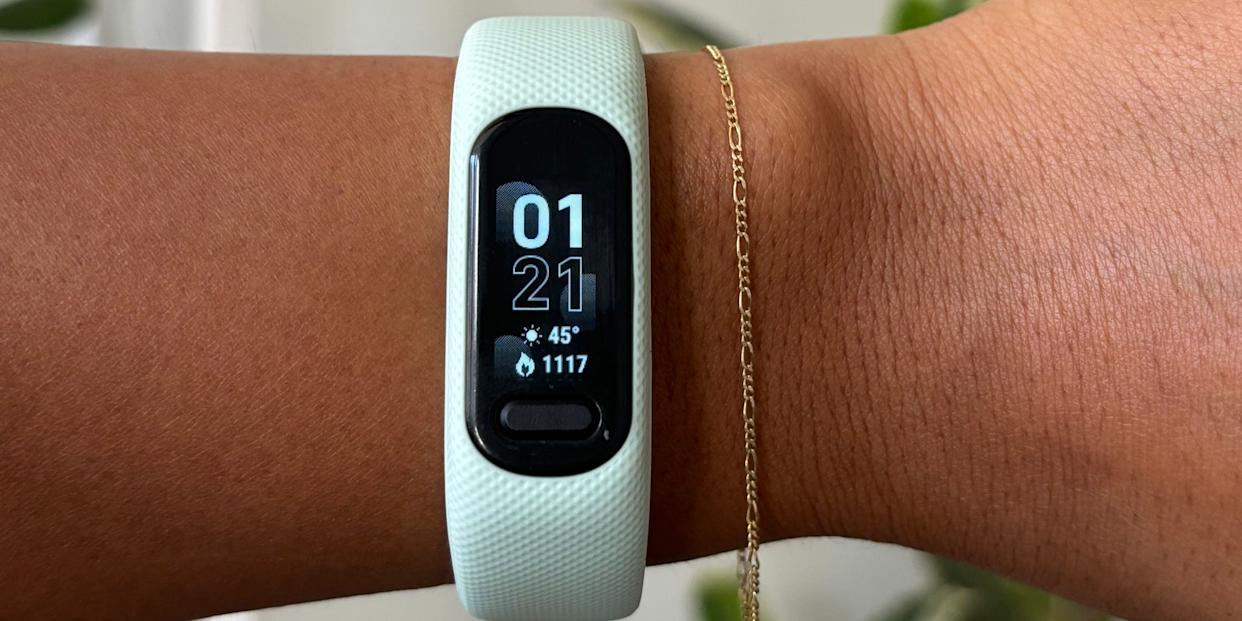
A minimalist option is the Vívosmart 5, which has a narrow band that makes it lightweight and comfortable, especially if you’re looking for a watch without a bulky watch face.
The Vívomove Sport is one of Garmin’s more stylish models that has a delicate design that looks more like jewelry than a fitness watch.
The Venu 4 maintains a slim profile with a slightly larger display that balances comfort and visibility, making it a great everyday option.
The Forerunner 570 offers a compact and comfortable fit, ideal for runners who want something lightweight.
If you’re after something substantial, the Fēnix 8 is built for extreme sports and adventure with big displays and extended battery life to match. It’s bulkier, but it provides the screen size needed for viewing maps.
Battery Life
Garmin watches are known for their impressive battery life. I was always so surprised to look down on my wrist and see 10 days or more on some of the models. Here’s a breakdown based on the approximate battery life in smartwatch mode:
You Might Also Like