
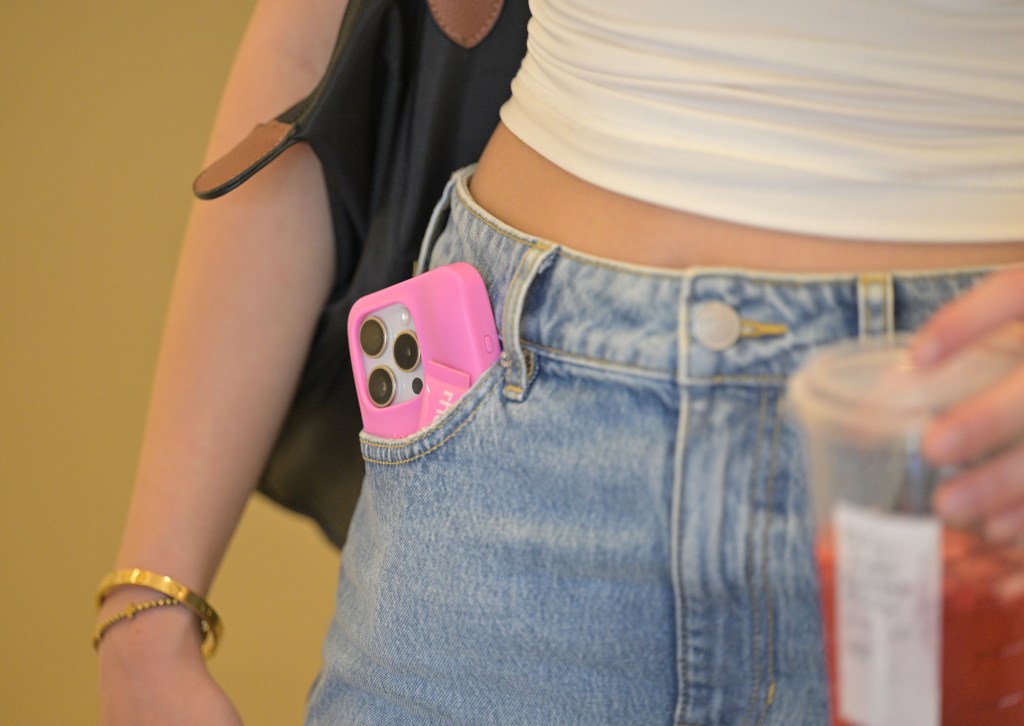
Students at the Tamalpais Union High School District’s five high schools will have new cellphone storage devices this fall to help create “phone-free” school days.
Trustees voted 3 to 2 on Tuesday to order NuKase hard plastic lockable cellphone cases for students at Tamalpais, Redwood and Archie Williams high schools.
The board also agreed to purchase small cellphone storage lockers for San Andreas and Tamiscal, the district’s two alternative high schools.
“It is hands-down that restricting students’ handling of phones for the school day will improve student learning,” Cynthia Roenisch, the board president, said in voting for the purchases. Trustees Kevin Saavedra and Jenny Holden also voted yes.
Teachers will lock the phones in the cases at the start of the first class period of the day. At the end of the seventh period, teachers will unlock each student’s phone for them to take home.
While a “phone-free” school day was not a total cure for cellphone app addiction or the negative effects of cellphone use on mental health and learning, “it does give our children a chance to reset and recalibrate,” Roenisch said.
“We are continuing to harm kids if we don’t move to ‘bell to bell,’” Roenisch said.
Saavedra agreed.
“I am confident this plan will not solve 100% of the problem, but it’s the best option out there, and we have to do something now,” he said. “I don’t think there’s any reason to delay this.”
Holden said she has noted “a shift” in parent and student attitudes toward recognizing the harm caused by the cellphones, especially since the recent legal verdicts against Meta, YouTube and other social media companies.
The verdicts, by juries in New Mexico and Los Angeles, said that the companies knew their apps were addictive and harmful, but they didn’t care and didn’t do anything to change it.
“I think we would be negligent if we didn’t do this now,” Holden said.
Trustees Ida Green and Emily Uhlhorn, who voted no, said they were not against the “phone free” concept, but they both had concerns about the speed of the process.
“For me, it’s a no until we see how it works,” Green said. She was also concerned about liability if a student were to drive off campus during lunch, get into a crash and not have a phone to call 911.
Uhlhorn said she wanted to allow more time for parent and student education about the need for the “phone-free” day. She suggested the district do a temporary trial run of the “no phones on campus” approach already in use at Marin Catholic High School, or try a mandatory backpack phone stowaway system, before making a financial commitment on locking devices.
“I’m not ready to spend $100,000 on this now,” Uhlhorn said. “I would like more two-way communication with parents and students to happen before spending the money.”
Roenisch said district officials have already discussed the issue of cellphone addiction, student mental health and learning distraction for almost three years.
Currently, the district requires students to store their phones in caddies or trays during classes, but they may retrieve them during lunch or between classes.
Superintendent Courtney Goode said the current policy doesn’t go far enough.
Students who are addicted to their phones can be distracted just by looking at their phone in the caddies and knowing they will get it in a half hour, he said. By grabbing their phones right after class, the students’ young brains do not have time to integrate the lessons just learned, he said.
“I spent a lot of time talking to people at schools that instituted the ‘phone-free’ school day,” Goode said.
“I have not heard one administrator say that kids were worse off,” he said. “They said there was actually more laughter, and more joyous students throughout the day.”
Goode said he has met with site administrators and lead teachers in the Tam District Leadership Council on the issue.
“I told them the locking cases would only require teacher involvement one or two times a day, compared to the estimated 10 times a day now,” Goode said.
“They laughed at me and said it was more like 100 times a day of interruptions,” he said. “‘Can I get my phone now? I need to get my phone.’”
The NuKase cases, which will cost $104,000 in the first year and between nothing and $10,000 in subsequent years, are cheaper than the previously considered Yondr pouches, which would cost $145,000 the first year and $30,000 in subsequent years, Goode said.
The NuKase cases also are less hackable than the flexible fabric Yondr pouches, which can be cut, torn open or easily unlocked, he said. Because the cases are semi-transparent, it would be harder for students to put in a fake phone or a deck of cards to mislead a teacher.
Goode said the district would delay the purchase of a district maintenance vehicle by one year to offset the cost.
About 20 people in person and online offered mostly supportive comments on the new plan.
Tracy Foose, a parent, said the cellphones’ electronic messages are not what is needed for the normal development of young brains.
“The adolescent brain needs real-world input to help cognition, socialization and impulse control,” Foose said. “This is one thing we can do to improve student health.”
Parent Noah Goldberg agreed.
“A delay is not going to make it any easier,” he said. “Let’s just cut the cord and help our kids move forward.”
Goode said that district and school administrators, along with interested teachers, would work on an implementation plan for the district’s approximately 4,400 students through the spring and summer. Student and parent education seminars also will be offered in the spring and fall, he said.