
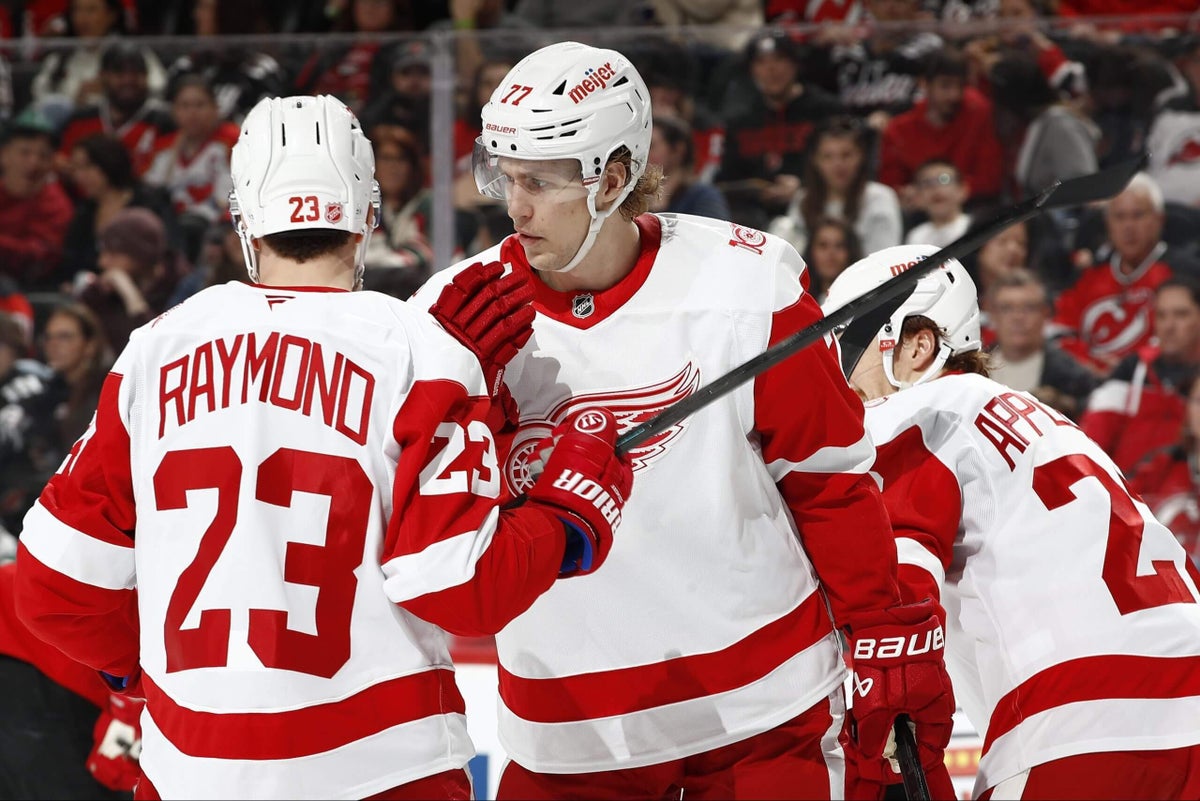
Emotions are still raw around the Detroit Red Wings — as they should be, after a tenth straight season missing the playoffs.
But as the exit interviews conclude and summer beckons, it will soon be time for the Red Wings to get back to work fixing what ails them.
Unsurprisingly for a franchise in Detroit’s position, there’s a lot to get to. But here are the most important items for the Red Wings to accomplish this offseason.
1. Settle any front-office decisions
This one hovers over all the rest of the business the Red Wings need to accomplish. I still think Steve Yzerman will be back as general manager next season, but seeing a similar late-season story play out yet again could nonetheless prompt some tough questions for the Red Wings’ brain trust. Do they make any changes to the existing structure? Bring in any new voices?
They’ll need to decide on this before they do anything else.
2. Determine how deep the roster changes need to go
This is really a question of which narrative you buy about this year’s Red Wings.
They were comfortably in a playoff spot at the end of February and let it slip away again in March (and April). So, does that mean they’re close and just in need of a couple of key tweaks to solve their problems at the end of the season? Or does the recurrence of that same trend over at least three seasons now mean deeper surgery is needed?
Perhaps there’s a middle-ground option to be found. But how close this team is to contention is a key underlying question to everything else the offseason entails.
3. Get clarity on Kane
I wrote more in-depth on this last week, but whether Patrick Kane stays or goes will determine how many high-lineup needs the Red Wings have this offseason. If he stays, it could be as simple (relatively speaking) as needing a top-line left wing. If he walks as a free agent, Detroit could have to reimagine what its second line looks like.
Perhaps there’s a need for that kind of reimagining regardless, but Kane and his linemate Alex DeBrincat were two of the few effective five-on-five scorers the Red Wings had this season, especially down the stretch. And with Kane sounding interested in a return, that’s not something Detroit can take for granted.
4. Find a top-line LW
This was a need last offseason, and it remains a need entering this one.
Emmitt Finnie filled the role for most of the 2025-26 season, and there were plenty of nights — especially early in the season — when he did so capably. And in fairness, scoring 30 points is a strong season for a 20-year-old rookie. Nonetheless, as the season went on, his production slowed — as did the top line as a whole.
Finnie might well become a legit top-six player as he progresses. Over the last decade, the majority of players who hit at least 30 points in an NHL season before age 21 have developed into solid contributors. But as Detroit saw with Marco Kasper this season, sophomore slumps can still be a real phenomenon.
That makes it worthwhile to search for a proven answer on the top line next to Dylan Larkin and Lucas Raymond — or, at a minimum, a flier on a player who has the potential to become one.
The top of the NHL free-agent market is shaping up to be rather weak on paper, but the league is full of players who blossomed in new surroundings, such as Trevor Zegras in Philadelphia, Dylan Strome in Washington or Sam Bennett in Florida. The Pittsburgh Penguins may have found something similar midseason with Egor Chinakhov. Could the Red Wings find a similar type of rehomed success story?
5. Reshape the bottom six
There’s no doubt the Red Wings need more from the bottom half of their lineup, in multiple ways. They need more offense, more physicality, just more to make the lineup deeper and more balanced.
“A team is made up of different players, and everybody has their role, and I think probably all of us could play better to our role than we did this year, right?” Kane said last week. “And your role has to be defined, and you have to know what’s expected of you, and you have to know how to do it. But I think we can all do a better job at that.
“Like, on our teams in Chicago, it wasn’t just one or two guys that are producing every night. It’s almost like it was somebody else’s night every different game, right? Like, somebody else stepped up. And it’s like, OK, maybe the next game will be my turn or somebody else’s, and it just kind of went through the lineup. And when you have that much depth and everyone committing to their role, I think that’s when you get the most out of a team.”
The Red Wings aren’t there right now. And that means some kind of change must be in order.
What this reshaping could look like will naturally depend on some of the above items. Do the Red Wings actually add a legit top-line (or at least top-six) winger to the upper-lineup mix? Does Kane return? If so, they can probably achieve some of this by slotting some current forwards (perhaps such as Finnie) into third-line roles.
A line of Finnie, Kasper and Michael Brandsegg-Nygård, for example, would have some pace, some physicality and the potential for different varieties of scoring, albeit missing a pure playmaker. Perhaps Finnie, Brandsegg-Nygård and Andrew Copp would be more balanced, though it would sacrifice some footspeed. Neither is a true slam dunk, but both feel like credible approaches.
Meanwhile, there’s little doubt the fourth line could use some old-school heaviness, and the free-agent market has some players who can offer it, such as A.J. Greer and Michael McCarron (the latter of whom is a Grosse Pointe native). Greer’s 17 goals this season could price him prohibitively, and the Red Wings will have to be careful not to overextend to fill a fourth-line role. But still, it’s a role they’ve largely gone without and an element worth pursuing, especially if a player’s impact can stretch beyond finishing hits and into some needed net-front havoc.
The big question might be how many of the current mix to keep. J.T. Compher, Mason Appleton and Michael Rasmussen remain under contract for next season. Compher offers some versatility and center depth but could also have a trade market for those same reasons. He’ll be an interesting decision for Detroit. And with Nate Danielson and Carter Mazur knocking on the door, how much patience will Detroit have for Rasmussen and Appleton, who killed penalties but didn’t provide meaningful production or physicality through the season?
The tricky balancing act is that the Red Wings can’t just relegate all of their youth — whom they will need to develop offensively and gradually take on more scoring responsibility — to down-lineup roles all season. At the same time, they also can’t jeopardize the effectiveness of the top six by over-relying on young players to produce at levels they aren’t ready for. That issue could be at the crux of some of Detroit’s toughest roster decisions.
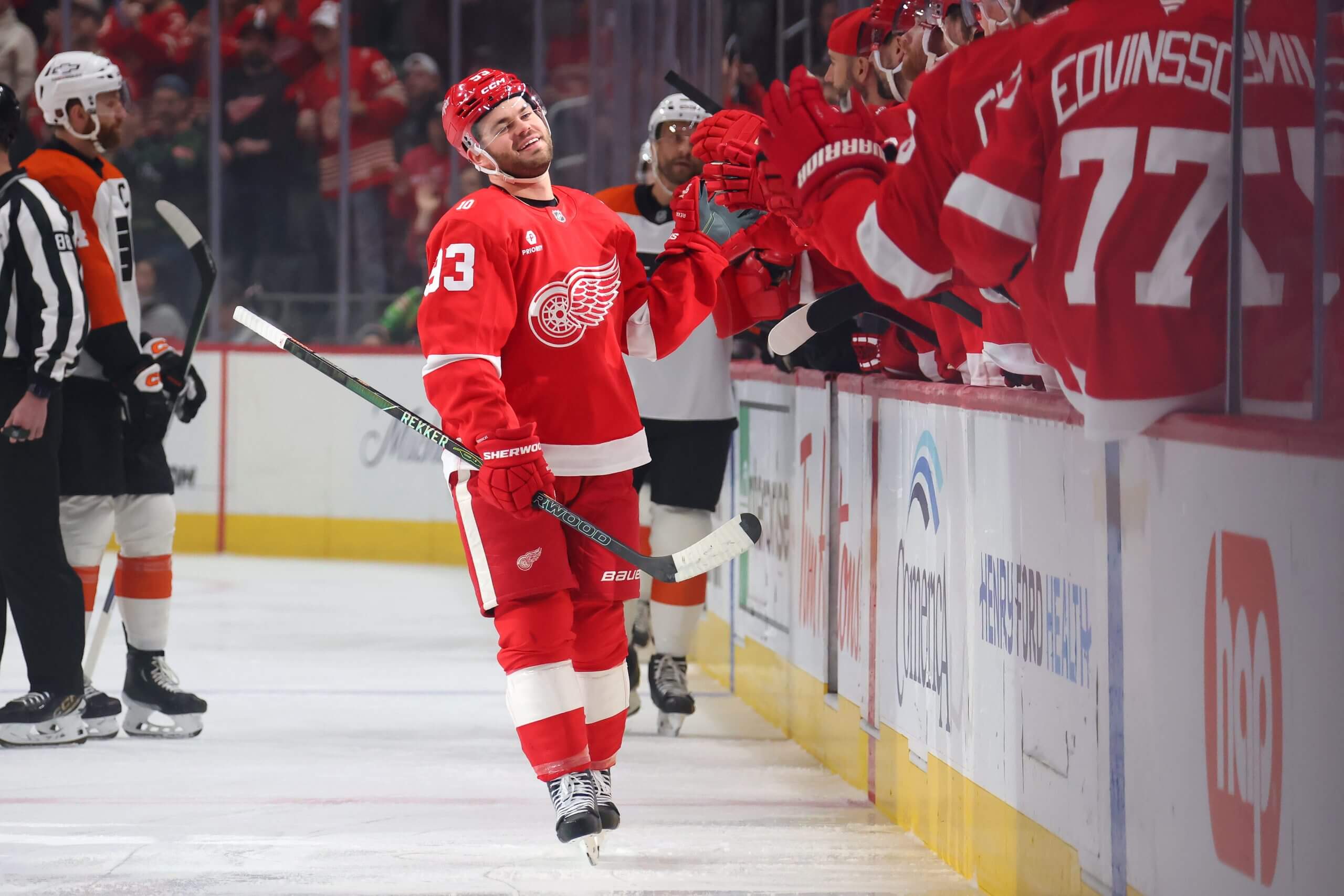
An Alex DeBrincat extension won’t come cheap, but the Red Wings can’t afford to let him walk. (Gregory Shamus / Getty Images)
6. Extend DeBrincat
Alex DeBrincat was the Red Wings’ most consistent forward this season. His 41 goals made him the franchise’s first 40-goal scorer since Marian Hossa in 2008-09, and his 85 points were a career high. He showed plenty of fight and grit beyond that, too.
He enters this summer just one year out from unrestricted free agency, though, and that’s a situation the Red Wings would do well to resolve promptly when DeBrincat becomes eligible for an extension on July 1.
A long-term extension will undoubtedly make him Detroit’s highest-paid player by a wide margin. It’s going to be pricey, with Adrian Kempe’s $10.625 million AAV on a long-term deal with the Los Angeles Kings feeling like a starting point (and possibly a floor). But DeBrincat is a 28-year-old, point-per-game scorer at a time when such players simply are not making it to free agency. The Red Wings can’t risk letting him get away a year from now.
7. Extend Edvinsson
Simon Edvinsson is Detroit’s most prominent restricted free agent in need of a new contract this summer, after logging more than 22 minutes a night this season on the Red Wings’ top pair.
His assist numbers dipped slightly this season as he dealt with multiple knee surgeries, but his underlying offensive numbers improved, and he has the look of a long-term pillar on the blue line alongside Moritz Seider. He can still make some youthful mistakes, but at his best, he can be a smothering 6-foot-6 defenseman with plenty more offense than he has tapped into thus far.
For that reason, it’s in Detroit’s interest to get him signed to a long-term deal this summer — and Edvinsson has signaled an interest in that as well.
“I felt like ever since I came here, it’s been great,” Edvinsson said last week. “All the people around, teammates, fans … it’s been great. So yeah, it would be an honor.”
The going rate for defensemen of his caliber is around $9 million, with the salary cap having skyrocketed in the last two years. That’s what fellow 2021 NHL Draft pick Luke Hughes signed for in October, and though he has produced more offense than Edvinsson thus far, the cap will go up again next season, and Edvinsson plays a similarly massive role.
Detroit could try to keep that number down in the short term with a bridge deal, but that would just kick the can down the road, with more cap growth anticipated in the coming years and real potential for an offensive breakout from Edvinsson in the next year or two.
The Red Wings are almost certainly better off getting a long-term extension done now, especially considering they’re flush with cap space. The number will be big, and it might look funny to see someone out-earn Seider on the cap sheet, but that’s the nature of a rising-cap world.