
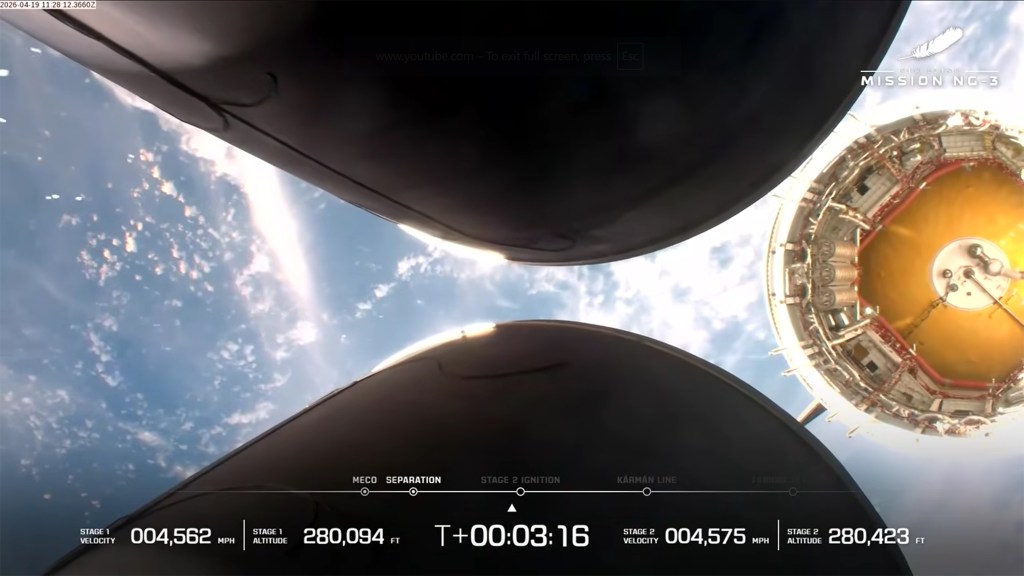
The Federal Aviation Administration has grounded Blue Origin’s New Glenn rocket following its Sunday launch from Cape Canaveral.
The rocket looked good on the way up, but the upper stage wasn’t able to put its payload into the correct orbit.
“The FAA is aware that Blue Origin New Glenn 3 experienced a mishap during the second-stage flight sequence following a successful launch,” according to an FAA statement released Sunday evening. “The FAA notified NASA, the NTSB, and the U.S. Space Force about the classification of the incident.”
FAA guidelines will require Blue Origin to complete an investigation into the event before the rocket is allowed to fly again.
“A mishap investigation is designed to enhance public safety, determine the root cause of the event, and identify corrective actions to avoid it from happening again,” according to FAA statements on past groundings. “A return to flight is based on the FAA determining that any system, process, or procedure related to the mishap does not affect public safety.”

The Blue Origin New Glenn rocket lifts off from LC36 at the Cape Canaveral Space Force station, Sunday, April 19, 2026, in Cape Canaveral, Fla. (AP Photo/John Raoux)

The Blue Origin New Glenn rocket lifts off from LC36 at the Cape Canaveral Space Force station, Sunday, April 19, 2026, in Cape Canaveral, Fla. (AP Photo/John Raoux)

The Blue Origin New Glenn rocket lifts off from LC36 at the Cape Canaveral Space Force station, Sunday, April 19, 2026, in Cape Canaveral, Fla. (AP Photo/John Raoux)

The Blue Origin New Glenn rocket lifts off from LC36 at the Cape Canaveral Space Force station, Sunday, April 19, 2026, in Cape Canaveral, Fla. (AP Photo/John Raoux)
Show Caption
1 of 4
The Blue Origin New Glenn rocket lifts off from LC36 at the Cape Canaveral Space Force station, Sunday, April 19, 2026, in Cape Canaveral, Fla. (AP Photo/John Raoux)
The New Glenn rocket, flying on its third mission ever, launched from Cape Canaveral Space Force Station’s Launch Complex 36 on Sunday morning. For the first time, it used a booster that had been previously flown. The booster landed intact, which should allow it to be used again.
While the booster’s launch and second landing was a success for the company, Blue Origin announced the payload of the BlueBird 7 satellite for Midland, Texas-based AST SpaceMobile, had been “placed into an off-nominal orbit.”
No further details were given by Blue Origin, but the mission timeline had stated the second stage was supposed to light its engines for a second time after reaching orbit to raise its altitude before deploying the satellite.
A news release from AST SpaceMobile confirmed that did not happen, saying the deployment was at too low an altitude to become operational. Its satellite did not have enough on-board thruster supply for it to climb to its required orbital position.
The company must now deorbit the satellite, which would have been its eighth in orbit. The cost for the lost hardware is expected to be covered by insurance.
Blue Origin was also supposed to have lit its upper stage engine for a third time after deploying its payload, so that it could head back to Earth for a safe crash landing in the open ocean.
The FAA has grounded several rockets because of mishaps in recent years, including SpaceX’s Falcon 9 and in-development Starship. Blue Origin had its smaller, suborbital New Shepard rocket grounded as well.
Investigation timelines vary, but can last for months before a rocket is cleared to fly again. SpaceX’s Falcon 9, though, was grounded for only 15 days in 2024 when it suffered an upper stage issue.
Blue Origin had been cleared to launch as many as 12 times a year by the Space Force, and CEO Dave Limp had indicated earlier this year he’d like to see New Glenn launch at least eight times.
For now, the company had only announced two more planned missions this year, including the MK1 Blue Moon lunar lander aiming to launch before the end of the summer. Amazon has been waiting for New Glenn to begin several launches slated to proliferate its Amazon Leo constellation of satellites.
New Glenn made its debut in January 2025, becoming the first commercial rocket to ever make it to orbit on its first try. A follow-up mission sending a pair of Mars-bound satellites to space came in November.
This is actually the second time New Glenn has been grounded. The first time was because the company was not able to land the booster on its debut launch.
In that incident, the FAA didn’t clear New Glenn to fly again for 2 1/2 months.