
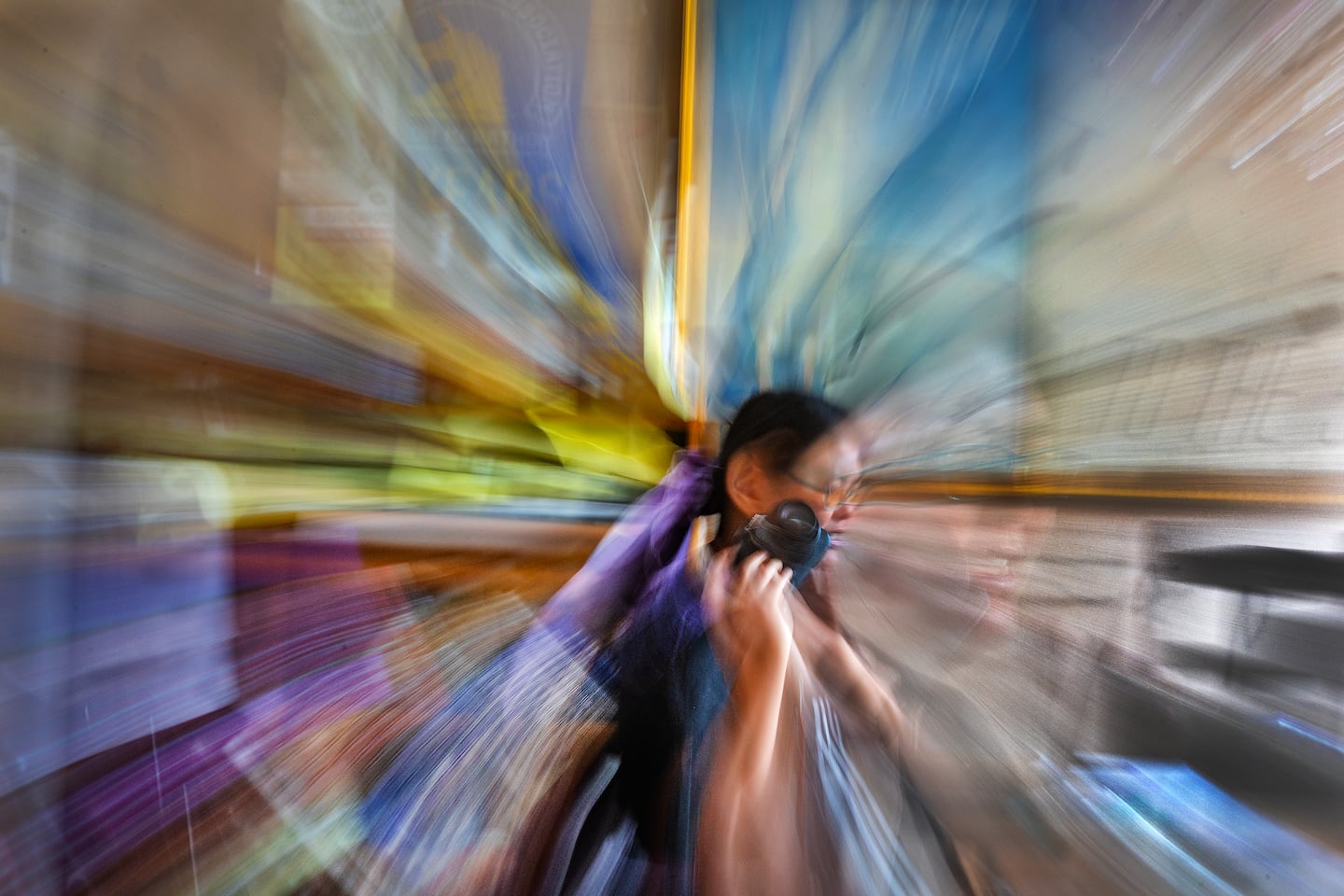
At times she can see but her brain can’t process the images. Sometimes she sees “blobs of color.” She has no depth or peripheral vision. On a bad day, because of a combination of other disabilities, seeing is “sometimes impossible.”
That’s when photography is a blessing.
“With the camera I can see things I can’t see with my real eyes,” says Caruso, 27.
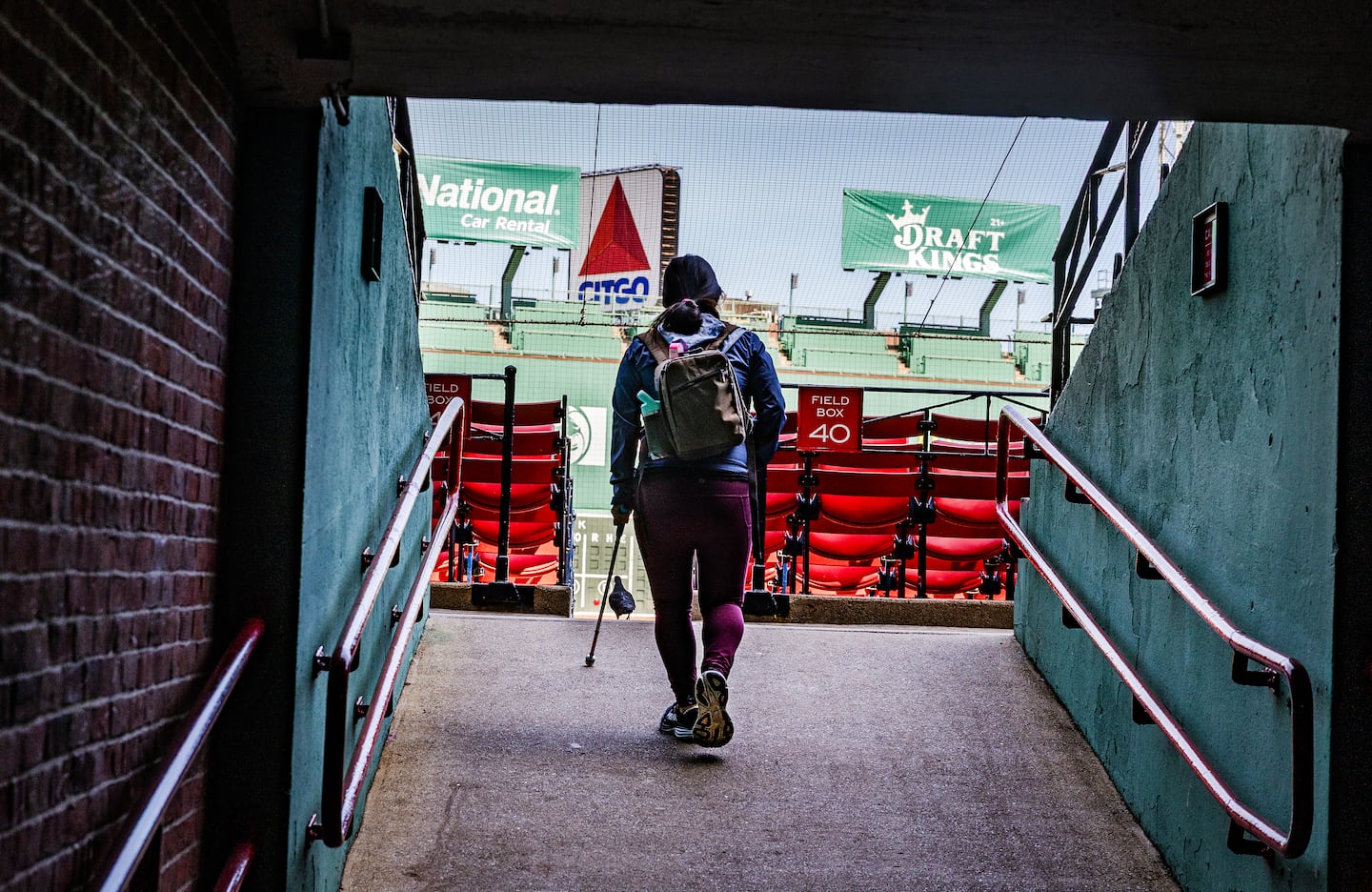 Caruso enters Fenway Park to photograph Beep Baseball on April 11.
Stan Grossfeld/Globe Staff
She’s a transracial adoptee from China. She’s not quite 5-foot tall but she’s a dynamo, a CVI and disability advocate hell-bent on making a difference.
She studied photography at Mass College of Art and Design, from which she graduated in 2025.
In the darkroom there, she couldn’t see in the low light. She once crashed into the trash can and couldn’t breathe because of the photo chemicals and her asthma.
“My throat almost closed up,” she says.
Still she persevered to become a photographer and artist.
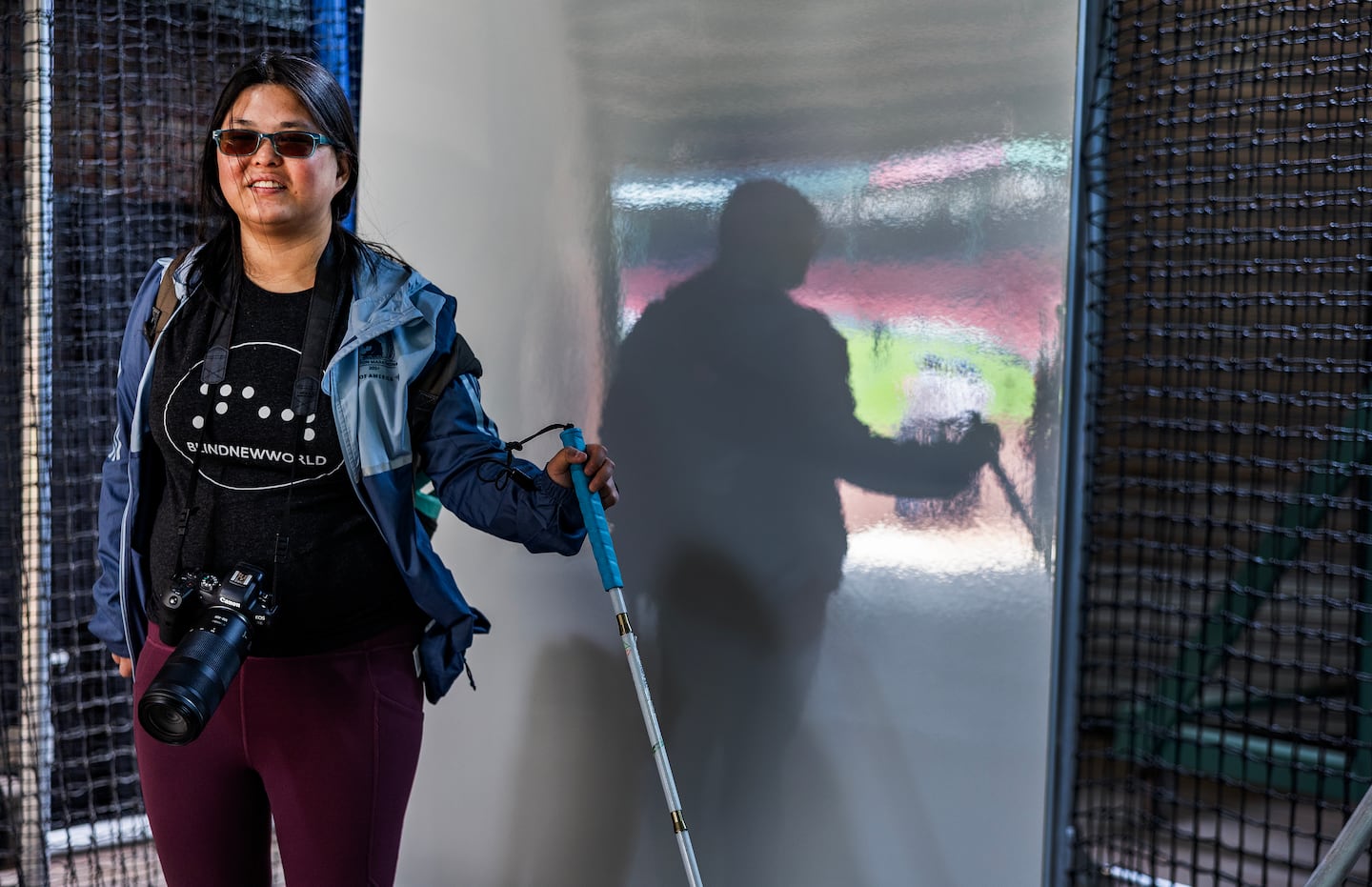 Caruso now loves her white cane, but initially she was ashamed of having to use it after she broke her foot in 2017.Stan Grossfeld/Globe Staff
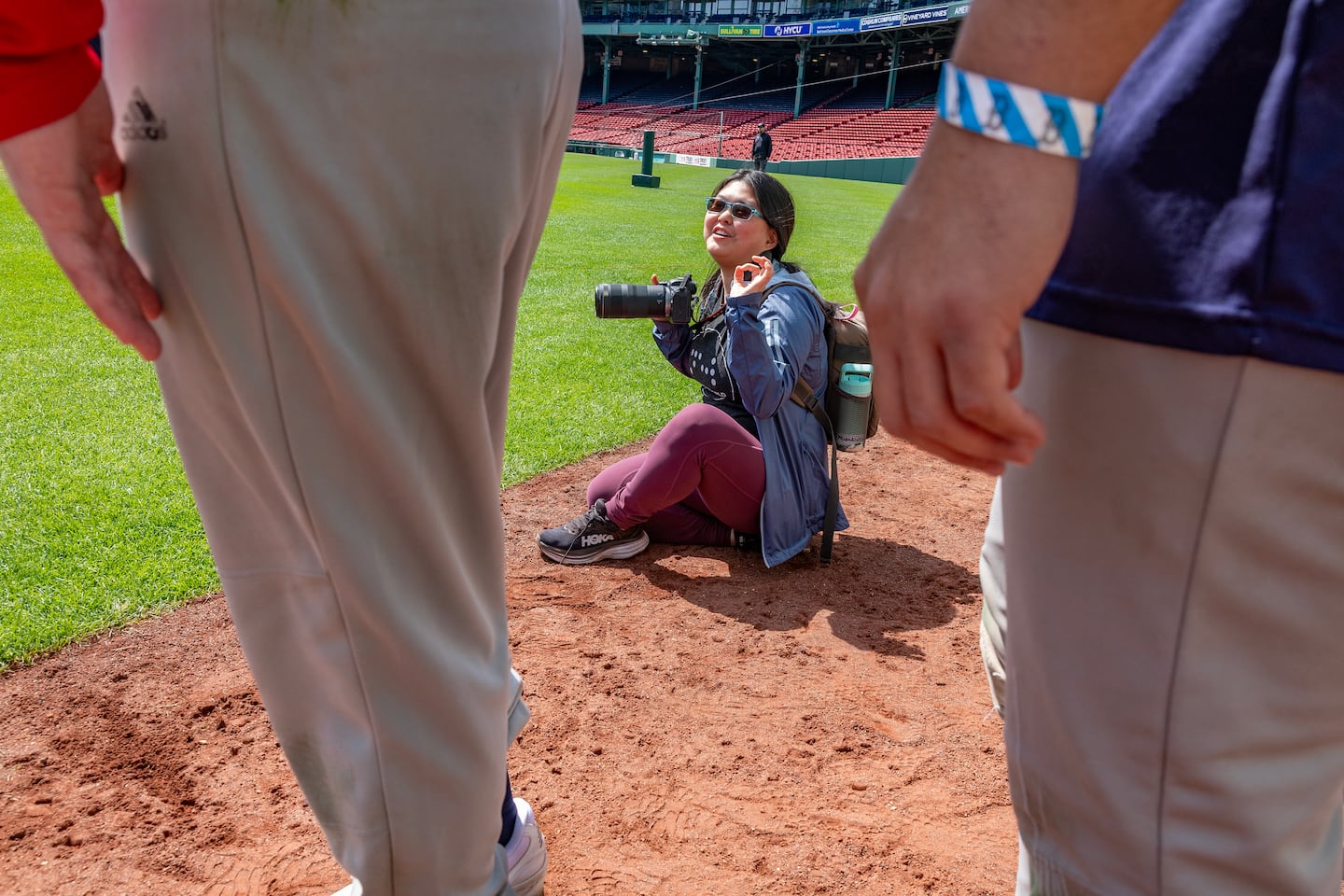 Caruso is funny, bright, and bubbly. That helps her get great access, like here at Fenway Park covering Beep Baseball.Stan Grossfeld/Globe Staff
When people find out she is a visually impaired/blind photographer, they give her weird looks.
“You know when your pet looks up at you after you do something really dumb like run into a wall. That’s the exact face people give me, ” she says with a smile. Caruso usually walks with a white cane she was initially ashamed to use, but now loves. She calls it Xi Xi.
Caruso was 11-months-old when she came to the Boston area. At age 6, she was diagnosed with dyslexia, ADHD, and nystagmus, an eye disorder.
Doctors didn’t diagnose her CVI until she was 19.
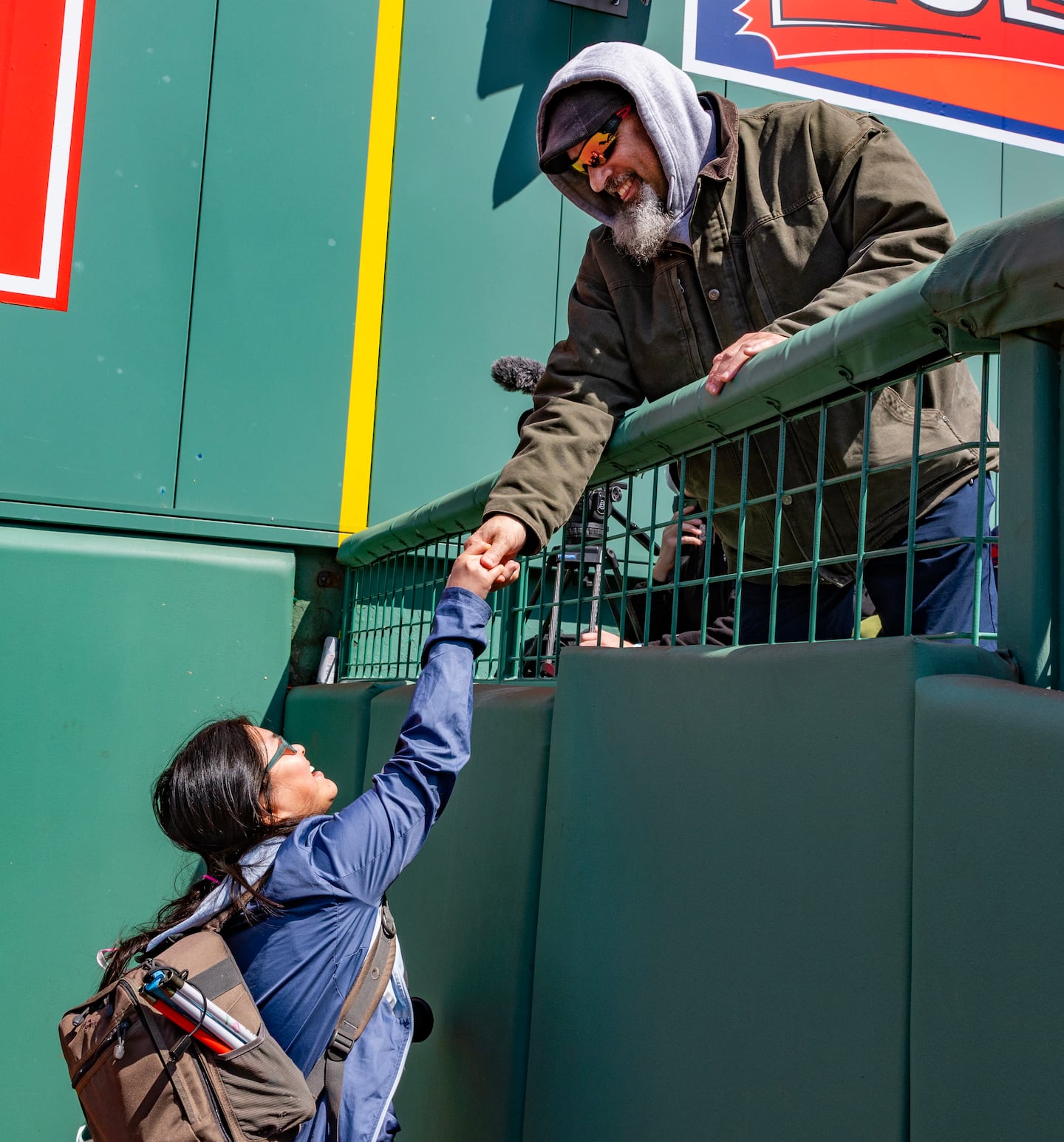 Caruso greets Joe LeMar, her Achilles International adaptive running coach who calls her “an inspiring, shining light.” She recently, tethered to a guide, completed a Boston Athletic Association 5K run.Stan Grossfeld/Globe Staff
She wrote a poem about it. “How I See The World.” (edited)
Imagine being blind for decades. Imagine no one believing you’re blind. Imagine you can’t process the world around you. Imagine you never will.
You wake up every morning and it’s like a movie set. Your life is a horror movie and you can’t escape. Everything, everything, everything is abstract. Nothing makes sense. Your eyes see, but your brain doesn’t.
Why is it a horror movie?
“Because it’s like we are in a VR (Virtual Reality) headset and walking, trying to cross the busiest street, like Mass Ave.,” she says.
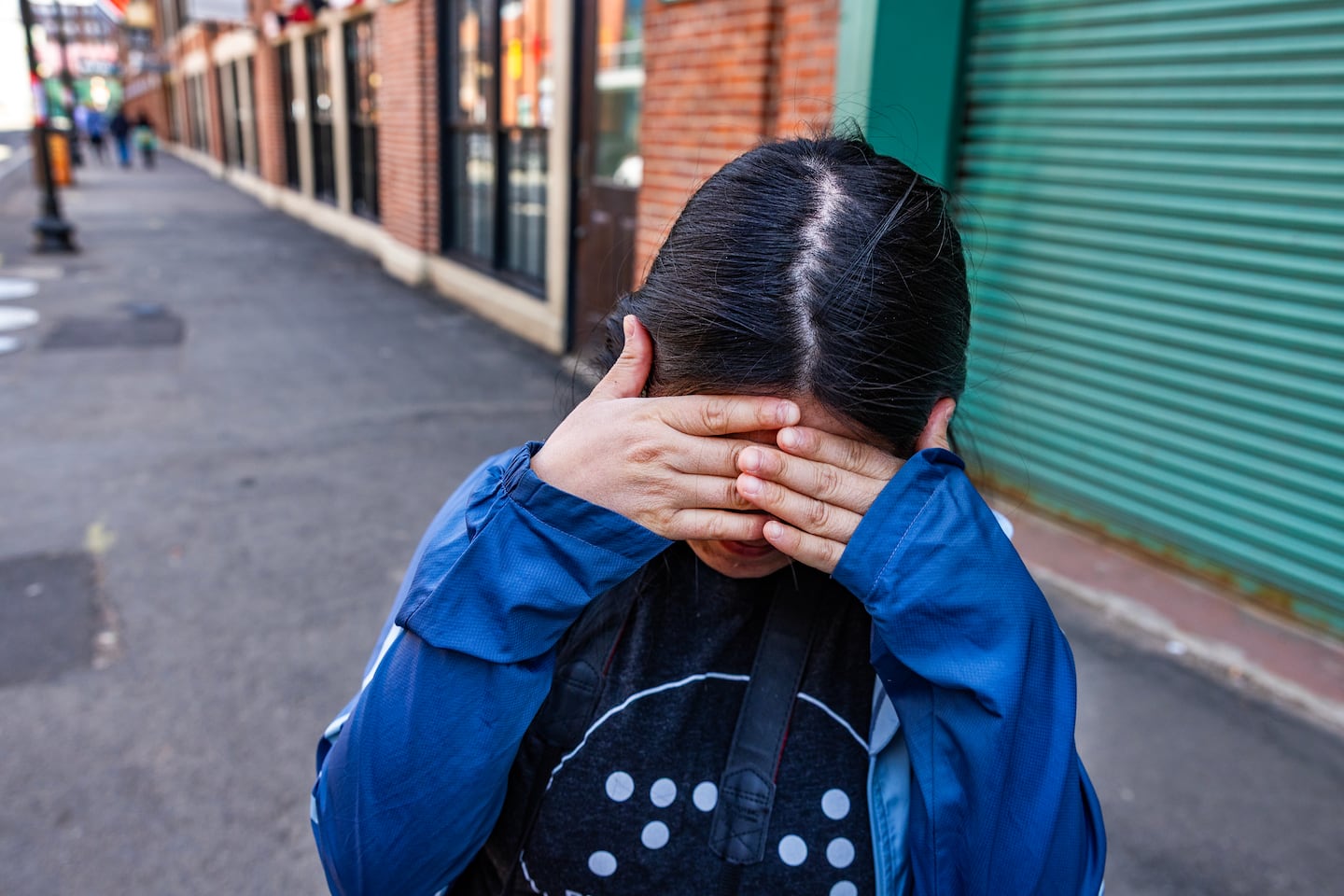 “I use my camera to be able to interact with the world. Like say if I’m at a family gathering, I can take photos and later I can be like, oh, that’s what happened,” says Caruso. “I’m like, oh, that’s my aunt, that’s my uncle. But at the moment I’m like, I don’t know who’s who.”Stan Grossfeld/Globe Staff
“Your eyes see, your brain can’t recognize your surroundings. You can’t recognize people’s faces. You’re alone. In your world. You feel misunderstood, but you reach for your camera.
You call how you see the world. Your camera becomes the eyes. You slowly start to see the world around you, but every photo you take is novel. You get excited, but slowly the photos you take open up the world to you. You get lost in photography.
Photography is something you can control. You become one with the camera. You have control. Photography has given you the tool to escape the horror movie.
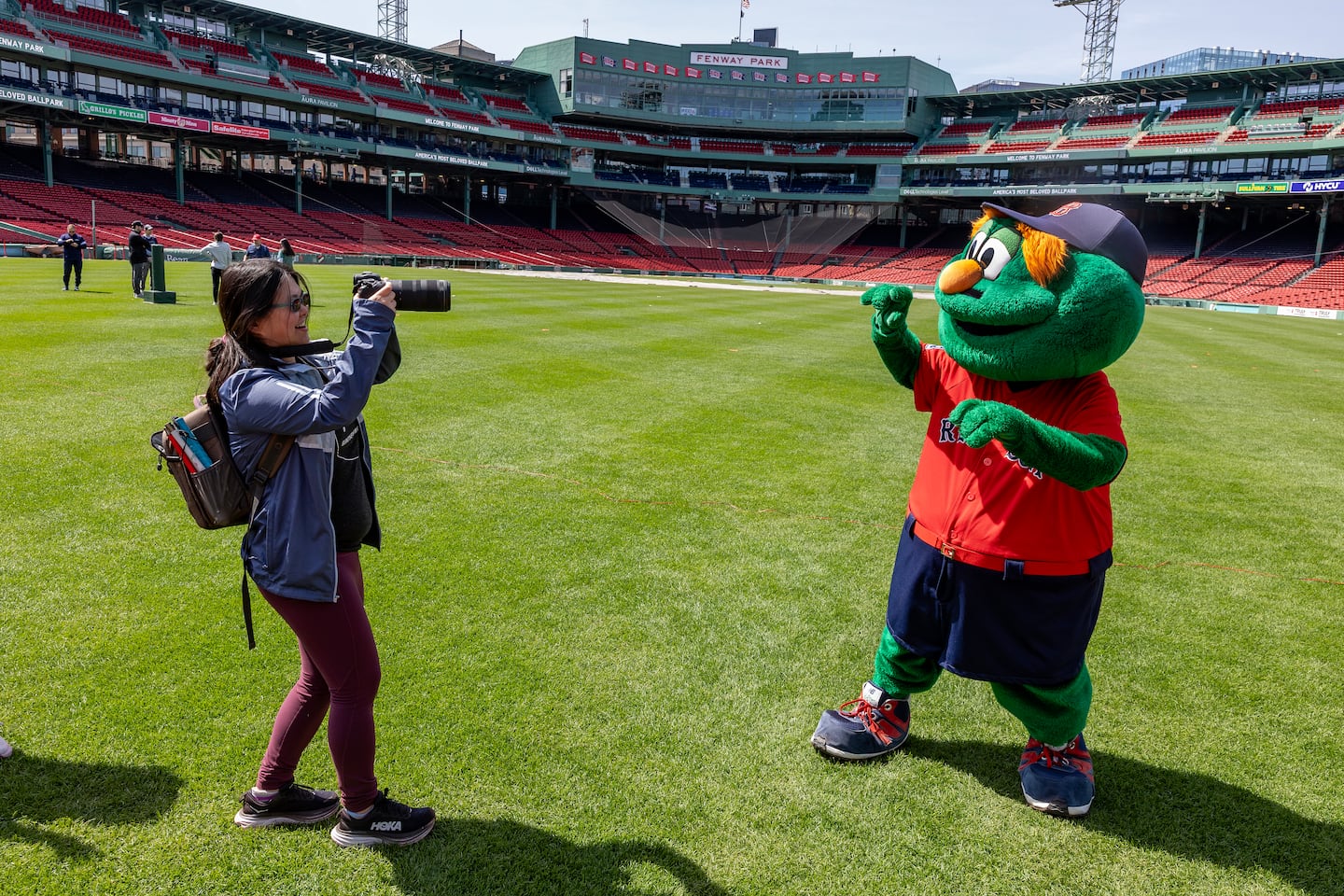 Caruso photographs Wally, the Green Monster.Stan Grossfeld/Globe Staff
Caruso’s remarkable drive has earned her quite a following.
She has twice appeared on the popular “Love on the Spectrum” TV series and has nearly 60,000 followers on Instagram. Before the inaugural Beep Baseball game at Fenway Park that Caruso photographs, she checks her photo equipment. Sometimes she can’t see the settings on the camera. For now, she can.
“I need to clean my camera. I don’t know how I got chocolate on it,” she says
Celebrity photographer and Shot@Love podcaster Kerry Brett, one of her mentors, gives her a pep talk outside Fenway.
“Tina, you’re an international star and an influencer and you have millions of downloads. So you have a lot of worth and a lot of power digitally online. And people love you.”
In the bleachers and on the field, people want selfies and give her hugs.
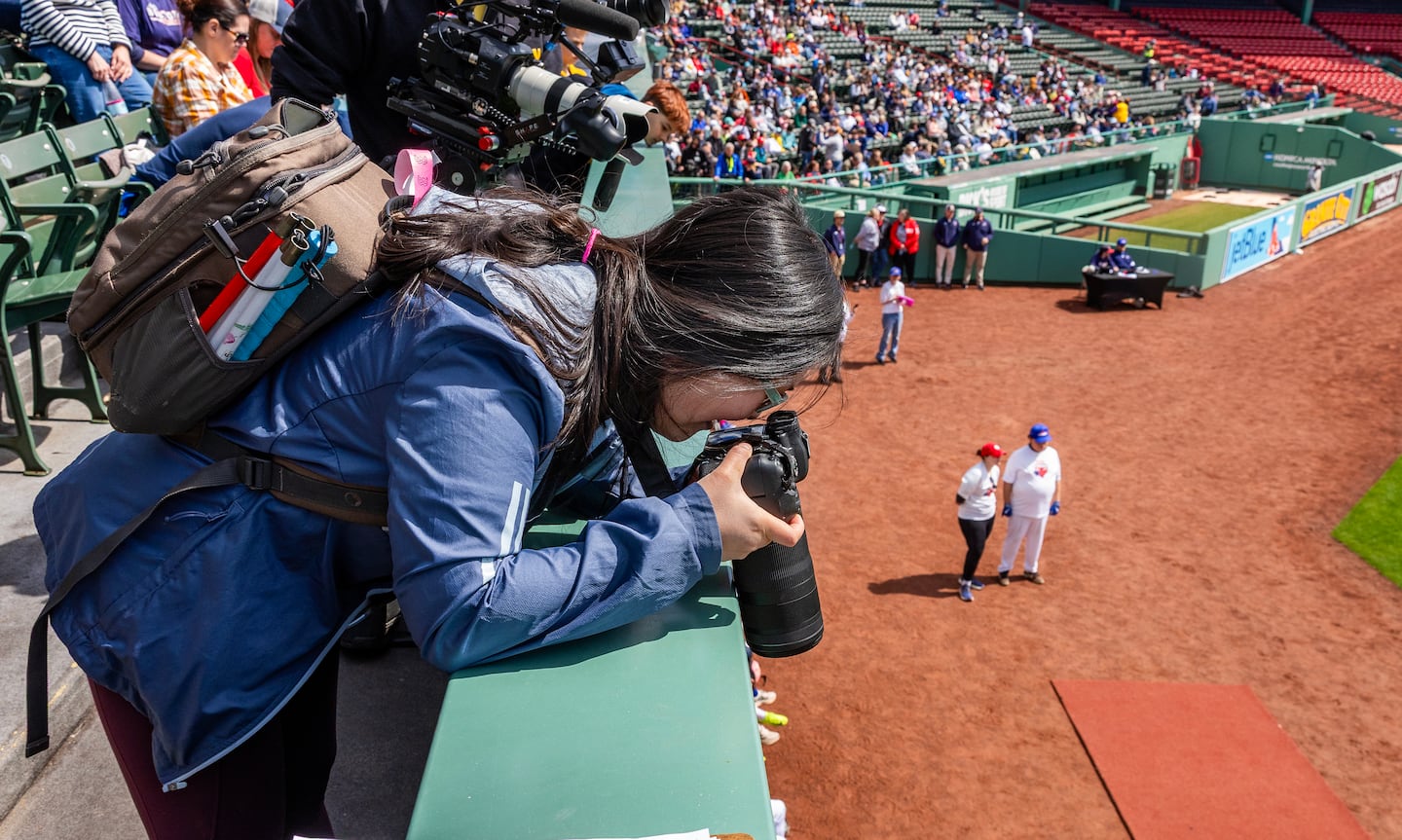 Caruso gets creative, shooting down from the bleachers at Fenway Park.
Stan Grossfeld/Globe Staff
“She’s inspiring. I saw her on ‘Love on the Spectrum.’ I’m a huge fan of her and her girlfriend,” says Gina Devinish, a coach with Boston Renegades, one of the teams at Fenway Park. “I just needed a little fangirl moment to say ‘Hi,’”
Caruso also greets Joe LeMar, her coach at Achilles International, which tethers runners with guides. On Saturday she completed the Boston Athletic Association’s 5K.
“She’s an inspiring, shining light who continues to make the world a better place with every single day that I’m alive and I get to see her,” says LeMar, a gold medalist at the 1992 Summer Paralympics in Barcelona.
Caruso’s photo work has been published locally and she has sold several fine arts prints. But she is still looking for a photography or nongovernmental agency advocacy job.
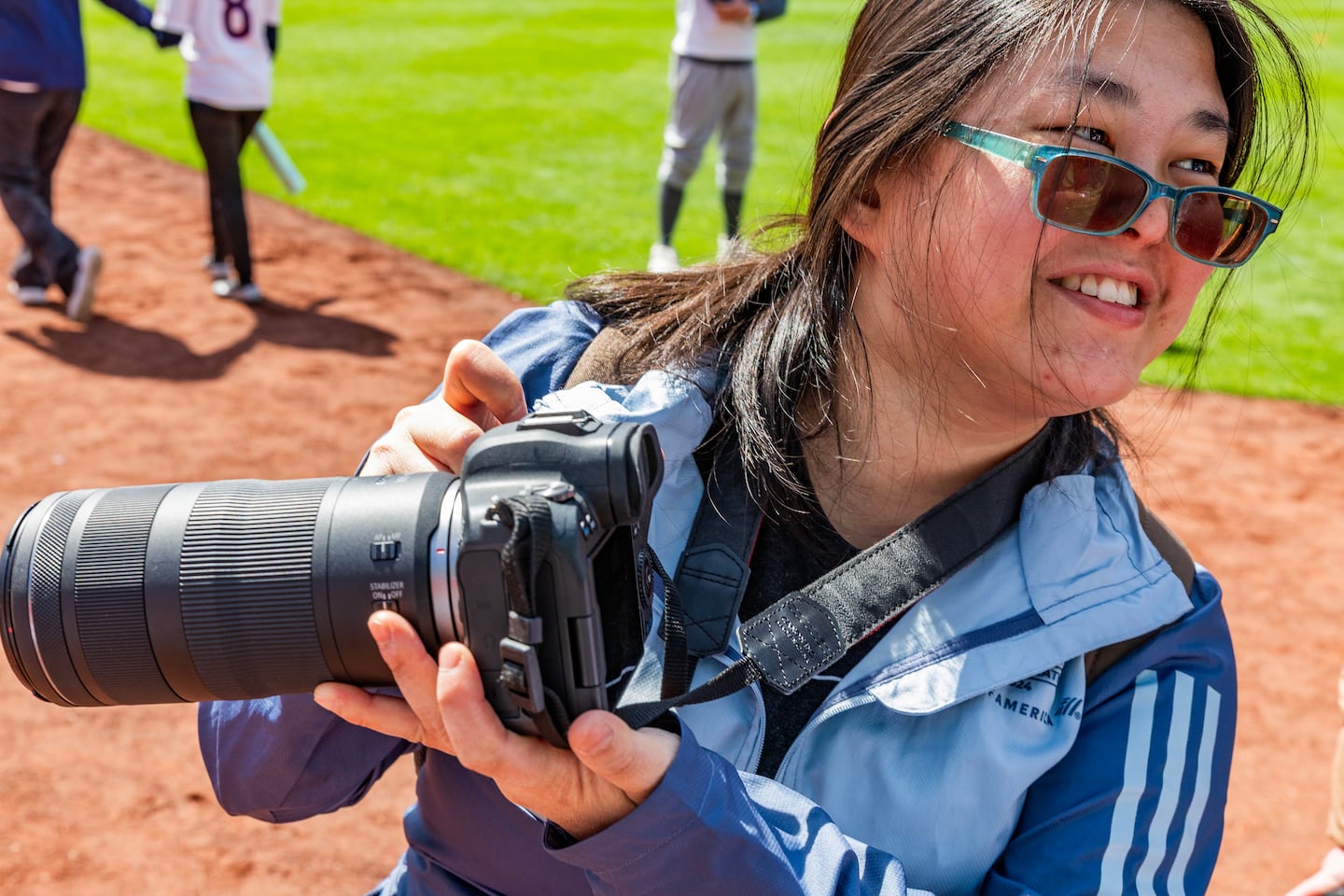 “I found that photojournalism was going to be my pathway. It’s because I always liked taking photos of action and crazy shenanigans and just irresistible situations,” says Caruso.Stan Grossfeld/Globe Staff
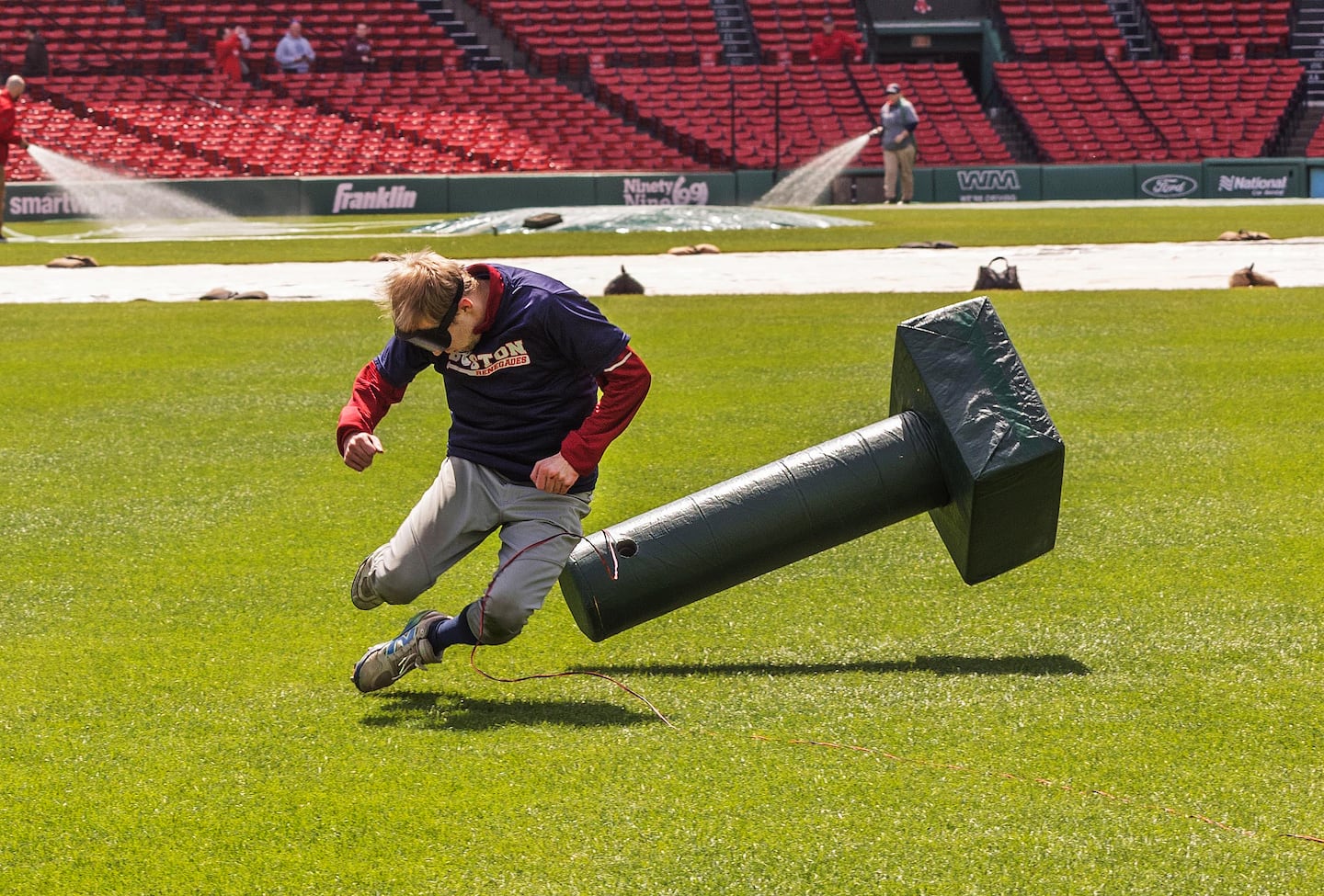 In an image taken by Tina Zhu Xi Caruso, Chris Kimball of the Boston Renegades is airborne as he tumbles into a sound-emitting base at Fenway Park.Tina Zhu Xi Caruso
“I want to show blind people that they don’t have to be in the box of always having rehabilitation services tell them they have to go stock shelves somewhere,” she says.
She’s most proud of her photographs from the “Stop Asian Hate” demonstrations in Boston during 2020-2021, a time when animosity against Asians was on the rise.
“I want to make a difference for any marginalized groups, including people with disabilities and the Asian American community, especially in the disability community,” she says.
In May, Caruso will receive the first Embrace Award honoring Henry Hom Dow, the first Chinese American admitted to the Massachusetts Bar Association.
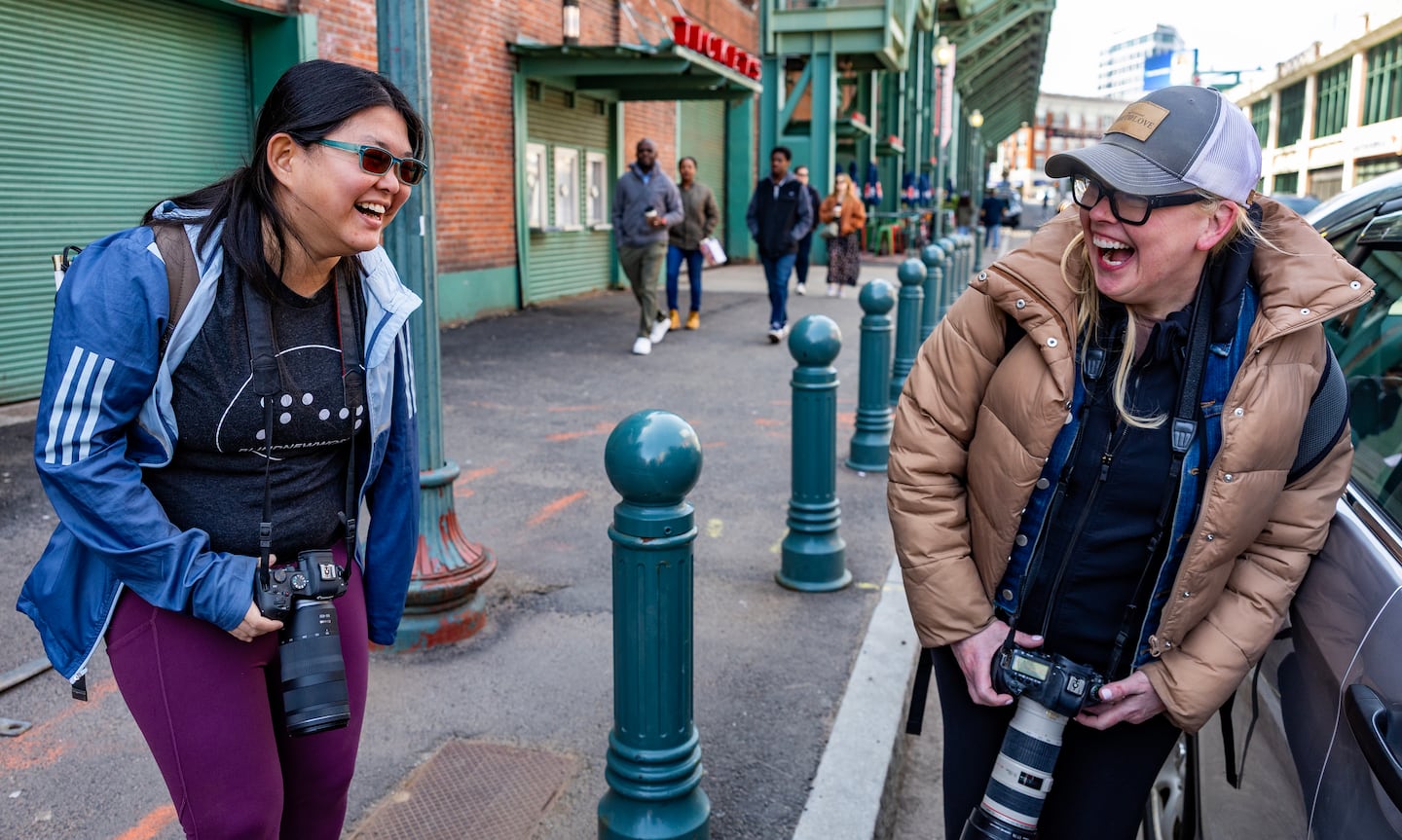 Caruso and one of her mentors, celebrity photographer Kerry Brett, laugh it up on Lansdowne Street.Stan Grossfeld/Globe Staff
The award celebrates “resilience, advocacy, and the courage to put forward the strengths of our (Asian American and Pacific Islander) community.”
The Red Sox have asked her to throw out the ceremonial first pitch for a AAPI night celebration on May 1. She’s thinking about tossing it underhanded.
During the Beep Baseball game, Caruso uses two cameras, one with a telephoto, the other a wide angle. The sunny day helps her to see better, unless she looks toward the sun. She shoots loose and blows up the images later.
She can relate to the athletes, all of whom have varying degrees of visual impairment.
Some wear blindfolds to even out the playing field with those with less vision. The ball beeps and the bases -soft foam cylinders – buzz. Some runners dive into them and it makes for good pictures.
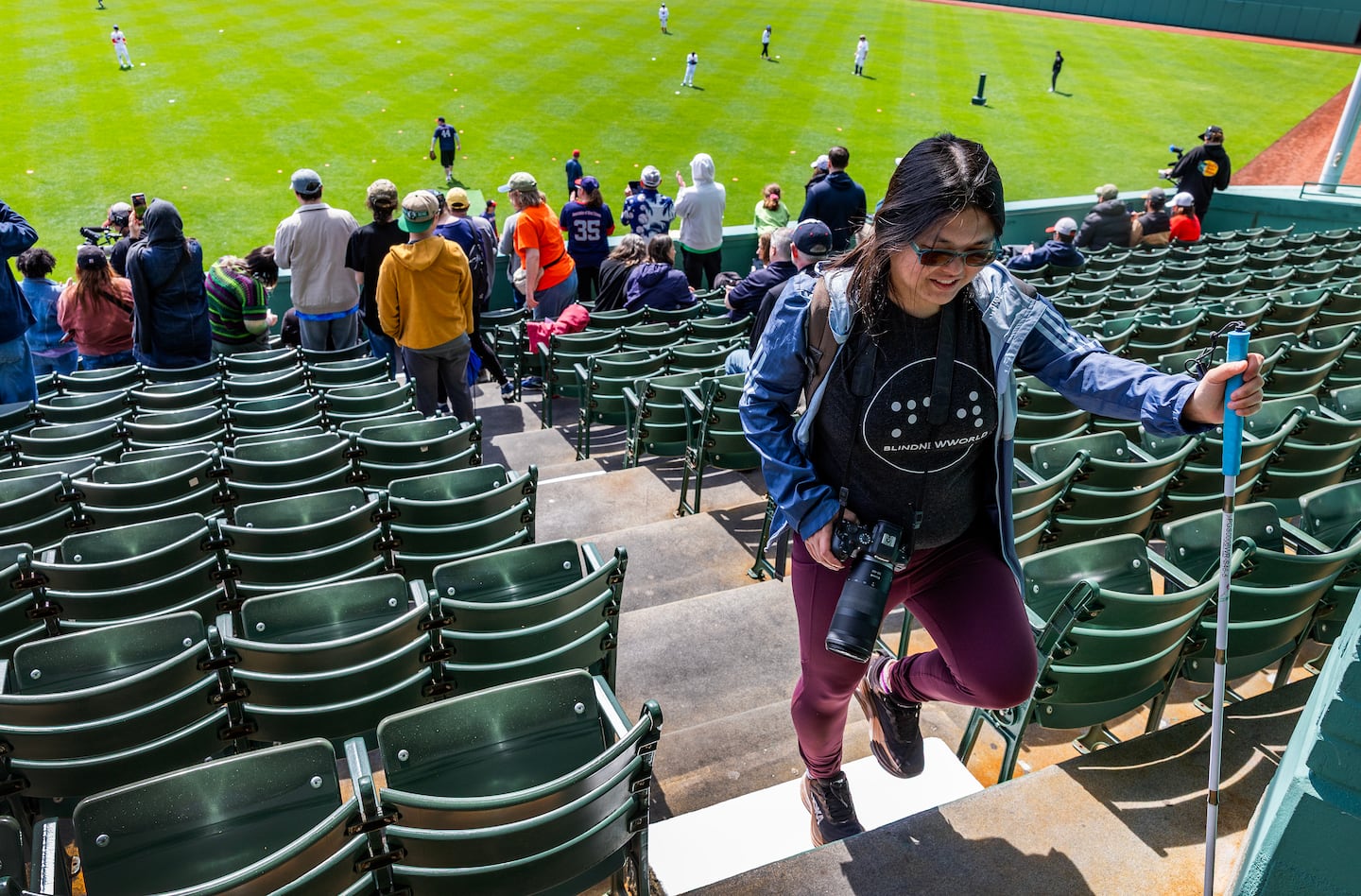 Caruso navigates the bleacher stairs at Fenway Park.Stan Grossfeld/Globe Staff
Caruso anticipates this and nails the action. Then, with an infectious smile, she races up to the low vision athlete.
“I just got an amazing photo of you,” says Caruso, gushing with enthusiasm. “I’m a blind photographer.”
“Oh, awesome, dude. That’s awesome … good for you,” says Chris Kimball, who works for Fidelity when he isn’t playing for the Boston Renegades.
Their joy feels bigger than when the three Red Sox outfielders converge and hug after a victory.
Kimball is happier for Caruso than he is for himself.
“To this day, it amazes me that people with visual impairments can do anything that anybody else can do . . . You can’t let things get in your way, if you have that mindset where you don’t accept the word no, you can do great things. And that is incredible.”
Stan Grossfeld can be reached at stanley.grossfeld@globe.com.