
Your support helps us to tell the story
From reproductive rights to climate change to Big Tech, The Independent is on the ground when the story is developing. Whether it’s investigating the financials of Elon Musk’s pro-Trump PAC or producing our latest documentary, ‘The A Word’, which shines a light on the American women fighting for reproductive rights, we know how important it is to parse out the facts from the messaging.
At such a critical moment in US history, we need reporters on the ground. Your donation allows us to keep sending journalists to speak to both sides of the story.
The Independent is trusted by Americans across the entire political spectrum. And unlike many other quality news outlets, we choose not to lock Americans out of our reporting and analysis with paywalls. We believe quality journalism should be available to everyone, paid for by those who can afford it.
Your support makes all the difference.Read more
Scientists have predicted that Venice’s monuments will only be accessible by submarine if sea levels continue to rise.
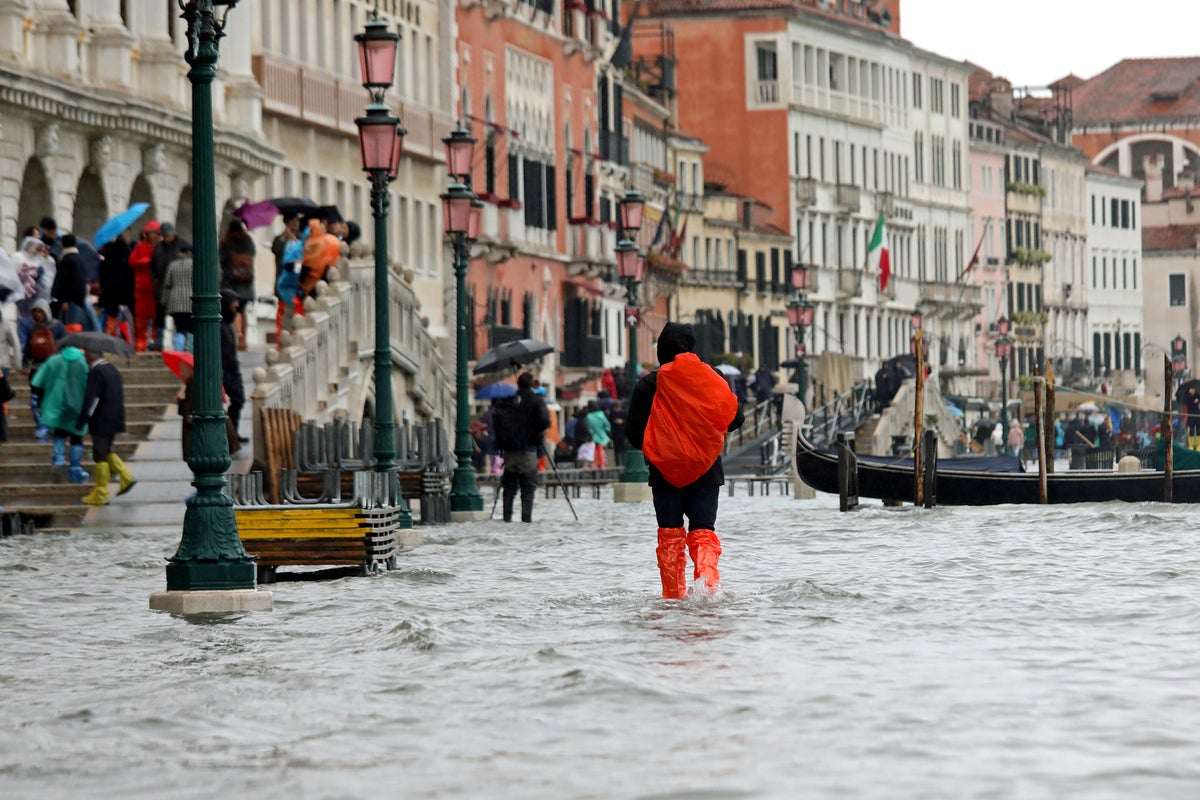
The Italian city of Venice is famous for its winding canals and network of islands. However, the city is at risk of being submerged due to rising sea levels and the weight of overtourism, with both visitors and water flooding the streets in recent years.
A report by the University of Salento, published on Thursday, 16 April, says that the projected sea level rise will require “unprecedented” long-term adaptations, balancing heritage preservation, social wellbeing and the financial cost of upkeep.
The researchers advise that Venice should consider the use of large flood barriers to isolate the city from the lagoon, or encircle the lagoon with permanent coastal dams.
In the worst-case scenario, in which the city is entirely flooded, historical attractions would need to be relocated further inland by dismantling and reassembling them.
While this is not imminent, extreme sea level rise could be unavoidable in the 22nd century under current climate policies and expected Antarctic ice sheet collapse.
Venice is home to many historical monuments, such as the Byzantine-style St Mark’s Basilica and the Gothic Doge’s Palace.
While the paper says that it would be possible to save some monuments if relocated, the “historical urban fabric, lagoon-based culture, traditional lifestyles and most economic activities would be irreversibly lost”.
The researchers predicted that a project like this could cost up to €100bn (£87bn). Aside from monuments, residential homes would have to be abandoned, with the loss of private properties costing up to €6.5bn (£5.6bn)
Anyone who would want to visit the flooded remains would only be able to do so for a limited time by boat and submarine.
“There are things we can do to delay this scenario, but they will not work forever – the future appears unavoidable,” Piero Lionello, who led the research at University of Salento, told The Times.
In 2020, Venice introduced Mose, a flood barrier system placed at various inlets of the lagoon, protecting the city and its islands from high tides and mass flooding.
More than half of the city is 80cm to 120cm above mean sea level, which makes it very susceptible to flooding. Mr Lionello said that by 2100 the mean sea level in Venice could rise by between 42cm and 81cm.
While Mose and other barrier systems could aid Venice in the long term, the researchers said that rapid action is still crucial to avoid the worst long-term outcomes.
Read more: Controversial entry fee set to return for tourists entering Venice this week