
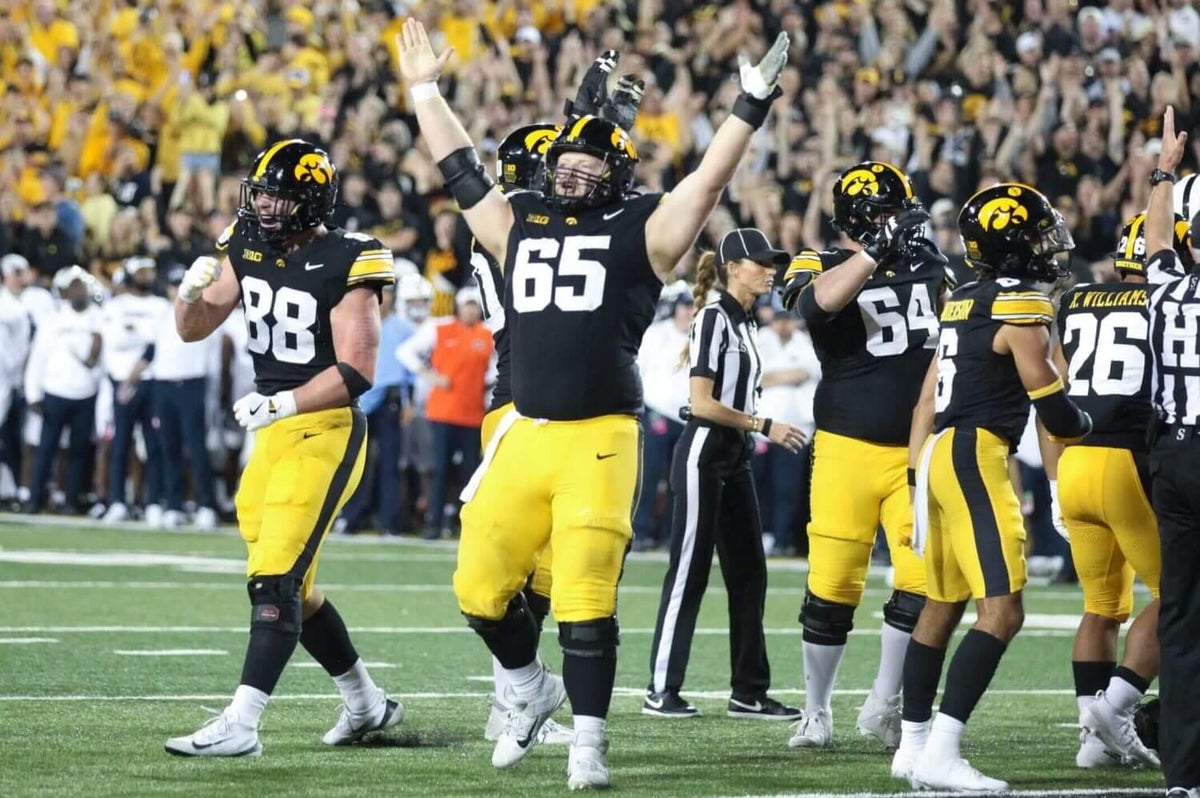
INDIANAPOLIS — Iowa center Logan Jones could have helped someone in last year’s NFL Draft: a three-year college starter with power, quickness and considerable football acumen, who had just earned All-Big Ten honors blocking for an All-American running back in an NFL-friendly scheme.
In what was considered a weak draft for center prospects, many NFL clubs would have selected Jones in a middle round with hopes of landing a long-term starter. But Jones had other plans.
“I was like, ‘I’m coming back. You don’t need to tell me what you’re gonna pay me,’” Jones said. “I know my coaches are gonna take care of me, and they absolutely did.”
In a sixth season at Iowa, Jones became a unanimous first-team All-American and anchored his offensive line to the Joe Moore Award. Without really negotiating, he collected about $750,000 from revenue sharing and NIL, which is less than what top-tier college offensive tackles make but still a high level for an interior offensive lineman.
Still, Jones turned down an opportunity to earn perhaps 50 percent more in the NFL. His decision once was unthinkable, but now it has become commonplace. More mid- and late-round draft-eligible prospects have chosen to remain in school and capitalize on name, image and likeness arrangements and revenue-sharing money from the athletic department for another year. It’s a strategy that suits players like Jones, who can perhaps increase his draft stock while receiving a guaranteed paycheck.
“You get more players staying in school because they’re going to get the money for one year, and then they can develop,” said retired NFL agent Ben Dogra, who represented 54 first-round selections over a 13-year period. “You have some kids that want to stay in school for six years, because those kids are sixth-round, seventh-round picks. They’re never going to make as much money because it doesn’t matter what the value of your four-year contract is. The only thing that matters is the guaranteed portion of the contract.”
Five years ago, very few players in Jones’ position would choose to stay in college and forfeit a year’s pay. In the 2025 draft, fifth-round pick Drew Kendall of Boston College was the only true center selected, and he was an underclassman. He received a four-year, $4.55 million contract, according to Spotrac. But with one more season working at one of college football’s top offensive line factories, Jones’ short-term financial setback could parlay into more pay this year.
For NFL clubs, choices like the one Jones made have made the middle and late rounds of the draft more difficult. In 2021, 128 players with eligibility declared for the draft, with 100 getting selected. By 2024, those numbers fell to 58 and 49 respectively. On one hand, it has led to a more experienced group of players — the average age of Day 3 selections (as of Sept. 1 of that draft year, per pro-football-reference.com) rose in that time from 22.4 years old to 23 — and a higher percentage of underclassmen becoming draft picks. But the talent pool has become shallower in the process.
In the middle rounds of past drafts, teams chose “younger developmental guys that haven’t scratched the surface yet,” according to Kansas City Chiefs general manager Brett Veach.
Now?
“You’re getting a little bit more already finished product,” Veach said. “So, that’s challenging.”
Three underclassmen selected on Day 3 of the 2021 NFL Draft — receiver Amon-Ra St. Brown, center Drew Dalman and safety Talanoa Hufanga — have made the Pro Bowl. None of the Day 3 underclassmen in 2024 have earned a Pro Bowl nod, although they have played only two NFL seasons.
This year, 69 underclassmen declared for the draft, and 64 percent (44) are ranked among The Athletic analyst Dane Brugler’s top 100 prospects, with 33 in the top 50. So the lower number of underclassmen available strips away some of the talent in the fourth round and beyond.
“It’s going to thin out every draft, which means you’ve got less margin of error if you’re an NFL general manager and head coach trying to assemble your team,” Dogra said. “Let’s say you have a third- or fourth-round pick. You’re expecting that player to become a starter of your team, maybe not an All-Pro player, but a functional starter. Now that player, if he’s staying in school, you’re elevating the fifth- and sixth-round picks into those positions, and the bust factor is gonna be higher.”
Still, it’s a gamble anytime an NFL prospect returns to college. That’s especially true at quarterback. Penn State’s Drew Allar declared his return for the 2026 season before he competed in the 2025 College Football Playoff and led the Nittany Lions to the CFP semifinals.
Before the 2025 season, Allar had top-five pick potential and Penn State opened at No. 2 in both major polls, but both failed to meet expectations. In the sixth game of the year, Allar broke his ankle and was lost for the season. This year, teams evaluating Allar now have a chance to get the skill set that helped his draft profile surge 15 months ago on a discount in the third or fourth round.
“My decision was not a financial decision,” Allar said. “It was a strictly football and personal decision to return to school, obviously, to further my football career, but also to graduate.”
Returning to school offers many quarterbacks a chance at a guaranteed seven-figure paycheck, something they may not receive in the NFL. Three quarterbacks sued the NCAA this offseason to retain college eligibility rather than enter the draft, and only one was successful. Former Tennessee quarterback Joey Aguilar, who lost his case and will try his luck in the draft, was graded as a seventh-round prospect by Brugler. Only two of Brugler’s top 20 quarterbacks in this draft are underclassmen, and they are ranked No. 1 and No. 2. In 2021, the top five quarterbacks selected had eligibility remaining and in 2024, four of the five did.
But there is a side benefit for NFL teams. The players are more mature socially and physically once they do reach the pros.
“Some that put their names in for an evaluation, let’s say they come back as a fourth- to sixth-round pick,” Houston Texans general manager Nick Caserio said. “Then they look and say, ‘All right, here’s a signing bonus and the contract associated with that.’ If they have the opportunity to maybe receive that same amount in college, maybe they feel the best thing for them is to go back and to play more football.
“A lot of those players are choosing to stay, and that’s OK, so we can evaluate who’s available, and then we’ve probably evaluated the player going back to school maybe a year later. We’re ahead in our process, because we’ve done the work.”
In the NIL era, NFL officials can also gauge an athlete’s off-field choices without making the financial investment themselves.
“I think NIL is actually somewhat of a good thing, because it gives us a little bit of a snapshot of what he’s like with money,” Carolina Panthers general manager Dan Morgan said. “From my perspective, it’s good to kind of see, what did he do with this money? Did he spend it recklessly? Did he go out and get in trouble with it? It tells you a lot about somebody.”
“That’s another way to look at it,” Caserio said. “Does he have eight cars and or does he actually have a financial advisor and he puts it into an S&P stock index because he’s trying to grow his portfolio?”
Some college programs, such as Iowa, along the offensive line, provide elite development to ensure an older prospect is even more NFL-ready. But for NFL teams that operate in win-now mode, a prospect returning to school at a position of need can mean the difference between winning and losing.
“That’s one of the negatives,” Morgan said. “There are some guys this year that I’ve watched that I wish would have come out and but there’s also some that came out. I think our job is to just evaluate who’s available and go from there.”