
ST. LOUIS — At the beginning of the 2025-26 season, the St. Louis Blues’ defense and goaltending were stunningly bad. In mid-November, the club had the worst goals-against average in the NHL (3.84).
Coach Jim Montgomery switched from a zone defense to man-to-man coverage, and the Blues tightened up in their own zone. From Nov. 16 on, they had the ninth-best GAA in the league (2.87), and goalie Joel Hofer’s save percentage was 52 points higher (.867 to .919).
The recovery was good to see, but without the poor start, they might be in the playoffs.
On Monday, The Athletic released the first of its two report cards for the Blues’ 2025-26 season, focusing on the team’s forwards. This time, I’ll be grading the defensemen, goalies, Montgomery and general manager Doug Armstrong.
Players had to appear in a minimum of 20 games or finish the regular season on the roster to be assessed (with the exception of Theo Lindstein, who was assigned to AHL Springfield for a playoff push).
The grading is based on a curve that considers players’ roles. This season, there are eight defensemen and two goalies, and they are listed alphabetically.
DefensemenPhilip Broberg
81 games, 6 goals, 34 points, plus-14
Broberg took the next step — and more — in becoming a No. 1 defenseman for the Blues. He averaged the most ice time per game on the team (23:21) and despite the club’s defensive woes at the start of the season, he was consistent from Game 1 to 82. Already a shutdown specialist, he added power-play duties to his responsibilities and shone.
Grade: A+
Justin Faulk
61 games, 11 goals, 32 points, minus-3
Few expected Faulk to have the season he was having before being traded to the Detroit Red Wings in March. As late as January, the veteran was leading the team in goals. His bounce-back season gave the Blues a valuable asset, which they flipped into a 2026 first-round pick. It is currently slotted at No. 15, pending the outcome of the NHL’s draft lottery on May 5.
Grade: A
Cam Fowler
82 games, 4 goals, 30 points, minus-11
In 2024-25, Fowler had nine goals and 36 points in 51 games after arriving from the Anaheim Ducks. It was a sneaky good trade, and, as a result, the Blues signed him to a three-year, $18.3 million deal ($6.1 million average annual value). But this season was a step back, and he was taken off the top pair and replaced on the power play. He started to find his game later in the season, but it was a little too late.
Grade: D+
Matthew Kessel
29 games, 2 goals, 3 points, plus-1
With the addition of Logan Mailloux, Kessel became a depth defenseman and saw spot starts. At five-on-five, he was on the ice for more goals for (12) than against (11), but there were still mistakes in his own zone that prevented the Blues from playing him more.
Grade: C
Theo Lindstein
17 games, 2 goals, 4 points, plus-6
As general manager Doug Armstrong marveled about Lindstein at the end of the season, not only did he step into the NHL and play well on defense at age 21, but he also did so in the top four. He got some guidance from veteran partner Colton Parayko, but for Lindstein to be plus-6 in 17 games and a minus player in only two of those games (minus-1 in both) was remarkable for a rookie.
Grade: A
Logan Mailloux
67 games, 5 goals, 13 points, minus-10
There was a lot of pressure on Mailloux after his trade from the Montreal Canadiens. Having only eight NHL games under his belt, breaking in on a new team proved to be a challenge. But he gained confidence from a stint in AHL Springfield, and after the trade deadline, he played in the top pair with Broberg and logged 21:44 per game, showing great signs for the future.
Grade: B+
Colton Parayko
77 games, 4 goals, 18 points, minus-6
Parayko wasn’t a liability by any means, but he wasn’t his steady self. He seemed indecisive early in the season, jumping up in the play less often and seeing his offense slip significantly from 2024-25. After a 16-goal, 36-point season, he finished with four and 18. The Blues tried to trade him in March, but he invoked his no-trade clause.
Grade: D
Tyler Tucker
69 games, 3 goals, 17 points, minus-4
It was evident that Tucker missed having veteran Ryan Suter at his side. Instead, Tucker opened the season with Mailloux as his partner, and that’s a lot different than Suter, who extinguished problems before they happened. Tucker played a career-high 69 games and did have a career-high 14 assists but seemed to chase the play more than dictate it.
Grade: C-
Goalies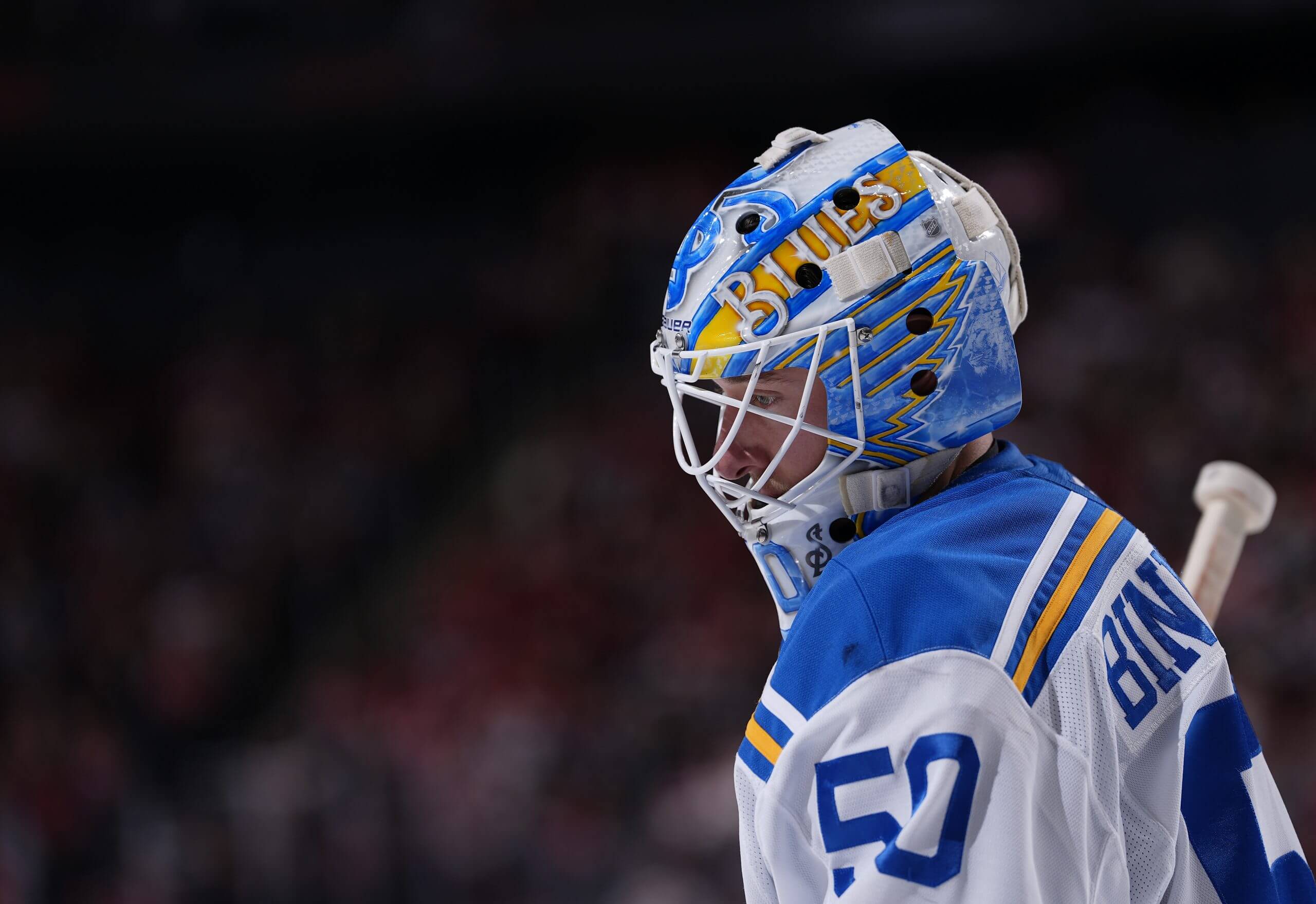
Jordan Binnington finished with the worst goals saved above expected in the NHL. (Elsa / Getty Images)
Jordan Binnington
41 games, 39 starts , 13-20-7, 3.33 GAA, .873 save percentage
Binnington had the fewest wins and the lowest save percentage of his career. According to MoneyPuck, he finished with the worst goals saved above expected in the NHL (minus-22.4) this season. There were some games where he looked like the Binnington of old, but they were few and far between, and with Joel Hofer’s solid season, the veteran lost his starting job.
Grade: D-
Joel Hofer
46 games, 43 starts , 24-13-5, 2.61 GAA, .910 save percentage
The first couple of months of the season were hard on Hofer, but beginning with an 18-save shutout over the Utah Mammoth on Nov. 29, he turned it around. From that point on, he had the third-best save percentage of any goalie with 20-plus games (.921). He finished second in the league with seven shutouts, one behind the New York Islanders’ Ilya Sorkin.
Grade: A-
CoachJim Montgomery
Record: 37-33-12
The Blues put a lot of focus on having a good start, but they did not — 3-7-2 after 12 games. Montgomery said he didn’t react well to an early-season loss (leading to a seven-game losing streak) and handled his frustrations poorly. He did shore up some areas and got the most out of young players, but offense, defense, goaltending and special teams must be better.
Grade: C-
General managerDoug Armstrong
Armstrong believed the roster he put together could be competitive, but that turned out not to be the case. He did, however, react accordingly and made the right moves at the trade deadline, accruing more assets for aging veterans. Also, under his direction, the amateur scouting staff showed that it’s doing its job well, with strong play from rookie call-ups.
Grade: C+