
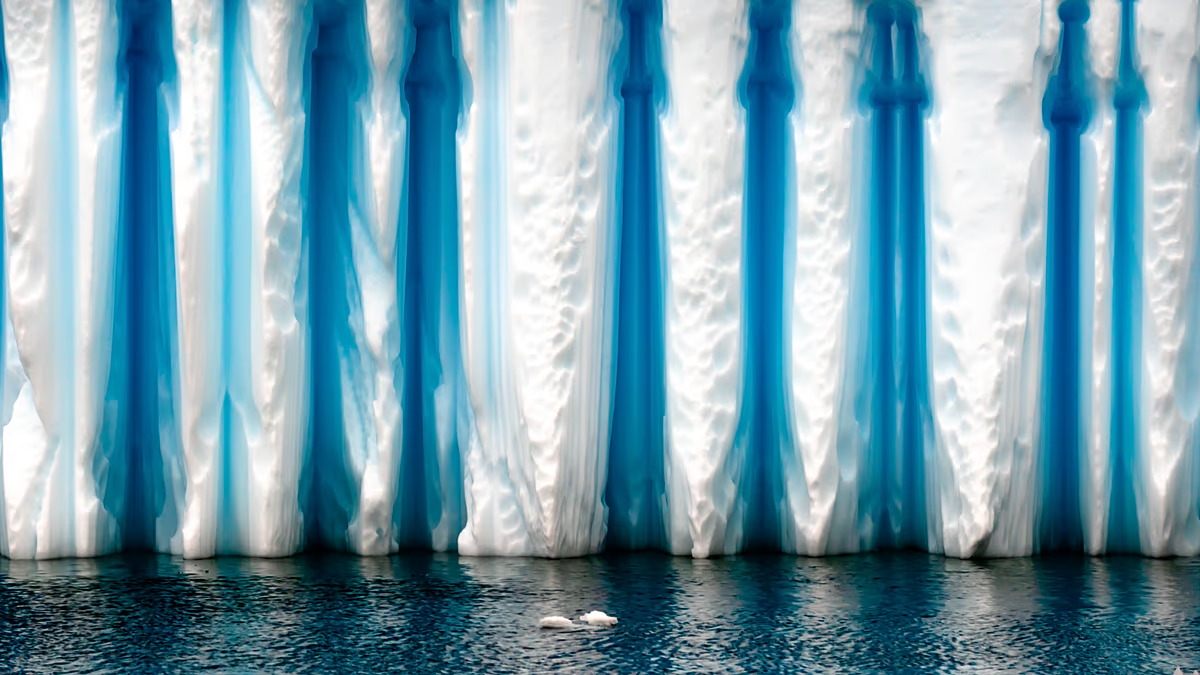
From the blue architecture of Icelandic ice caves to the flamingo-pink shores of Kenya’s Lake Magadi, photographer Jon McCormack has spent years revealing the hidden geometry of Earth’s natural systems.

ADVERTISEMENT
ADVERTISEMENT
What he has found is that they are changing faster than he can photograph them, as climate change-fuelled extreme weather wreaks havoc on natural habitats.
His new book, ‘Patterns: Art of the Natural World’, published on Earth Day 2026 (22 April), captures beauty and urgency in the same frame.
“What these images suggest is that the natural world is not random. It is structured, responsive, and deeply interconnected,” McCormack tells Euronews Earth. “When one system shifts, many others move with it.”
Living structures under pressure
The past three years – 2024, 2023 and 2025, in that order – were the hottest ever recorded globally. It marked the first time a three-year period has exceeded the 1.5°C threshold, according to Copernicus data.
“I think people underestimate the quiet systems that make the planet feel stable: ice, water, plankton, soil, forests, tidal zones, migratory cycles. They are so foundational that we tend to experience them as background rather than as living structures under pressure,” says McCormack.
Europe is suffering the effects, as the fastest-warming continent on Earth. Alpine glaciers are on track to almost disappear by the end of the century; half the continent’s wetlands have been destroyed over the past 300 years; forest damage could double by 2100, driven by wildfires and storms.
“In my book, I was often drawn to places where these systems become visible as form, where a glacier reveals its internal architecture, where a braided river writes sediment across volcanic sand, where algae turn a lake into an abstract field of colour, or where microscopic life creates extraordinary geometry,” says the Australian-born, US-based photographer.
“What makes these systems especially vulnerable now is not just warming in the abstract, but speed. Natural systems can adapt to change over long arcs of time. What they struggle with is acceleration, compression, and the layering of stress upon stress.”
‘Scenes that feel ancient reveal themselves to be alarmingly temporary’
McCormack’s work gives him a unique opportunity to document Earth’s delicate systems, mapping their change over time. He says glacial environments show some of the starkest shifts.
“When you spend time photographing ice caves, meltwater channels, and the surface structures of glaciers, you begin to understand how dynamic they already are. But in recent years, what has struck me is how quickly those structures form, destabilise, and vanish,” he says.
“In southern Iceland where I photograph ice caves… scenes that feel ancient reveal themselves to be alarmingly temporary. You see caves collapse, surfaces thin, melt patterns intensify… The pace of transformation is what stays with you. It is not theoretical. It is physical and immediate.”
Iceland has lost roughly 50 glaciers since 1890, and they continue to retreat at an accelerating rate – an average of 40 to 50 metres per year across the country. It mirrors a European-wide pattern as winter snowfall hits record lows and summer temperatures soar.
“A glacier does not simply melt; it alters water flow, habitat, temperature and timing downstream,” McCormack says.
“A forest does not simply burn; it changes regeneration cycles, soil, moisture, and the species that depend on it. Many of the patterns I photograph are beautiful, but they are also precarious. Their beauty can disguise how contingent they are, and how quickly the conditions that formed them can disappear.”
‘This is changing faster than we realise’
McCormack has also witnessed the patterns in coastal, lake and river systems appear “more volatile, more fragile than they once did”.
“What unsettled me most was not one single dramatic event, but the repeated experience of encountering environments that seemed to be losing their long-held rhythm,” he says.
“That is when the thought comes: this is changing faster than we realise. Not because the change is always spectacular, but because it is cumulative. You begin to sense that entire systems are being pushed out of the conditions that shaped them.”
The volatility that McCormack senses is reflected in the data: extreme river flooding in Europe has doubled in frequency since 1990, with central and western countries facing the most dramatic increases.
Last summer, parts of the Rhine, Danube and Po ran at historically low levels – the same rivers that flooded catastrophically just years earlier. As climate change gives rise to ever greater wet and dry extremes, the fallout of stressed natural systems bleeds into daily life from agriculture to transport.
‘Images can make climate change felt rather than simply understood’
McCormack says data is essential: “Science gives us evidence, scale, causality and clarity” on everything from retreating glaciers to biodiversity collapse and rising temperatures.
But he hopes his work can make these facts less abstract, more tangible. “Images can make climate change felt rather than simply understood… [they] can draw someone into wonder first, and then into recognition,” he says.
“That sequence matters. People tend to protect what they feel connected to, not just what they are told is in danger.”
That gap between knowing and feeling is well-documented. Despite near-universal awareness of climate change across Europe, Eurobarometer surveys consistently show that most people rank it below cost of living and job security in their personal concerns.
By connecting the complex layers of the natural world, which is “beautiful, intelligent, patterned, and under strain all at once”, McCormack wants to tell “not just a story of loss, but a story of relationship”.
“‘Patterns’ invites people to see the Earth not as scenery or backdrop, but as a living system of astonishing intricacy, one that we are part of and responsible to.”
Jon McCormack‘s book is released on Earth Day 2026 – the 56th anniversary of the annual global event, and at a moment when the natural systems he photographs are changing faster than at any point in recorded human history. All proceeds will benefit Vital Impacts, a women-led nonprofit supporting conservation storytelling worldwide.