
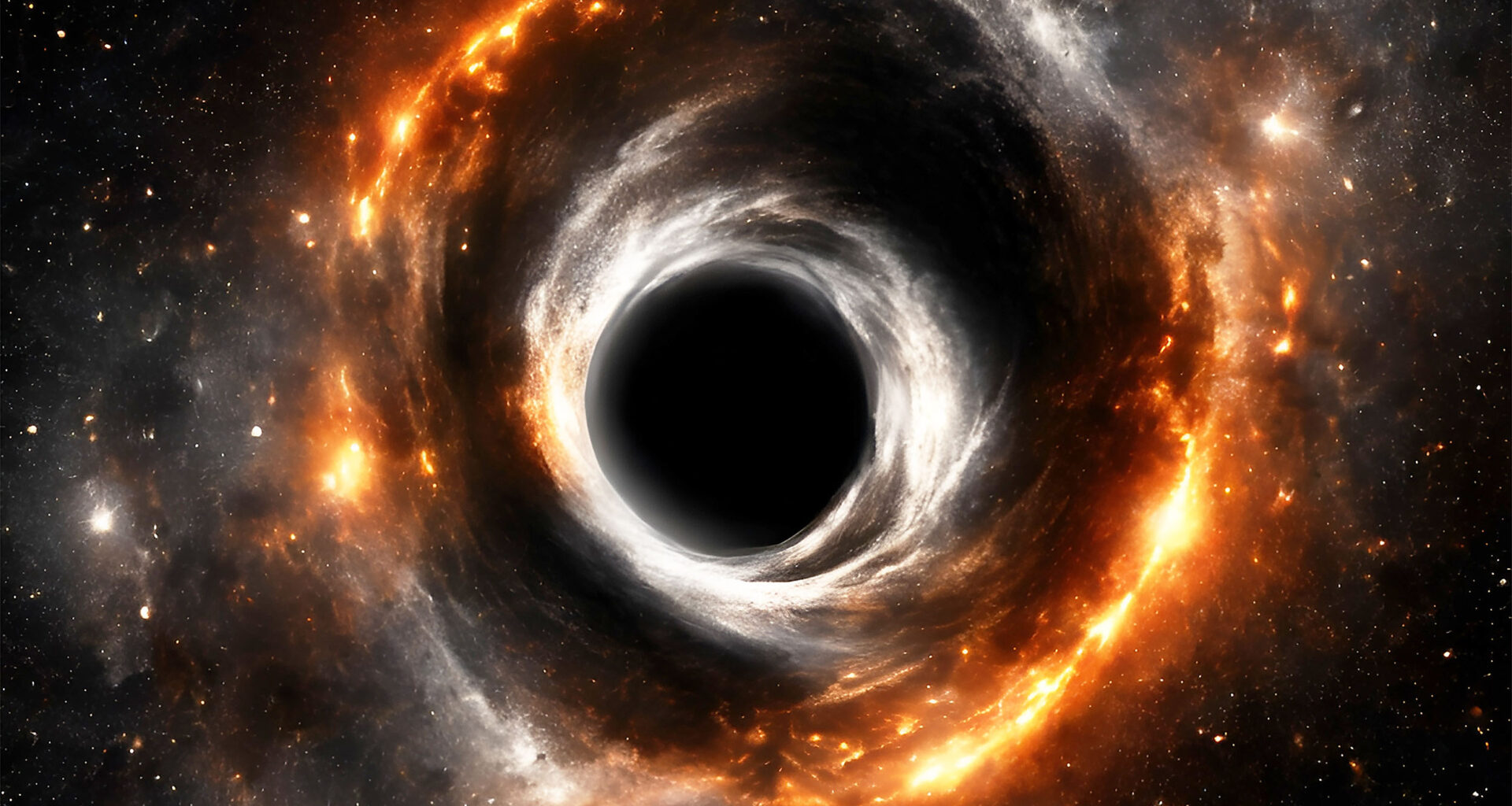
Researchers have found that black holes formed before the Big Bang could still exist today as surviving relics.
These ancient objects would carry mass and structure from an earlier cosmic phase, offering a new way to explain how galaxies formed and why unseen matter dominates them.

Within this framework, relic black holes emerge from a universe that contracted before rebounding into expansion rather than beginning from a single origin.
By tracing how structures behave across that transition, Enrique Gaztañaga at the University of Portsmouth showed that some compact objects would persist through a “cosmic bounce.”
Black holes born before the Big Bang
A cosmic bounce describes a universe that first shrinks down to an extremely small, tightly packed state, where matter is compressed to its limits.
Instead of collapsing into nothing, that compression stops and reverses, causing the universe to expand outward again into the large, growing cosmos we observe today.
Space then begins expanding again, carrying forward whatever structures managed to survive the transition.
Those survivors would not form anew after the hot beginning but instead retain properties shaped during the earlier collapse, pointing toward additional relics that could still influence the universe today.
Beyond one beginning
Standard cosmology still explains a remarkable amount about how the universe expanded and how matter spread out.
That picture also matches faint leftover light from the early universe and the broad spread of galaxies.
Planck measurements place dark matter, invisible mass seen by gravity, at about five times ordinary matter in a 13.8-billion-year-old universe.
Bounce models reopen those problems by replacing one explosive start with a collapse that turns around instead of breaking physics outright.
Where physics breaks down
In Einstein’s equations, the usual Big Bang runs backward to a singularity, a point where current physics stops making usable predictions.
Gaztañaga argued that warning sign mattered because infinities often tell physicists their description has gone past its safe range.
“Singularities often signal that our theoretical description has reached its limits,” said Prof. Gaztañaga.
His alternative lets contraction reach an extreme but finite density, then reverse before the math stops making sense.
Pressure changes everything
Near that turnaround, the model says extreme compression built quantum pressure that pushed back against further collapse.
Similar pressure already helps white dwarfs and neutron stars avoid endless squeezing, so the idea borrows a familiar stabilizing effect.
In this picture, the rebound also mimics inflation, a burst of extremely rapid early expansion, without adding a separate trigger.
Because the same setup may also connect to today’s faster expansion, the proposal tries to tackle several puzzles at once.
Some objects can’t survive
Size determines what survives the bounce, because only objects larger than about 295 feet could remain beyond the cosmic horizon and avoid being disrupted.
Objects or ripples that stay outside that limit avoid being rearranged, because forces cannot act across them during the crossing.
Calculations suggested surviving relics could include gravitational waves, ripples in spacetime, along with compact objects and dense clumps.
That broad menu matters because different survivors would leave different fingerprints in later galaxies and in the sky.
Black holes may behave as dark matter
In galaxies, relic black holes would act like the unseen mass already inferred from orbital speeds and the broad arrangement of galaxies.
If they exist in huge numbers, they would behave as dark matter because gravity does not care whether matter glows.
Unlike many particle ideas, this version would not need an undiscovered ingredient, only ancient objects surviving an earlier collapse.
Abundance is the hard part, because too few relics would explain almost nothing and too many would break existing limits.
Seeds of the first galaxies
Another payoff appears during the earliest phase of galaxy building, where preexisting black holes could give the first galaxies a head start.
Webb has already found compact red objects that often seem tied to feeding black holes, including little red dots.
“If massive black holes already existed immediately after the bounce, the early Universe would not need to start from scratch when building the first galaxies,” Gaztañaga said.
That would ease the race to explain why some enormous black holes appeared so early in cosmic history.
Signals in waiting
Evidence for a collapse phase before the Big Bang, a period when the universe was shrinking instead of expanding, would have to arrive indirectly in patterns no telescope has yet pinned down.
One target is a background of relic gravitational waves, which would preserve motion from the earlier phase.
Another is the cosmic microwave background (CMB), leftover light from the hot young universe, where subtle patterns could hold older scars.
Small effects from ancient compact objects could also bend light or stir hot gas, giving future surveys something to rule in or out.
Many questions still remain
Big claims invite hard checks, and this one depends on assumptions about how structures formed during contraction.
Those assumptions set how many relics survive, how massive they become, and whether they group together in ways astronomy would notice.
Competing ideas still explain dark matter with particles, and other models try to account for early black holes without a bounce.
“But if the Universe did experience a bounce, the dark structures shaping galaxies today could be remnants from a cosmic epoch that preceded the Big Bang,” Gaztañaga added.
Seen as a whole, the proposal turns black holes into possible messengers from before the hot beginning – not just debris from it.
Better maps of early light, compact objects, and gravitational waves will decide whether this idea stays provocative or becomes useful.
The study is published in the journal Physical Review D.
—–
Like what you read? Subscribe to our newsletter for engaging articles, exclusive content, and the latest updates.
Check us out on EarthSnap, a free app brought to you by Eric Ralls and Earth.com.
—–