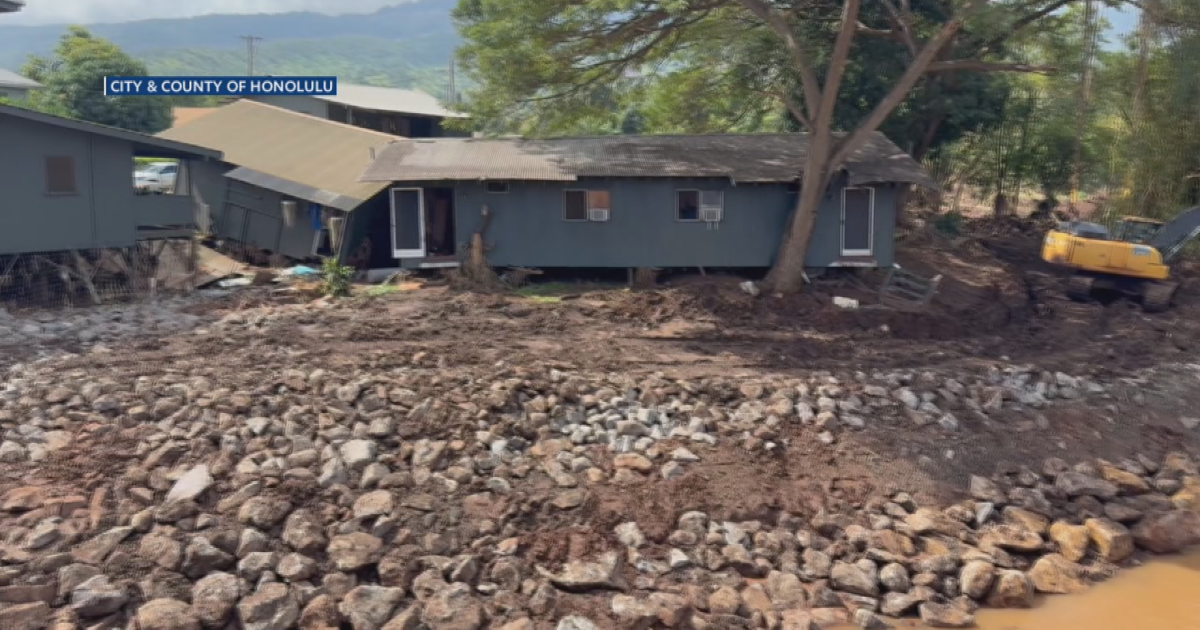
There has been recovery and relief efforts across the island following recent storms, but there’s another impact that isn’t as visible. The mental health toll from this devastation is something experts say could affect many people in the weeks and months ahead.
HONOLULU (Island News) — The physical damage from the recent storms is easy to see…
But the emotional toll is often harder to recognize.
“We learned a lot from the Maui fires, and it was a big tragedy. And we noticed that a lot of people who struggled with that, they didn’t see symptoms right away,” said Kumi Macdonald, the Executive Director at NAMI Hawaii
Mental health professionals fear a similar outcome in weeks and months following the historic flooding.
“We did see a little bit of an uptick in asking for help,” said Macdonald.
She continued, “What we’ve noticed is that a lot of people who have the fires, who experience that, and then they experience the heavy rains. It retriggered some of the old memories of the trauma.”
That trauma can look different for everyone.
“We noticed that some people are being more aware that they have a lot more anxiety, they’re having a lot less sleep. They’re a little bit more agitated,” said Macdonald.
And it’s not just adults.
“There’s a lot of high emotions. There are even some signs of PTSD; when any type of rain falls, there are kids saying, ‘Mom, I think we need to go.’ And these are young children, so there are going to be some long-term effects,” said Joey Cadiz, a kalo farmer.
Experts said repeated disasters can compound stress, especially for those already under pressure.
“The Kona Low storms, that’s an acute stressor on top of the chronic burden and stressors that they’re already having to navigate through. So it’s just compounding and making it so much more challenging for our farmers and agriculture producers or ranchers or fisheries,” said Thao Le, a professor at the University of Hawaii, Department of Family Consumer Sciences.
And the warning signs aren’t always obvious.
“Anything excessive, that’s what you’re going to be looking for, something out of the ordinary. So if you’re excessively eating or excessively not eating, if you’re excessively worried, excessively sad or even excessively happy, anything of excess, something that’s out of the ordinary,” said Macdonald.
But support systems can make all the difference.
“When we go through a traumatic experience, if we have support, if we have somebody near us, it doesn’t affect us as much, or sometimes it doesn’t even stick with us as a trauma, you know, just a distant memory,” said Macdonald.
Because for many, the hardest moments haven’t come yet.
“Right now, they’re just trying to survive. They’re trying to clean up, trying to get their life back on track, and when things get kind of normalized, that’s sometimes when it pops up. So it could be several months to half a year, but we know that people are struggling,” said Macdonald.
And as simple as it sounds, reaching out matters.
“If you’re not feeling well, go to your friend, go to a counselor, if you have one, talk to your teacher, talk to your parents, your community,” said Macdonald.
Because sometimes, even the sound of rain can bring it all back.
If you or someone you know is struggling, you can call or text 988 for support.