
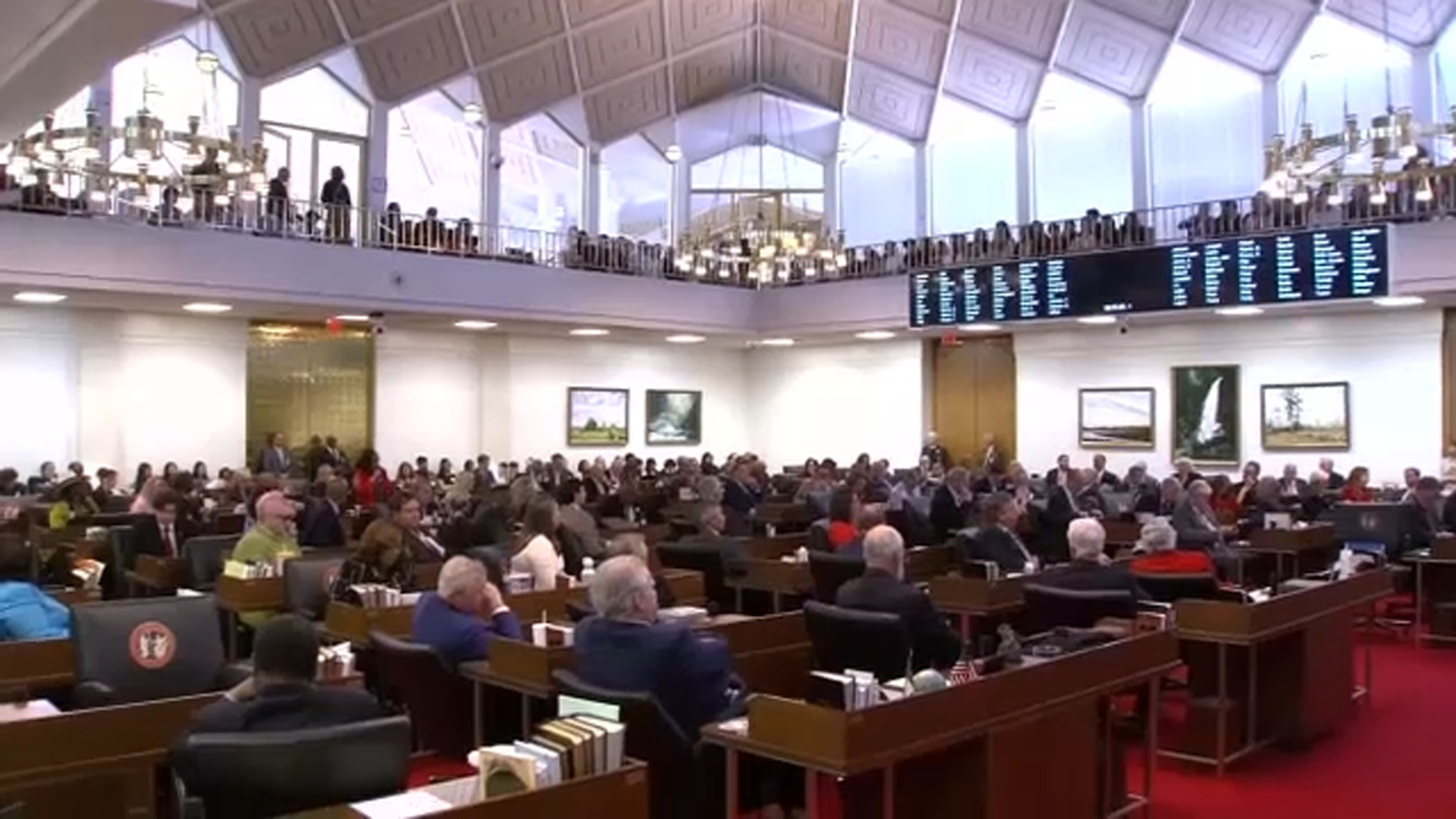
RALEIGH, N.C. (WTVD) — The North Carolina House moved forward on a key funding measure Wednesday after legislative leaders in both chambers announced an agreement to fund the Medicaid Rebase, money intended to keep pace with rising health care costs and enrollment.
On Wednesday afternoon, the Senate approved the bill following months of debate about rising enrollment and increasing costs.
The vote was 48-1. Sen. Michael Garrett, D-Guilford, was the lone vote against the bill.
The agreement came after extensive negotiations between House and Senate Health Care committee chairs to address the Medicaid rebase funding needs and determine ways to address costs.
“We cannot continue to throw dollars at a program without making changes to protect taxpayers and ensure the North Carolinians who truly need Medicaid can get care,” said Sen. Benton Sawrey, R-Johnston, chair of the Senate Health Care Committee. “Republicans in the General Assembly are taking fraud, waste, and abuse at all levels seriously, and this deal provides us an avenue to keep the program running while examining the reasons for the exorbitant cost increases.”
The new version of House Bill 696 includes $319 million to fund the state’s Medicaid program, and includes provisions to:
Implement federally required work requirements and six-month redeterminations for current Medicaid expansion beneficiaries and applicantsLimit the use of self-attestation as the sole evidence of eligibility for Medicaid or SNAPPrevent people who are here illegally from receiving benefitsFund a performance audit of the North Carolina Medicaid program and the NCWorks Career Centers Provide tools for managed care organizations to more effectively manage beneficiary care by addressing fraud, implementing utilization management, and improving the overall quality of careDirect the DHHS to develop a plan to achieve further cost savings and efficiency measures in the Medicaid programStrengthen protections for children with autism spectrum disorder receiving Applied Behavior Analysis (ABA) therapy on MedicaidRequire providers to ensure high-quality standards and appropriate services for youth in our state by adding guardrails on who can provide these services and how they are delivered. It also ensures each beneficiary has an individualized care plan that includes parental involvement.
“(The provisions are) largely revolving around getting our hands around the cost because the way that the costs have increased under Medicaid, really over the course of time, but especially the last year or two years, it’s just not sustainable at the end of the day,” said House Speaker Destin Hall on Tuesday.
The $319 million would cover Medicaid expenses through June. State health officials say that amount is needed to keep pace with higher-than-expected participation and healthcare costs.
The agreement was announced the same day Gov. Josh Stein released his budget proposal, which also called for fully funding Medicaid.
The bill includes several provisions aimed at addressing alleged waste, fraud, and abuse in the Medicaid program. Those measures were a major focus of a lengthy hearing at the legislature last week, during which Attorney General Jeff Jackson and Department of Health and Human Services Secretary Kody Kinsley were questioned by lawmakers.
“It’s unrealistic to believe that we should just pour more money into a program without making sure it’s performing as well as it can,” said Sen. Amy Galey, R-Alamance, chair of the Senate Health Committee. “Putting these measures in place will help us create a more efficient, cost-effective Medicaid program that delivers better outcomes for patients.”
The legislation would allow for a potential audit of the Medicaid program by State Auditor Dave Boliek and would make changes to the Medicaid renewal process.
House Democrats said fully funding Medicaid remains their top healthcare priority, particularly to protect Medicaid expansion.
“House Democrats’ top priority in the healthcare space is making Medicaid whole,” said Rep. Cynthia Ball, D-Wake. “Ensuring that it continues to provide the life-saving coverage people rely on and protecting the years-long effort to expand Medicaid that now covers about 700,000 North Carolinians.”
On Wednesday, Medicaid recipients and family members of beneficiaries responded to the funding.
“I think relief was definitely the first emotion that hit me,” said Jonathan D’Angelo, who serves as Chair of the North Carolina Council on Developmental Disabilities.
D’Angelo was born with a neuromuscular condition. He is one of more than 3 million North Carolinians who use Medicaid and has spoken directly with state lawmakers about the program’s importance.
“For people with disabilities, Medicaid is absolutely a lifeblood. It provides services no other payer pays for. For me, I need help with almost all of my activities and daily living. Getting out of bed, getting dressed, getting in the shower. going to the doctor,” he said.
Jenny Hobbs, a mother of three whose children utilized Medicaid, also spoke of the importance of the coverage.
“It’s helped with medications, with surgeries, hospitalizations, all of those things that really would have bankrupted our family because of the high cost of insurance premiums and then the deductible and out-of-pocket expenses. Medicaid is sort of that bridge to help us where we needed it so that we could continue to keep our kids at home with us and let them lead as much of a normal childhood as they could,” Hobbs said.
Betsy MacMichael, another mother, said Medicaid has been vital for her daughter, Janie Desmond.
“There are other secondary economic consequences to the family care providers that even when someone does have services, there’s a fair amount of investment that family does have to do,” MacMichael said. “And we’re happy to do that, but without Medicaid services and that health insurance, it would be impossible. Just last week, Janie had two MRI’s. The week before (she had a ) nerve and muscle conduction test. These are all the different specialist — neuro-ophthalmologist, geneticist, urologist. We’re all kind of, in partnership, and it works well. Without services, I’m not honestly sure what we would do.”
MacMichael and Desmond spoke with ABC11 on Wednesday afternoon from the daughter’s home in Durham, where she has lived independently for a decade.
“I love (the freedom),” said Desmond, who has KAND, a rare neurodegenerative disorder.
Desmond is also able to work, in part thanks to assistance from support staff made possible through Medicaid.
“For many of us, providing these services is cheaper than the alternative,” said D’Angelo, who works as a program manager in the software industry. “It would be much more expensive for some might need to be in a nursing home vs. in my own home, where I have a job. I pay taxes. Enabling people to be fully productive members of society is incredibly important.”
Though the funding agreement has been welcomed, advocates are hopeful for further action to sustain the program in the years ahead.
“For people to stay alive and be able to contribute to the community and do the best they can given their own particular challenges, we really need Medicaid long term,” MacMichael said.
Rhaegan Jackson, who serves as Director of Health Access with the North Carolina Alliance for Health, added, “While it’s great that we have a funding mechanism for the remaining money that we need for our Medicaid program, we still have a lot more work to do. So that was only for the 2025- 2026 fiscal year, so now we’re looking at 2026-2027. And traditionally, that’ll go in a state budget. We’ll need to push for that.”
In addition to the healthcare aspect, the bill also contains other funding, including:
$1 million nonrecurring to cover the remainder of the 2025-26 school year scholarship awards for students receiving the Children of Wartime Veterans Scholarship$10 million recurring in fiscal year 2026-27 for the Children of Wartime Veterans Scholarship program$80 million nonrecurring for the Department of Adult Correction$2.5 million recurring and $1.2 million nonrecurring for the State Bureau of Investigation$165,000 nonrecurring to maintain and operate the Business Court’s current case management software$13.1 million recurring and $8.5 million nonrecurring for the Division of Motor Vehicles
“North Carolinians across the state who rely on Medicaid should rest assured that the General Assembly is committed to making sure the program prioritizes care for residents, not its bureaucracy,” said Sen. Jim Burgin, R-Harnett, chair of the Senate Health Committee. “I’m encouraged by the Department’s willingness to work with the General Assembly to keep costs down.”
In a statement, a spokesperson for NCDHHS wrote: “We appreciate the North Carolina General Assembly’s commitment to fully funding NC Medicaid for the current year. We will continue working with lawmakers to ensure efforts protect and strengthen access to care for all North Carolinians.”
A final vote on the bill is expected next week.
Copyright © 2026 WTVD-TV. All Rights Reserved.