
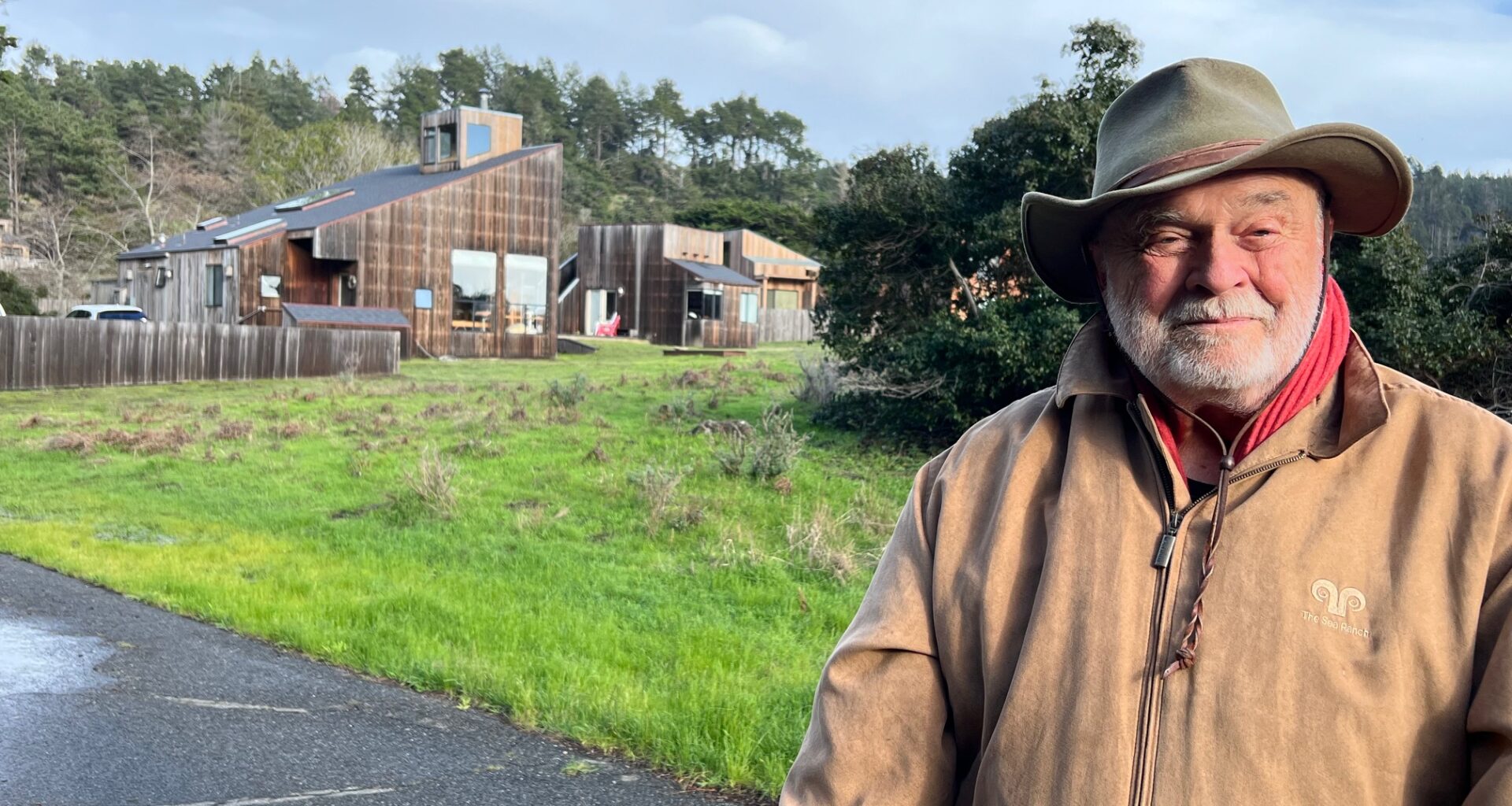
Donlyn Lyndon stands outside the house he designed for himself and his wife at the Sea Ranch, one of several homes he created in the famed coastal Sonoma County community.
Marisa Macklin
A home with sweeping coastal views at the Sea Ranch in Sonoma County on Dec. 19, 1989.
Chris Stewart/S.F. Chronicle file photo
The “Malibu Wall,” a stand of closely packed homes at the Sea Ranch, on Dec. 19, 1989.
Chris Stewart/S.F. Chronicle file photo
The cover of Donlyn Lyndon’s book “The Sea Ranch,” first published in 2004, reflects the coastal landscape and design philosophy that defined the iconic Sonoma County community.
Jim Alinder/Princeton Architectural Press
Donlyn Lyndon walks Rhumba, his wife Alice’s guide dog, at the Sea Ranch.
Courtesy of Laura Lyndon
The Donlyn Lyndon-designed Sea Ranch home known as the Lightbox uses glass, wood and careful siting to draw in light and frame sweeping views of the Pacific Ocean.
Courtesy of Maynard Hale Lyndon
Donlyn Lyndon in the 1980s.
Courtesy of UC Berkeley
Donlyn Lyndon in a recent photo.
Courtesy of Maynard Hale LyndonDonlyn Lyndon, a key architect behind the iconic Sea Ranch community, died at age 90 at his home there in April.Lyndon designed several notable homes at Sea Ranch and served as a longtime professor at UC Berkeley, influencing generations of Bay Area architects.The Sea Ranch now features about 2,000 homes, all with natural, unpainted exteriors, reflecting the original design principles Lyndon helped establish.
Donlyn Lyndon’s Berkeley architectural firm had been in business for about an hour, he liked to say, when business walked in the door that would shape his practice for the next 60 years.
The prospective client was the developer of 10 miles of craggy California coastline in Sonoma County. The job, pitched to Lyndon and his fellow partners from architecture school at Princeton in the early 1960s, was to design a condominium complex on a former sheep ranch that would serve as a prototype and showcase for all future construction at an ecocentric vacation home project to be called the Sea Ranch.
Article continues below this ad
That first big commission to the firm Moore Lyndon Turnbull Whitaker, or MLTW, opened on a bluff above the Pacific Ocean in 1965, and was on its way to multiple prestigious design and architecture awards, including listing on the National Register of Historic Places. It is known internationally for design elements including sloping rooflines that follow the hillside, as well as use of redwood and other natural, unpainted materials.
Lyndon himself occupied Unit One in Condominium One, which was supposed to be followed by Condominiums Two through Nine. But the idea of clustering residential units together to “live lightly on the land,” as the saying went, ran into the economic reality of buyer preferences in the vacation real estate market. Condo construction ended with Condominium Two, as most demand was for individual homes that fit into a naturalistic landscape master plan that emphasized common outdoor space.
The use of natural, unpainted materials is a hallmark of homes in the Sea Ranch community.
Jim Alinder/Princeton Architectural Press
Among several thousand stand-alone homes built at the Sea Ranch, Lyndon designed nine, including one for his brother and one for himself after he moved out of Condominium One. Along the way, he outlived the developer who hired him; Al Boeke of Oceanic Properties; the lead landscape architect, Lawrence Halprin; the Sea Ranch Store designer, Joe Esherick; and the graphic and logo designer, Bobbie Stuffacher Solomon. Lyndon also outlived his partners at MLTW, Charles Moore, William Turnbull Jr. and Richard Whitaker.
San Francisco Chronicle Logo
Make us a Preferred Source to get more of our news when you search.
Add Preferred Source
This gave him the distinction of being the last living member of the original design team — the Sage of the Sea Ranch. He wrote the text for a coffee table book titled “The Sea Ranch” that was published by Princeton Architectural Press in 2004, and revised in a 2014 edition marking the community’s 50th anniversary.
Article continues below this ad
Lyndon ended up moving from Berkeley to the Sea Ranch full time in 2022. He had two homes under construction at the Sea Ranch that he had designed for clients in collaboration with a younger architect, and he was still at work, visiting his projects and getting out of the car to walk around and feel the site. He died April 5, at age 90, at home at the Sea Ranch — just six weeks after his wife of 62 years, photographer and sculptor Alice Wingwall, died there, also at age 90.
Architect Donlyn Lyndon and his wife, photographer and sculptor Alice Wingwall, at the Sea Ranch in 2025.
Courtesy of Susan Quinn
Lyndon died of natural causes, said his son, Andrew Lyndon, who noted that his father’s health declined rapidly after the death of his wife.
“My dad was a poet architect, or a thinker architect,” said Andrew, a fine arts painter. “He thought about base and light and how it would work relative to the landscape. He was a great architect of windows. He used intuitive window placement and sizing that feels entirely organic.”
Lyndon was also a rigorous academic who served stints as head of the architecture schools at both the University of Oregon and Massachusetts Institute of Technology. His longest tenure was at UC Berkeley, where he taught for a total of 30 years before retiring in 2004.
Article continues below this ad
“Donlyn was an example of someone who had one foot in academia and one foot in practice at all times, which gave him the authority and ability to inform his teaching with his practice and inform his practice with his teaching,” said Renee Chow, dean of the College of Environmental Design at UC Berkeley. “He extended a very important legacy that people describe as the legacy of ‘place.’ As an architect, you recognize what is unique about a landscape and its geography and you work within that, not apart from that.”
Lyndon published his concepts both in an architectural journal he co-founded and edited for 25 years — Places: Forum of Design for the Public Realm — and in a field guide, “Place at the Sea Ranch,” published in 2020. He also practiced them every day on his two-mile walk up College Avenue from his home, in the leafy Elmwood District of South Berkeley, to work at Wurster Hall on campus, and again on the way back.
Architectural historian Dan Gregory, who was a teaching assistant for Lyndon in his urban studies course at Berkeley, described him as a “place whisperer” in a memorial essay for the College of Environmental Design newsletter.
Donlyn Lyndon in one of the units at Condominium One at the Sea Ranch.
Courtesy of Susan Quinn
“He was a remarkable observer with an omnivorous curiosity about the world, and in his teaching and writing was adept at unraveling the complex patterns that structure the natural and built environments,” wrote Gregory, former home editor for Sunset magazine in Menlo Park. “He found ways to knit those patterns into memorable environmental designs.”
Article continues below this ad
Donlyn Lyndon was born Jan. 7, 1936, in Detroit. His father, Maynard Lyndon, was a modernist architect who made up the first name Donlyn so that his full name would form what Donlyn liked to call a “syllabic palindrome” — pronounced the same forward and backward. He embraced it and did not like being called Don for short.
Donlyn’s parents divorced when he was young, and Maynard Lyndon moved to Southern California, where he developed a reputation for the modernist designs of public school buildings including Juan Cabrillo Elementary School and Point Dume Marine Science School, both in Malibu, and Bunch Hall at UCLA. Lyndon stayed in Detroit with his mother, Dorothy, who was a public schoolteacher.
Donlyn earned a scholarship to Princeton University, where he received his bachelor’s degree in architecture in 1957 and his master’s in the same field in 1959. He then won a Fulbright scholarship to photograph ancient temples in Japan and India for the architectural library at Princeton. He persuaded his younger brother, Maynard Hale, to take a semester off college and join him traveling the country in 1960.
“It was a wonderful bonding experience for us,” said Maynard, an industrial designer who founded a chain of retail stores called Placewares to emphasize the familial sense of place. The store, with seven locations, was a spinoff from Design Research, another retailer with an outlet in the clock tower at Ghirardelli Square.
Upon his return, Lyndon moved to California to set up MLTW with his Princeton friends Moore, Turnbull and Whitaker, who was a teaching assistant for Halprin at UC Berkeley. In 1960, Lyndon got a job there himself as an instructor in the architecture school, where he met his future wife, Alice Wingwall, who had a job sorting the slides to be projected during lectures. They were married on Dec. 28, 1963, at the Swedenborgian Church in Pacific Heights, San Francisco.
Article continues below this ad
Alice Wingwall and Donlyn Lyndon atop the Lyon Street steps in San Francisco, around the time of their wedding in 1964.
Courtesy of the Lyndon family
By then, Lyndon had risen from instructor to assistant professor, and MLTW was at work on the Sea Ranch condominium project. As it was being completed in 1965, Lyndon wrote an article titled “Sea Ranch: the Process of Design,” published in the book “World Architecture 2,” by a London printing house.
The renown helped him get hired away from Berkeley by the University of Oregon, which elevated him to associate professor and head of the architecture department. In 1967 he was hired away again, by MIT, which also made him head of the architecture department, a position he held until 1978, when he returned to UC Berkeley as a full professor.
He and his wife purchased a house on Russell Street in the Elmwood neighborhood, and raised three kids — Andrew, Laura and Audrey. The dinner-table conversation was rigorous.
“Every day you had to describe what you were studying,” said Andrew. “He was teaching us how to think and how to analyze and how to notice the differences between houses.”
The rigors paid off. All three Lyndon children became academic deans — Andrew as dean of Fine Arts at California College of the Arts, Audrey at the College of Nursing at New York University, and Laura at the Wright Institute, a graduate school of psychology in Berkeley.
Their father set a standard as the inaugural holder of the Eva Li endowed professorship at UC Berkeley. In 1997, he was awarded the Topaz Medallion, the highest honor in architectural education, issued by the American Institute of Architects and the Association of Collegiate Schools of Architecture.
An interior of a home in the Sea Ranch community.
Jim Alinder/Princeton Architectural Press
It was among a list of honors and awards that ran to five typed pages on his CV, topped by the Distinguished Architect Award by the Sea Ranch Association, bestowed in 2022, the year he and Alice had sold their Elmwood home and moved to the Sea Ranch full time. By then Alice was blind from a degenerative eye disease.
Architect Mary Griffin, Turnbull’s widow, made the presentation at the Del Mar Center.
“Donlyn became the advocate for the original principles and vision of the Sea Ranch, and it was his book that cemented it,” said Griffin, a member of the Sea Ranch Design Committee. “He was there from the beginning, and he came back to it. Everything he did in the last decades of his life was tied to the Sea Ranch.”
The Sea Ranch is now mostly built out with about 2,000 homes, none of which have painted exteriors. The dozen or so designed by Lyndon, some with MLTW and some with a subsequent partner, Marvin Buchanan, all have vertical redwood siding or cedar shingles, unstained.
The Sea Ranch home of Maynard and Lu Lyndon, nicknamed the Lightbox, was designed by Maynard’s brother, architect Donlyn Lyndon, to frame light and ocean views within the landscape.
Courtesy of Maynard Hale Lyndon
The best examples are his own home in the Sea Ranch, built in 1991, and the one he designed for his brother Maynard on a lot three doors down, built in 1999. For that project, the brothers mapped out the floor plan while vacationing at a 16th century villa near Venice, Italy, drawing on it for inspiration.
The house, which they nicknamed “the Lightbox,” appeared in many architectural journals, and in Lyndon’s book, with photographs by Jim Alinder.
Sited on a bluff, the Lightbox is oriented so that from the front porch a visitor can look through the glass front door, through the house and out the glass back door to the ocean beyond.
Maynard and his wife, Lu, lived in that house full time before selling it in 2024 and moving to Healdsburg in retirement.
“We miss that place every day,” said Lu Lyndon. “We would wake up in the morning and there would be sun on one side of the house, and during the day the sun would go around the house and set on the other side, and we could watch it every step of the way.”