
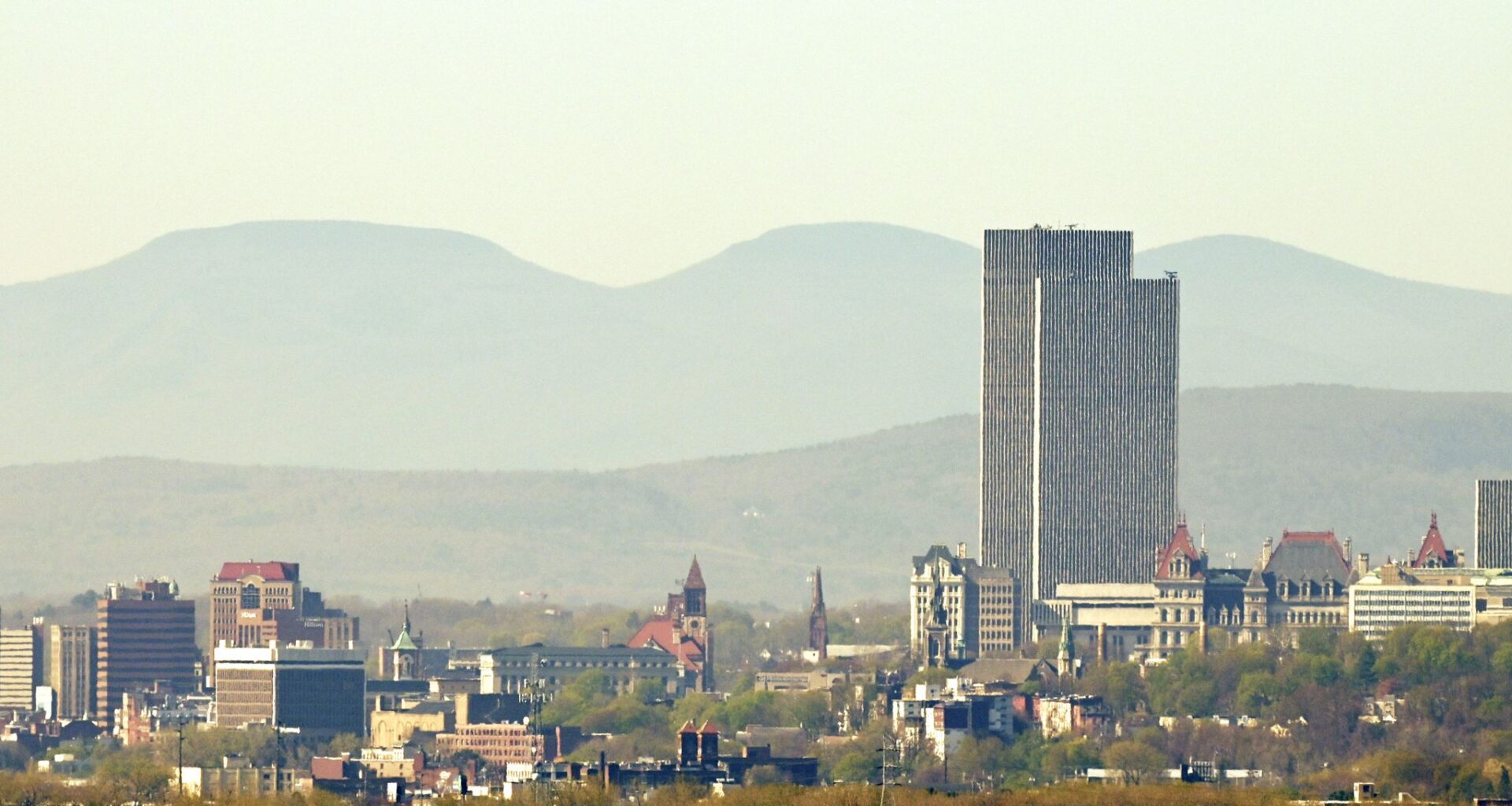
A hazy view of the Albany city skyline is seen from Prospect Park in Troy on Thursday. The American Lung Association’s “State of the Air” report found that the Albany area’s air quality has slipped, thanks to pollution spikes. (Will Waldron/Times Union)
Will Waldron/Times Union
A hazy view of the Albany city skyline is seen from Troy’s Prospect Park on Thursday. (Will Waldron/Times Union)
Will Waldron/Times Union
ALBANY — Despite improvements in overall air quality, the Capital Region continued to see worsening spikes of hazy air, according to the latest “State of the Air” report from the American Lung Association.

The annual report ranked the Albany-Schenectady metro area 69th-worst in the nation for short-term particle pollution — a decline from last year’s 73rd-place ranking despite an unchanged average of 2.8 unhealthy air days annually. It placed 171st for year-round particle levels, also worse than last year’s 180th-place ranking, though still considered a “passing grade.” For ozone pollution, the region ranked 143rd, slipping from 149th last year, even as the average held steady at 0.7 unhealthy days per year.
Article continues below this ad
The report data show slight variations over the past decade for ozone pollution and annual particle pollution concentrations, after marked improvements from the late 1990s to around 2010, especially for ozone pollution. The more striking change in recent years can be seen in data for 24-hour, or short-term, particle pollution, which has crept up from 0 unhealthy days — where it sat from 2012 to 2019 — to its current 2.8 days.
“We basically have a B, a D and a passing grade, which is moving in the right direction,” Michael Seilback, assistant vice president of nationwide advocacy and state public policy for the American Lung Association, said.
Seilback said a region’s air quality is determined by the worst reading from a monitor in that area. In the 10-county region making up the Albany-Schenectady metro area, that monitor is in Albany County, he said. Readings are ranked against 278 other areas.
Make the Times Union a Preferred Source on Google to see more of our journalism when you search.
Add Preferred Source
The rankings reflect the dramatic improvement in air quality resulting from stronger state and federal regulations on emissions and other air pollutants over the last few decades, Seilback said. But spikes in particle pollution, such as from wildfire smoke, wood-burning stoves or power plants, are worsening. Climate change is one factor. Not only does it increase the likelihood of ground ozone, or smog, due to warmer weather, it has also increased wildfire risk, he said.
Article continues below this ad
“Back in June 2023, we all remember when the sky turned orange,” he said. “I think all of us thought that was a once-in-a-lifetime thing; unfortunately, that may not be.”
Air quality and its health impacts can have a number of complicating factors, explained Shao Lin, chair and professor at the Department of Environmental Health Sciences at the University at Albany. Social demographics and income can influence health risk, and even a thunderstorm can change how pollutants spread.
“We need to control for all other variables,” she said. “We should look at all the other pollutants and weather patterns and the community factors.”
Ozone and fine particulate matter, known as PM2.5, are both associated with health effects such as asthma, chronic obstructive pulmonary disease and other cardiovascular diseases. Seilback compared breathing in ozone to “getting a sunburn on your lung tissue.” Less attention is paid to ultrafine particles, or PM0.1, which may pose an even greater risk and are not as closely monitored, Lin said. Studies have linked them to increased risk for stroke, heart disease, diabetes, kidney disease and even depression — particularly because they are small enough to enter the bloodstream or cross the blood-brain barrier.
Article continues below this ad
“We need to maintain strong policies,” Seilback said. “Unfortunately, decisions that are happening in D.C. and being considered in Albany are absolutely a threat to New Yorkers.”
In March, the federal Environmental Protection Agency announced its “biggest deregulatory action in U.S. history,” reconsidering regulations on power plants, the oil and gas industry, greenhouse gas emission reporting, and other emission standards. Seilback was also critical of Gov. Kathy Hochul’s urging the state Legislature to extend the greenhouse gas reduction deadlines of the 2019 Climate Leadership and Community Protection Act.
Hochul has said the act’s goals need to be adjusted to avoid a spike in utility costs. In an opinion piece Thursday in the Times Union, she wrote the Climate Act’s timeline “no longer matches our current economic, political or energy reality.”
Article continues below this ad