
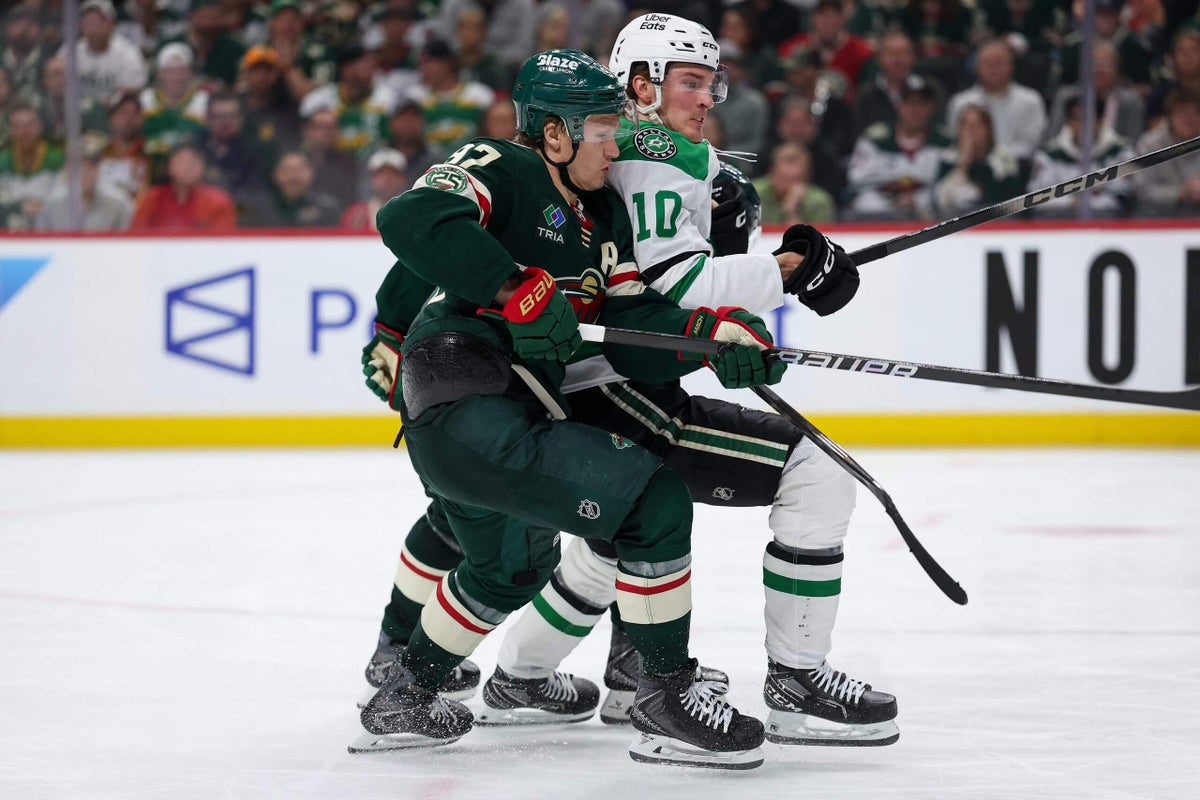
ST. PAUL, Minn. — Is this 2023 all over again?
In a series the Minnesota Wild look right on par with the Dallas Stars, Kirill Kaprizov once again can’t get going, the Wild once again keep parading to the penalty box, they are once again hemorrhaging on the penalty kill, and their power play once again smells like a beer league locker room.
Coach John Hynes is suddenly facing the same questions that an exasperated Dean Evason did during the Wild’s series with their arch nemesis three years ago.
As he was being peppered during Thursday’s off-day availability about how the Wild can get Kaprizov going, line combinations and potential personnel changes heading into Saturday’s Game 4, Hynes interrupted and said: “The priority today is the special teams.
“That’s the priority this morning. We’ve been meeting for a while. We’re on it.”
If they’re not, if the coaches don’t find fixes and the players don’t find ways to execute better in critical situations, the win-now Wild, who gave up the farm for Quinn Hughes in December, are in dire risk of a ninth consecutive first-round exit and premature offseason.
Because if Marcus Foligno truly believes the Stars can’t “hang” with the Wild at five-on-five, the Wild certainly have shown they can’t hang with the Stars on special teams.
Saturday, we gave you a laundry list of reasons this year could be different from 2023.
Six days later, here’s a laundry list of what needs to change if it is going to be.
1. Get Kaprizov going
Whether Mats Zuccarello plays in Game 4 or not — Hynes had his fingers crossed Thursday — the Wild simply have to get Kaprizov going.
After a 3-point night Game 1, Kaprizov has just 1 point in the past two games. He mustered only two shots on goal in Wednesday’s 4-3 double overtime loss, and that included being part of seven power plays. Kaprizov has six shots on goal in the series, just two more than Jared Spurgeon and Jonas Brodin.
Not good enough.
Kaprizov has the kind of talent and drive to take over a series. But he hasn’t been nearly as noticeable as fellow star Matt Boldy, who has 17 shots on goal in the first three games. It doesn’t help that the Wild have struggled to find the right mix on Kaprizov’s line, first going with Vladimir Tarasenko (didn’t work), then Bobby Brink.
Kaprizov’s chemistry with Zuccarello is special, but he has been sorely dependent on his buddy to produce. It’s on Hynes now to figure out how to get more out of him. Is it on Kaprizov or his linemates?
“I think it’s a combo. It’s never one thing,” Hynes said. “I think that there’s some things in Kirill’s game that we talk with him about that I think that can be a little bit better. But I also think it’s not all on one player, either. It usually winds up being a combination of things.”
The Wild could go with Boldy, Kaprizov and Joel Eriksson Ek, as they did for short stretches in Game 3, with the trio out-attempting the Stars 5-1 in 4:30 of five-on-five play. The Kaprizov-Ryan Hartman-Brink line wasn’t bad analytically, out-attempting Dallas 9-4 in five-on-five play. It didn’t help that Hartman won just five of 21 faceoffs, which isn’t likely to happen often. The Wild could try inserting rookie Hunter Haight on that line at center or the right wing. The brass was impressed with the second-year pro’s play in recent call-ups. He has speed, skill and a knack for puck retrieval.
But it feels like most of this is on Kaprizov. He needs to get back to his identity: a relentless puck-battle hound and play-driver, and a four-time 40-goal scorer. He’s about to become the highest-paid player in NHL history, with a $17 million average annual value next season, so this won’t be the last time the spotlight shines on him.
Dallas’ bottom six hasn’t produced in the series. But Dallas’ stars have — Wyatt Johnston, Jason Robertson, Mikko Rantanen and Matt Duchene. The Wild’s bottom six need to catch up.
2. Fix the power play
A 38-year-old Zuccarello being out of the lineup is no excuse for the power play to be as absolutely inefficient as it was Wednesday night into Thursday morning.
Despite nearly 14 minutes of power-play time, the Wild had seven shots on goal on seven power plays (six scoreless ones) and one measly high-danger chance, good for 0.78 expected goals, per Natural Stat Trick.
For a power play that has Kaprizov, Boldy, Eriksson Ek and Quinn Hughes (Boldy missed one in the trainer’s room), those are incredible numbers, particularly when they had two chances to turn a 3-2 lead into a 4-2 lead in the third period and three chances to break a 3-3 tie in the third period, overtime and double overtime.
The biggest lost opportunity came in overtime, when the Wild wasted a chance to isolate Radek Faksa when he was without a broken stick. The Wild also had no one-timer option with Brink playing the bumper at times and Tarasenko ineffective in the first period and Hartman the game before that.
“Usually when the power play struggles, it’s a couple things,” Hynes said. “One is, faceoffs are always critical. Execution and decision-making is important when plays are available and when plays are not. And the pace in which we play with on the power play, and going through it in detail today, the execution was not what it needed to be. I think puck recoveries need to be better.
“But then there are opportunities that we did not take, and to me, that’s some decision-making and some structural things that need to be better. From what I’ve reviewed so far and digging into it, that was the issue.”
The Wild scored three power-play goals in the teams’ final regular-season meeting, two by Kaprizov. They scored two power-play goals in Game 1, both by Eriksson Ek.
Marcus Johansson scored in the first period Wednesday, but the Wild did a terrible job generating chances from in front of the net. In fact, according to Sportlogiq, the Wild had no shots from the house in any situation in the game.
Sometimes simplifying is key. Just look at Miro Heiskanen’s shot on Johnston’s winning power-play goal. It was a simple shot from the middle of the point. Hughes needs to do more of that rather than always looking to make the extra play or deke defenders out of their skates with puck-handling shimmies to create seams.
Now, Kaprizov hit the post. So did Boldy. As Hynes said, they get two there, we’re not having this discussion.
But they didn’t, and the Wild lost because their power play failed dramatically.
So we’ll see if there are personnel changes Saturday if Zuccarello can’t play, like perhaps getting right-shot Brock Faber onto the power play.
3. Stay out of the box
Hynes approached rookie Danila Yurov after the double-overtime loss to make sure he was OK. The Russian rookie was in the penalty box for the Stars’ game-winner after taking a delay-of-game penalty. At the end of a tiring 54-second shift in which the Wild were hemmed in, he flipped the puck high into the stands.
Hynes wanted to reassure Yurov and tell him it wasn’t his fault. He wanted to support him. Everyone makes mistakes. Veteran Marcus Foligno, for example, failed a clearing attempt before the penalty.
“He was obviously upset, and I couldn’t imagine a young kid like him the way that he must have felt,” Hynes said of Yurov. “It was important that he recognized that the game’s not on him. It was a mistake. We all make mistakes. He wasn’t the only one in the game. And to keep his head up. And we’ve got his back.
“It’s playoffs. We win as a team. We lose as a team. It’s not on one guy.”
Still, the Wild are well aware they’re taking too many penalties, ranking last of 16 playoff teams through Wednesday with 17 times being short-handed. It’s uncharacteristic for a team that was short-handed the fourth-fewest times in the NHL during the regular season. Game 2 was a case of Minnesota players playing overly emotional, from Nick Foligno’s elbowing penalty to Marcus Foligno’s WWE-style takedown of Thomas Harley for a double minor.
In Game 3, however, there were needless stick penalties, interference calls and two delay-of-game calls for pucks over the glass.
“Yeah, if you take the lessons out of the two games, I think in Game 2, there’s a little bit too much ‘emotional,’” Hynes said. “It’s not even just, like, Marcus’ penalty or whatever. I just think that we got away from our game a little bit. But I thought last night, down by two, stayed with it, got ourselves back in. A lot of adversity in the game. I thought that we did a good job of staying focused and not playing with emotion, playing hard like we did, but it wasn’t an emotional response.
“We still did a lot of good things in the game. So, the penalties, as I told the team, it’s the playoffs. You have to expect the unexpected, and you have to just play regardless of what happens. A big hit, penalty, power play, up a goal, down a goal, just play. In the playoffs, things unexpected happen all the time. Right now, it could be how many penalties are in the games, right? You have to continue to play and deal with the situation that arises.”
4. Kill penalties
Sound familiar?
Penalties are inevitable, but killing penalties was the Wild’s downfall in 2023, when they allowed nine power-play goals to the Stars.
The difference this time? Glen Gulutzan coaches Dallas, and this is the man who coached the league’s best power play for years in Edmonton as an assistant.
He’s the king of adjustments and recognizing what penalty kills are allowing and creating options for his guys.
The Wild have allowed three rush-chance power-play goals in the series, with Dallas taking advantage twice on the right side (Boldy) and once on the left side. They’re doing the double drop pass in the neutral zone, and it’s creating havoc with the Wild forwards’ re-gaps at the blue line. And they’ve been gaining the offensive zone on entries way too easily.
The Stars went 3-for-8 on the power play with 18 shots, nine high-danger chances and 2.29 expected goals.
“They are a good entry team, and we’re aware of that,” Hynes said. “I think that there’s times where we’ve done a good job. But there’s a couple slight mistakes, and those have wound up in the back of the net on the penalty-kill forecheck. So those are some adjustments that you look at. But, to me, more of the focus is on the power play.”