
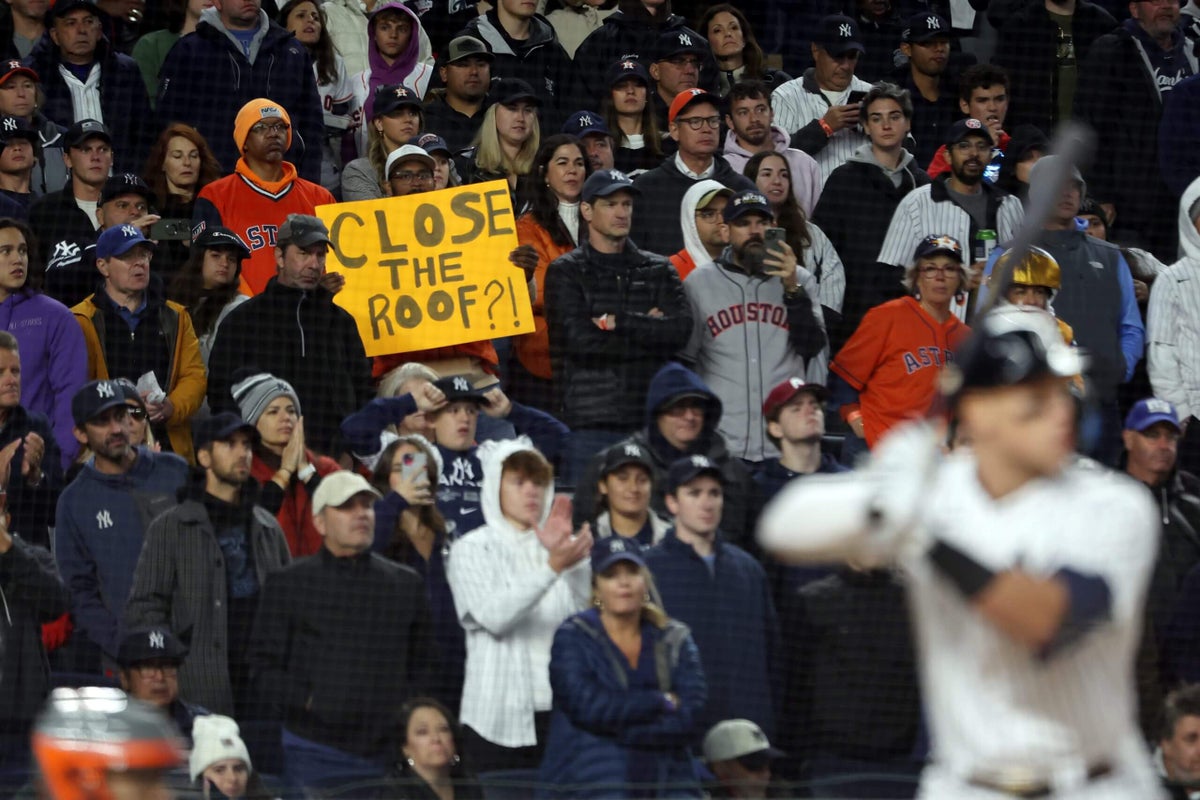
HOUSTON — A mere four outs separated the New York Yankees from a 2-0 deficit in the 2022 American League Championship Series when Aaron Judge hammered a hanging slider toward the right-field seats.
Statcast assigned it a .910 expected batting average. In Yankee Stadium, the system declared that it would have been a home run.
But the baseball took flight on a fine October evening in downtown Houston. First-pitch temperature was 78 degrees, winds blew 10 mph out to left field, and, importantly, the ballpark’s roof was open. That, the Yankees felt, was why Judge’s fly ball traveled only 345 feet as it fought that breeze.
Inside Minute Maid Park, it found a home in right fielder Kyle Tucker’s glove. New York never threatened again in a 3-2 loss that gave control of the series to the eventual World Series champion Astros.
“The roof open kind of killed us,” manager Aaron Boone bemoaned afterward.
Judge, Boone and the Bronx Bombers need not worry about a similar scenario during this weekend’s three-game series inside the stadium now called Daikin Park. According to data compiled by The Athletic, the Astros have only opened the roof twice for a regular-season game since the end of the 2022 season.
Other ballparks across the sport — and one in the state of Texas — appear more amenable to opening their roofs when weather permits. Globe Life Field opened its roof for three of the Texas Rangers’ first nine home games this season. Last year, the Arizona Diamondbacks played 11 of their first 14 games at Chase Field with an open roof. The 2025 Miami Marlins did it for 14 of their first 16 games at loanDepot Park.
In comparison, Daikin Park’s roof has become retractable in name only. Closing it during Opening Day on March 26, on an afternoon that was within the Astros’ guidelines for playing open-air baseball, robbed slugger Yordan Alvarez of a potential home run. Houston was shut out by the Los Angeles Angels, but refused to wonder what would’ve been if the roof had been open.
“We still want it closed,” manager Joe Espada said about an hour after Alvarez’s towering fly ball banged off a roof panel above right field and landed in foul territory.
How often do teams open the roof?
TeamRoof openings in March/April
75%
51.52%
25.86%
3.27%
Data from 2023-2026
Players both past and present do not all share this preference, according to interviews The Athletic conducted this month. Some prominent ones do, perhaps precipitating the Astros’ hardline stance on keeping it closed.
“I don’t want to be sitting through rain delays,” said third baseman Carlos Correa, the unquestioned leader of Houston’s clubhouse. “I want to show up, know I’m playing at 7:10 and if you hit it, it’s going to go, and if you miss it, it’s going to be an out.”
It ultimately remains somewhat of a mystery why the Astros are so insistent on closing the roof. Perhaps, it’s viewed as a competitive advantage due to elevated crowd noise in an enclosed space. Ex-Astros infielder Chris Burke said that opening it might have cost them the 2005 World Series. “That was a huge part of our home-field advantage, and we were all pretty frustrated.”
Maybe it’s simply a prioritization of controlled comfort. After all, humidity is a year-round issue in Houston. Heck, maybe it’s the ballpark’s naming rights deal with an HVAC company, wanting to put their product to good use under the domed cover.
In response to an interview request for anyone with decision-making power regarding opening the Daikin Park roof, an Astros spokesperson referred all questions to the team’s website, which lists a set of six conditions “under which starting a game with a closed roof at Minute Maid Park is considered.” The website has not yet been updated to reflect the ballpark’s name change, which occurred 16 months ago.
Among the conditions listed: a temperature or heat index above 77 degrees or below 65 degrees during the game window, the threat of rain or severe weather before or during the game window, the threat of excessive wind — which the Astros describe as sustained above 20 mph — a dew point of at least 55 degrees and a relative humidity of at least 50 percent.
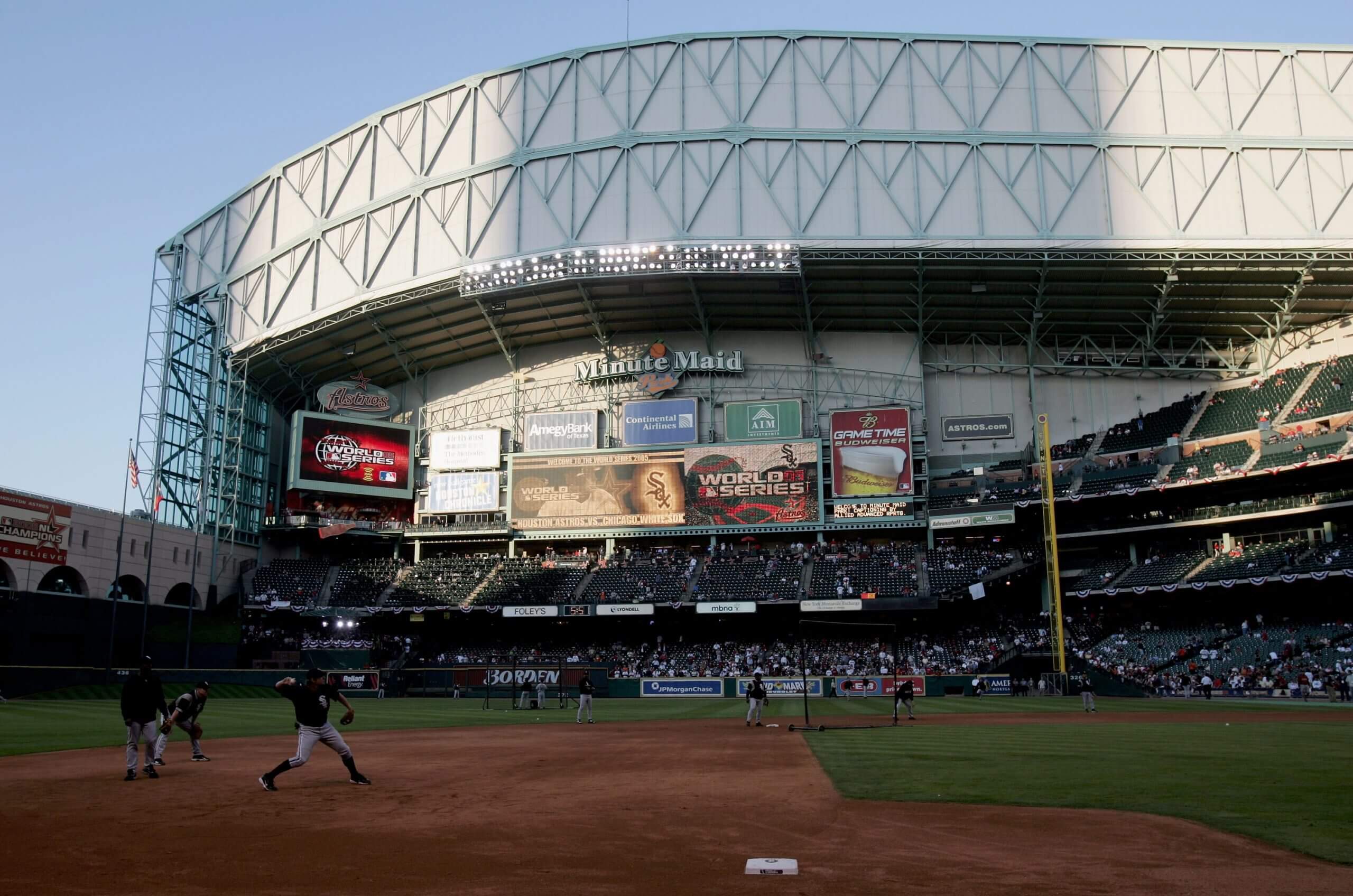
During the 2005 World Series, the status of the roof at then-Minute Maid Park became a major topic. (Ronald Martinez / Getty Images)
But the data shows that the Astros still won’t open their roof, even when none of those six conditions are present. On March 28, the third game of this season, the outside temperature at first pitch was 74 degrees. There was no chance of rain. Winds breezed at around 3 miles per hour. Humidity was 41 percent, and the dew point was 49.12.
There was not one weather-based justification to close the roof. But after batting practice, the Astros did just that.
“I prefer the roof open. Weather permitting, the roof open,” said Christian Walker, who signed with the Astros in 2025 after playing eight years in another ballpark with a retractable roof: Arizona’s Chase Field.
“I think it feels like traditional baseball — open air, which is always nice. But I think the energy is cool. I think there’s something cool about the high-walled stadium, the retractable roof with the sun coming in on the field. Fans and dugouts are in the shade, field is in the sun. I just like the aesthetic of it, the vibe of it. It’s cool.”
On April 10, 2023, the Arizona Diamondbacks opened their retractable roof for a night game against the Milwaukee Brewers. First-pitch temperature was clocked at 94 degrees Fahrenheit. The night after, it was open again with the climate just one degree cooler.
In April of last season, the Marlins played 12 consecutive home games with the roof open — all with first pitch temperatures that would have triggered a closure in Houston.
While climate factors could play a role in the Texas teams’ conservative approach to roof openings, it’s undeniable that the preferences and priorities are not aligned.
Over the past three-plus seasons, the Astros have played 59 of their 61 March and April games indoors. The Rangers have played 43 of 58 such games indoors. And by comparison, the Marlins have played 32 of 66 games indoors. The Diamondbacks, meanwhile, have closed the roof just 14 times in 56 opportunities over the same time span.
“With the understanding that the roof will be closed during the summer months,” said a Marlins spokesperson, “we try to have it open at the start and end of the year as much as we can.”
The Rangers say they have a similar approach — arguing they “want to play as many games as possible with the roof open.” A team spokesperson said that humidity and dewpoint have caused issues in the ballpark when open, including malfunctioning elevators, glass fogging and slick concourses.
The Diamondbacks — who say they will generally have the roof open barring very high temperatures, winds in excess of 25 miles per hour, or a forecast of rain exceeding 20 percent — have played with the roof open even when it probably should have been closed. A March 2024 exhibition at Chase Field was postponed mid-game due to a rain shower. A month later, there was a two-hour delay due to a swarm of bees.
Major League Baseball takes no position on how teams do, or do not, utilize their retractable roofs. The league does require that each club make a filing and submit it to the league’s baseball operations department, which lists the open and closure policy for the regular season.
In the postseason, the league itself will determine whether a roof is open or closed. But it does so based on that previously filed team-created criteria. For example, the roof at then-Minute Maid Park was open for Games 2 and 6 of the 2021 World Series — two games that had first-pitch temperatures of 73 and 72 degrees, respectively.
Generally speaking, most teams try to play with the roof open. For teams in colder environments, including the Brewers, Blue Jays and Mariners, that opportunity typically presents itself later in the season. “I love the roof open,” Blue Jays manager John Schneider said in 2023. “I’m a big roof open guy.”
The preference to keep a roof open could have multiple factors. Baseball is an outdoor game, and fans tend to believe that, if possible, it should be played that way. It could be to help an offense — Schneider may be a “roof open guy” because his team averaged 6.17 runs per game with the ballpark open last season, compared to 4.70 with it closed.
Walker acknowledged that many of his former Diamondbacks teammates thought the ball “flew a little bit better” with the Chase Field roof open.
“Arizona had the roof and then had the windows out toward left center. It seemed like the wind would come in the top, hit the backstop, then go out the window,” Walker said. “Depending on the day, it felt like it played more true, but I would say the ball carried a little more just because it provided a slight breeze out.”
Money could also be a factor in decision-making. According to a private study commissioned by the Brewers in 2022, air-conditioning to cool a closed-roof baseball stadium at 78 degrees is typically around $20,000 per game.
The risk of opening a stadium roof to start a game is minimal, as well. Even in a worst-case scenario where rain or extreme heat enters the forecast unexpectedly, teams are allowed to close (or open) their roof once mid-game. That process varies by team, but it typically takes no more than 10-15 minutes.
The Marlins, Diamondbacks and Brewers also utilize retractable wall panels that can be removed or added independently of the roofs.
Yusei Kikuchi has pitched for the Mariners, Blue Jays and Astros in his career — three of the four uniforms he’s worn are those of teams that can control their climate.
For his career, he’s a much better pitcher indoors — with a .708 OPS against him in roofed stadiums, compared to .783 when he pitches in open air. His strikeout rate dips from 10.4 strikeouts per nine innings to 9.0 when that roof opens up.
But for Kikuchi, baseball is better when the air is fresh, even at the expense of his stat line.
“I love playing baseball under the sun,” the current Angels starter said through an interpreter. “While I was playing with the Blue Jays, when the roof was open, I was real happy. It’s better when it’s open.”
Longtime Houston-based meteorologist Frank Billingsley prefers to go to games when the roof is closed. The controlled environment is of higher importance to him than a starry Texas evening.
Billingsley wasn’t quick to dismiss the idea that Houston’s climate could truly be the reason for his hometown team’s indoor preference.
The common denominator of Texas, Arizona and Florida is year-round heat. But beyond that, there are significant differences that the KPRC weatherman of 25 years wasn’t quick to ignore.
“They’re dry,” Billingsley said of Phoenix. “Their humidity is nine percent in Phoenix. While ours, even in April, can be kind of stickier. The humidity, sometimes in the afternoon, is in the 50 percent range, which can be kind of miserable.
“So why do it, if there’s any chance of being uncomfortable? Keep it closed.”
But the Marlins play in Southern Florida, which can be extremely humid year-round. So why doesn’t the same standard apply?
“April is the last great month of the year in Florida,” Billingsley said. “October to April, amazing. May to September, thunderstorms every afternoon, hot and humid. So they may be taking advantage of knowing that this is the last gasp.”
The same could be said for Texas. Perhaps it’s why the Rangers, located 257 miles away from Houston, have seized opportunities early this season to open the roof at Globe Life Field. As Billingsley acknowledged, few post-April days are conducive to playing open-air baseball.
“But that’s the thing — we’re not committing to opening it all season,” Walker said. “It’s not like we have to play open or closed and you have to deal with the humidity. It’s like ‘We could still get that weather, maybe.’”