
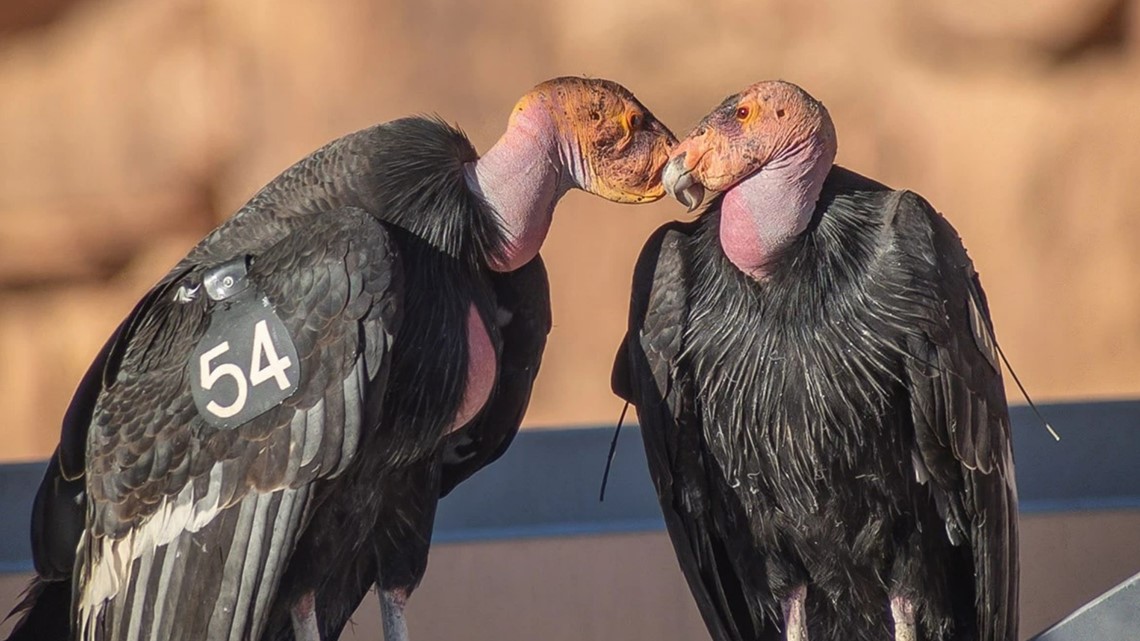
North America’s largest land bird once neared extinction. Now, California condors are slowly recovering, with sites in the Northwest helping restore the population.
BOISE, Idaho — There was a time when the California condor flourished in the western United States. But in recent decades, the largest land bird in North America, dwindled to an extremely weak population.
California condors reigned during the Pleistocene era, often known as the Ice Age. The birds have been part of the ecosystem for thousands of years. By the 1980s, they were nearly gone.

This story continues below.
Just 22 condors remained in the world, pushed to the brink of extinction by human-related threats including lead poisoning, habitat disruption and illegal egg collecting. In a last-ditch effort to save the species, wildlife officials made a decision to capture every remaining California condor and begin a captive breeding program.
That decision marked the beginning of a very intensive wildlife recovery effort.
Today, the population has grown to more than 600 condors, with about 200 of those flying free in the wild. The increase is slow but steady, driven by carefully managed breeding programs and partnerships in the western half of the country.
One of those efforts is based in Boise, through The Peregrine Fund at the World Center for Birds of Prey.
RELATED: The Peregrine Fund celebrates two new California Condor eggs laid in Boise
“They are also really important for the environment because they’re nature’s cleanup crew, they are scavengers,” said Leah Esquivel, who is the Propagation Program Director for the organization.
There, biologists and conservationists play a critical role in raising condors from mate matching to egg laying to release.
The process is detailed and deliberate. Eggs are sometimes incubated artificially, hatchlings are closely monitored and young birds are raised and gradually prepared for life in the wild.
“Every single egg that hatches, we know is a success,” said Esquivel.
Before release, condors spend months in socialization pens, learning behaviors essential for survival.
Boise is one of several key propagation sites, working alongside partners like the Oregon Zoo, facilities in Los Angeles and San Diego and a release site in Arizona. Together, they form a coordinated recovery network to establish self-sustaining populations.
The collaborations are active and ongoing. Eggs are sometimes transferred between facilities to ensure successful hatching and rearing: anything to accomplish the shared goal across organizations, which is the survival of the species.
This year’s breeding season is already proving successful. In Boise alone, 18 eggs have been laid. Multiple chicks have already hatched and more are expected through spring. Each successful hatch represents another big step forward for a species that once teetered on extinction.
But breeding is only part of the challenge.
Condors continue to face serious threats in the wild. Lead poisoning remains the most significant danger, often caused when birds consume carcasses or remains containing lead ammunition from human hunting. Other risks include electrocution from power lines and illegal egg collecting.
Recovery programs also focus on reducing these threats across the landscape, including promoting the use of non-lead ammunition and improving habitat safety.
Marti Jenkins, a senior keeper for the California Condor breeding project at the Oregon Zoo, told KTVB that the main goal is, “the success of the species, and it’s the survival of this bird.”
While the population is growing, condors have not yet returned to all of their historic range.
“With the amount of lead that’s still available on the landscape, we lose more condors than would allow for a self-sustaining population,” Jenkins said.
There are currently no wild condors in Idaho, Oregon or Washington. The closest population in the Northwest is in Northern California, where a newer release site in the Redwoods is beginning to show promising signs, including nesting activity. Marti Jenkins of the Oregon Zoo told KTVB that this location developed in partnership with tribal and conservation groups.
That site could play a key role in future expansion.
“Although they’re not found here in Idaho, they could potentially be here in the future,” Esquivel said.
Experts say that as populations stabilize and threats are reduced, condors could eventually spread into parts of the Northwest where they once lived. The long-term goal is not just survival, but restoration and a future where condors once again soar across a broader portion of the West.
“It’s so special and unique for people to get to see California condors in the wild,” said Jenkins. “What I would really like is for that to be common.”
The California condor’s comeback is ongoing, but decades after coming dangerously close to disappearing forever, the species is once again finding its place in the sky.