
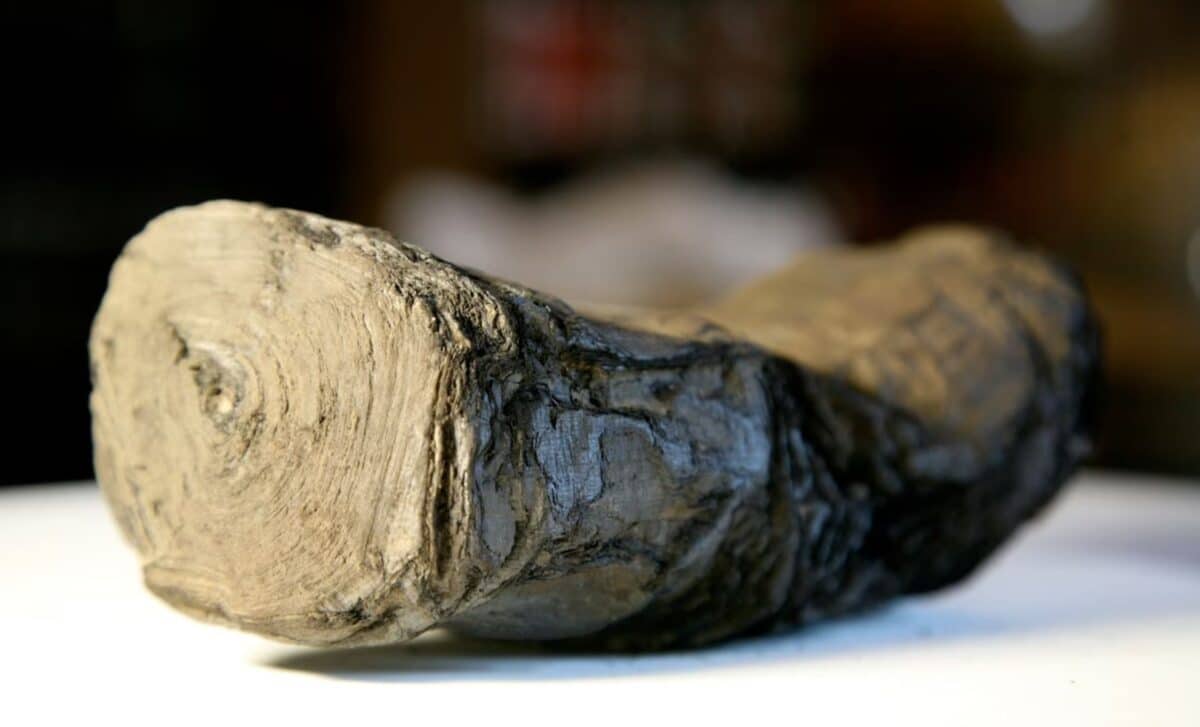
A charred papyrus, long considered impossible to read without destroying it, has finally revealed its contents. Thanks to artificial intelligence, researchers accessed the text without opening the document and managed to spot writing inside something no one had been able to read for over 2,000 years.
For years, this ancient artifact remained sealed because of its extreme fragility. According to a release published by Oxford University, any attempt to unroll it risked wiping out the ink completely, leaving researchers with no safe method to study it.
The work shows a new way to deal with ancient texts that are too fragile to touch. For historians, it’s a big shift after decades of getting nowhere. The combination of advanced imaging and AI analysis now allows scientists to examine objects once considered permanently inaccessible.
An Artifact Too Fragile To Be Opened
The text is part of the Herculaneum scrolls, buried in 79 AD. When they were found, they looked more like lumps of charcoal than books. Trying to open them would just destroy them.
As stated in the statement, one of these scrolls has been sitting at the Bodleian Library for years, with no real way to read it. Researchers tried different methods, but nothing worked. For a long time, it was basically a dead end. The papyrus was there, but its content remained completely out of reach.
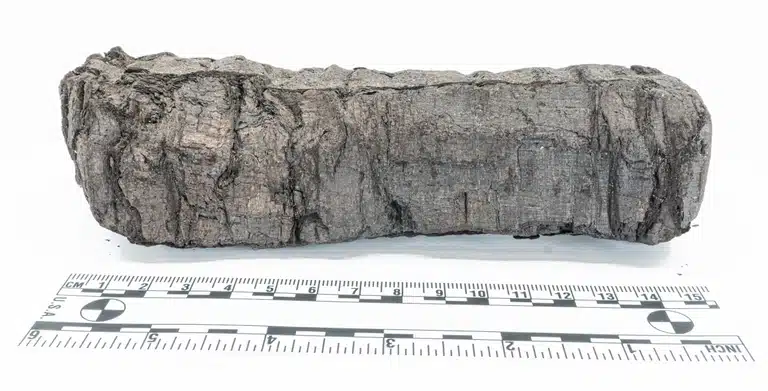 The exterior of the scroll is too damaged and carbonized to open physically. Credit: Vesuvius Challenge
AI Reconstructs Text Without Physical Contact
The turning point came in 2024 when researchers tried something different using the Diamond Light Source. This machine sends high-energy X-rays through objects to map their internal structure without damaging them.
According to the same source, this technique made it possible to virtually reconstruct the papyrus document and reveal entire sections of text. Often referred to as digital unwrapping, the process relies entirely on data processing rather than physical interaction.
“Researchers are further refining the image using a new segmentation approach, in the hopes that it will improve the coherence and clarity of the lines of text currently visible, and perhaps reach the end of the papyrus (the innermost part of the carbonised scroll) where the colophon with the title of the work may be preserved,” explained the authors.
A Long-Lost Papyrus Text Begins To Emerge
One key detail made this scroll stand out: its ink. Researchers noticed it appears more clearly in X-ray scans than others, possibly because it contains lead.
As reported by the Oxford team cited in the article, this made it easier for AI to detect letters. The system highlighted sections of text, which experts from the Vesuvius Challenge then worked on manually.
“The image of the virtually unrolled scroll shows a considerable part of the papyrus and – most importantly – some columns of text (with about the last 26 lines of each column),” stated the researchers “Whilst efforts are underway by University of Oxford scholars to interpret the text, the Vesuvius Challenge is inviting others to come forward and join the collective effort to fully decipher its contents.”
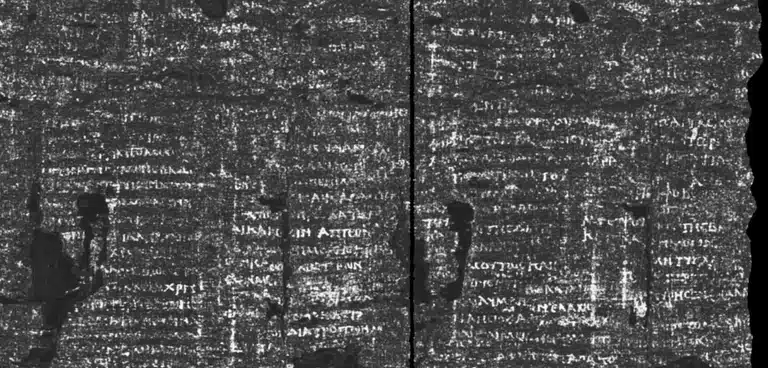 AI-processed scan revealing hidden text inside a carbonized ancient papyrus. Credit: Oxford University
Dr. Brent Seales pointed out that the results are promising, even if there’s still a lot to figure out.
“We are thrilled with the successful imaging of this scroll from the Bodleian Libraries and are grateful to our partners for their support and collaboration. This scroll contains more recoverable text than we have ever seen in a scanned Herculaneum scroll.”
The scroll may contain more readable text than others scanned before, and researchers are continuing to improve their tools to uncover the rest.