
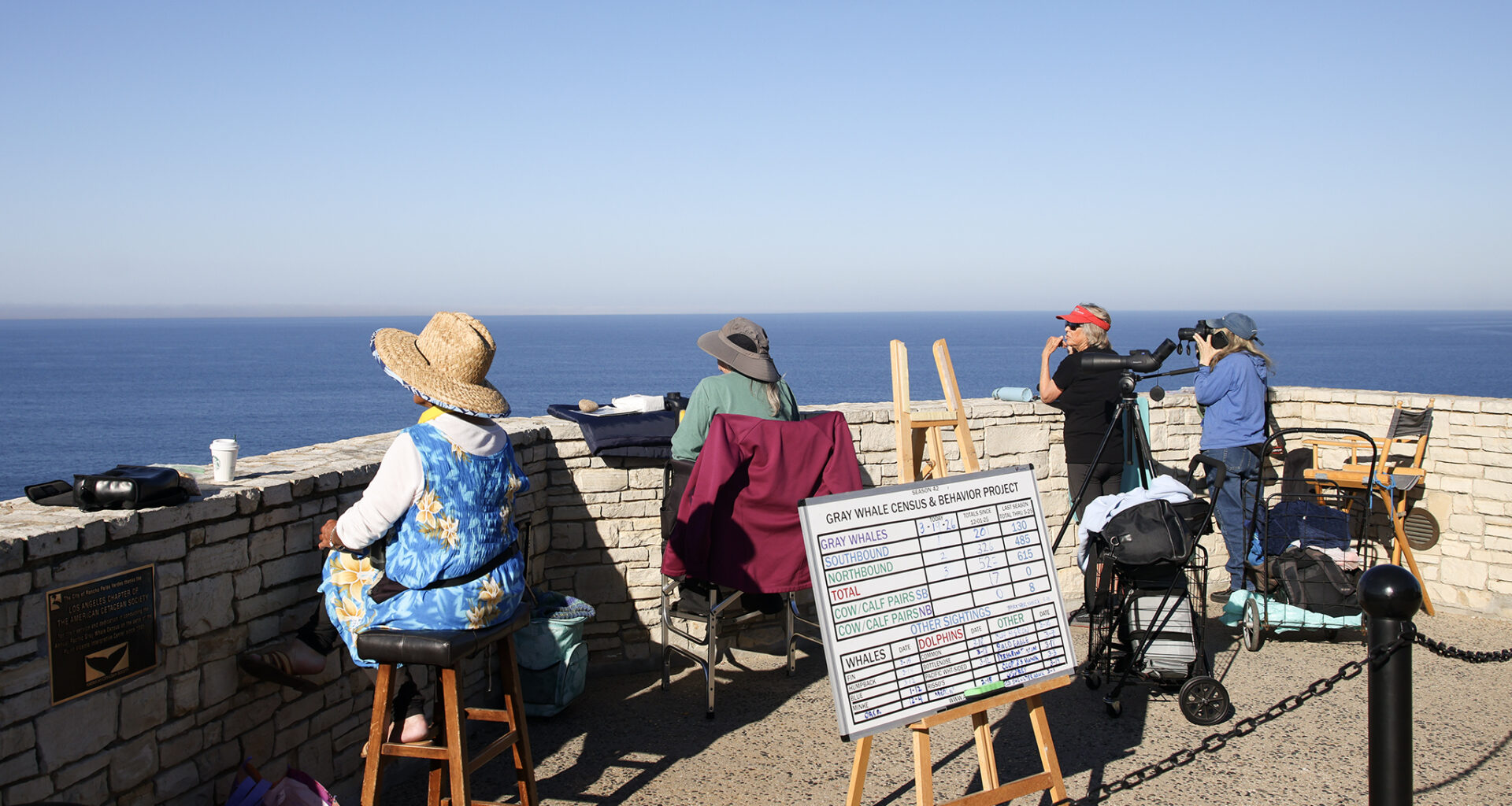
The handful of people sitting outside Point Vicente Interpretive Center on a Thursday morning in March came prepared. They donned long-sleeved shirts and wide-brimmed hats for sun protection, carried folding chairs and ample snacks so they could sit for hours on end, and wielded binoculars with a built-in compass (the group even has an official preferred model, Fujinon 7×50).

For most people, whale watching is a decidedly casual endeavor. People might spot a whale while on a tour boat, or in a lucky sighting while lounging on the beach. Casual is not the word to use for the volunteers with the Gray Whale Census and Behavior Project. For over 40 years, this mighty team of volunteers has staffed the interpretive center’s patio daily from December through mid-May, methodically watching the ocean for whales.
Alisa Schulman-Janiger has been there for each of those 40 years. The director of the Gray Whale Census and Behavior Project, which is operated by the Los Angeles chapter of the American Cetacean Society, has watched as gray whale numbers off the California coast climbed, then plummeted, then slowly climbed back up again. Now the gray whale population is on the decline once more, but this time it might not bounce back — all while the very land the whale count volunteers sit on slowly slides into the ocean.
Article continues below this ad
ACS board member Alisa Schulman-Janiger looks for whales at the Point Vicente Interpretive Center in Rancho Palos Verdes, Calif., on March 19, 2026.
Jessie Alcheh/SFGATE
“It’s the longest-running gray whale project, it’s full-season, and it’s also citizen science; there is no other thing like this,” said Schulman-Janiger, who has a photo of a whale for her phone background and is at the count at least four days a week. “We’ve been looking at the same water since 1984.”
The Point Vicente Interpretive Center sits on the doomed Palos Verdes Peninsula, where landslide movement has accelerated following record-breaking rainfall in 2023, as climate change drives increasingly intense extremes between heavy rainfall and drought conditions in California. Meanwhile, climate change is also warming the ocean and reducing food for the gray whale population that migrates past the peninsula each year. In a way, both the gray whales and their watchers are staring down the same ticking climate clock.
Article continues below this ad
The whale count study started in 1979 at the Marineland of the Pacific, an aquarium theme park on the Palos Verdes Peninsula that shuttered in 1987. By then, the group of whale watching volunteers already had another station about a mile northwest near the Point Vicente Interpretive Center, which is “about 125 feet above sea level and where the water depth abruptly drops off close to shore,” providing prime whale-spotting conditions, according to the American Cetacean Society’s Los Angeles chapter. The whale-viewing patio is staffed seven days a week, during every daylight hour from Dec. 1 through May 15.
The exterior of the Point Vicente Interpretive Center in Rancho Palos Verdes, Calif., on March 19, 2026.
Jessie Alcheh/SFGATE
The patio is roped off so volunteers can stay fully focused on the horizon, and fence posts lining the edge of the coastal bluffs are each painted with their own individual number, so volunteers can quickly call out which fence post everyone should turn their binoculars toward in the event of a potential whale sighting. A whiteboard faces out toward the public, ticking off the number of whale sightings for the day and for the season — as of 9 a.m. on the Thursday in March, three whales were spotted so far — and also notes sightings of other creatures, including dolphins, blue herons, bald eagles and hawks.
Article continues below this ad
It’s an early example of modern citizen science, the practice of members of the public collecting observations and data about the world around them. Today, the practice is popular via the iNaturalist app, which allows people to upload photos of plants and animals, which the app can help identify. That data is increasingly used in scientific research, and the massive amount of data collected by the public is even helping speed up ecology research.
The Point Vicente whale count’s methods are a little more old-school. Volunteers carry clipboards and pass around laminated sheets showing photos of different whale species, using them to help identify what they might have seen on the horizon. (Schulman-Janiger does post daily updates on the count on Facebook, where the ACS-LA team also now sprinkles in some drone footage).
Data of species seen at the Point Vicente Interpretive Center in Rancho Palos Verdes, Calif., on March 19, 2026.
Jessie Alcheh/SFGATE
Even with the massive amount of hours they spend staring at the ocean, the gray whale census team doesn’t claim to count every whale that passes by the peninsula. Many whales migrate offshore near the Channel Islands, out of sight from even the Fujinon 7×50 binoculars. The team’s counts aren’t used on their own for population estimates, but instead are used to track usage and patterns along the near-shore migratory whale path. The totals track overall population trends among gray whales and include counts of calf sightings, which can help monitor the population’s future.
Article continues below this ad
Last year’s numbers were the bleakest on record. In all, the group counted the lowest number of southbound whales, the lowest number of northbound whales and the lowest number of calves. The team also saw “three times more skinny whales than we’ve ever seen before,” a sign that the whales that are passing by aren’t finding enough food, Schulman-Janiger said. For the first time, the team didn’t see a single calf traveling south.
Numbers are higher this year, but still far below the average. Warming ocean temperatures have impacted the population of amphipods (tiny shrimp-like creatures that live along the ocean floor) that the whales travel toward Alaska to feed on, leaving the whales with fewer reliable food sources.
People look out at the Point Vicente Interpretive Center in Rancho Palos Verdes, Calif., on March 19, 2026.
Jessie Alcheh/SFGATE
“The gray whale is used to going to certain spots and going to the bottom and feeding, and it was always there [for] years and years and years, very dependable; it’s like opening up your refrigerator. You expect to see food there. You don’t expect to have it empty,” said Schulman-Jangier.
Article continues below this ad
National Oceanic and Atmospheric Administration Fisheries, which conducts its own official count of southbound whales along the coast, agrees. The population size of the eastern North Pacific gray whale population was nearly 27,000 a decade ago, “one of the highest estimates of our data time series that extends back to 1967.” But the number of stranded dead gray whales along the West Coast increased starting in late 2018, which led the agency to declare an “Unusual Mortality Event” for the species through November 2023. That event was associated with “localized ecosystem changes in the whale’s Subarctic and Arctic feeding areas that led to changes in food, malnutrition, decreased birth rates, and increased mortality.”
By the 2024-2025 season, the population estimate was between 11,700 and 14,450 whales, the third-lowest ever recorded. There have been unusual mortality events in the past, including one around 2000, that have often been followed by an increase of the whale population. But this time, the population’s ability to bounce back is less certain, as the causes of the decline seem more permanent in nature.
A lighthouse near the Point Vicente Interpretive Center in Rancho Palos Verdes, Calif., on March 19, 2026.
Jessie Alcheh/SFGATE
“The duration and magnitude of the current decline, coupled with the low calf production that has occurred since 2019, raise concerns that recent and continued environmental changes in the Arctic and sub-Arctic feeding grounds could be impacting population resilience,” according to NOAA Fisheries.
Article continues below this ad
The federal government’s (and the broader public’s) attention to the gray whale population began after the population plummeted when millions of whales were killed by the whaling industry. The massive industry of the late 1800s and early 1900s included activity on the same Palos Verdes Peninsula that Schulman-Janiger and volunteers have watched from as the whale population recovered, only to drop again due to climate change. About 3 miles from their observation point, a historical marker memorializes a whale station that was active from 1860 to 1885.
After the whaling industry died out, LA’s burgeoning real estate industry swept in, and the rest is history: Ocean-view homes were raised up on the peninsula, only to now, decades later, be condemned by land movement that’s pushing parts of the peninsula out to sea.
An ACS whale watching group looks for whales at the Point Vicente Interpretive Center in Rancho Palos Verdes, Calif., on March 19, 2026.
Jessie Alcheh/SFGATE
It’s also starting to throw a wrench in the whale-watching team’s consistency. For years, the team never missed a day during whale observation season; they were first thwarted for over a year by the pandemic. More recently, they’ve had to adapt to heavy rainfall and road closures from land movement. In March, the road to the interpretive center bobbed up and down like a roller coaster as crews worked to repair the most recent damage from the intensifying land movement.
Article continues below this ad
But for now, the gray whale census team plans to remain sentinel on their patio outside the Point Vicente Interpretive Center for years to come, either until the last whale passes by the peninsula or until the peninsula itself slides farther into the sea.