
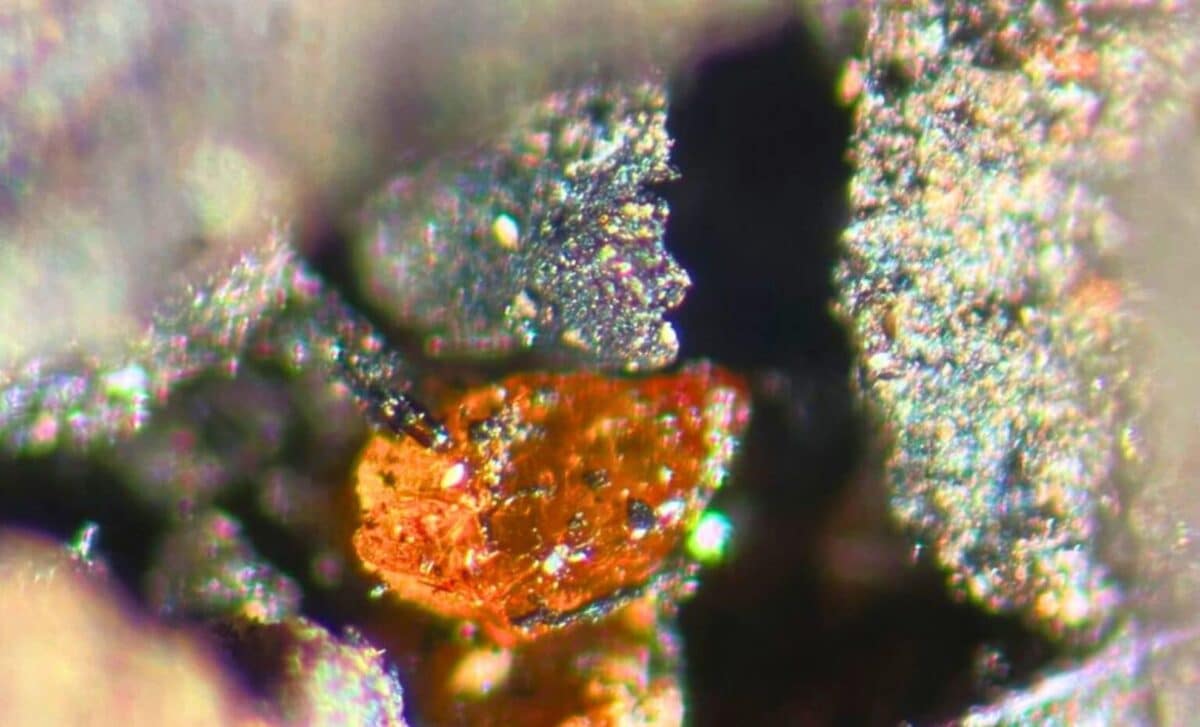
A small piece of amber found in West Antarctica is changing how scientists picture the continent’s past. Pulled from the Pine Island Trough, it shows that resin-producing trees once lived close to the South Pole.
The fragment dates back between 92 and 83 million years, during the mid-Cretaceous. It provides a direct link to a time when Antarctica supported forested landscapes very different from today.
The sample, called Pine Island amber, was collected in 2017 during an expedition aboard the RV Polarstern. Scientists used the MARUM-MeBo70 seafloor drill to extract sediment cores from the Amundsen Sea Embayment. And as mentioned in the journal Antarctic Science, this is the first confirmed amber ever found in Antarctica, which makes the find stand out right away.
The Southernmost Amber Ever Found
The identification of amber in Antarctica fills a long-standing gap in the fossil record. Before this, the southernmost known deposits dated to the mid-Cretaceous in southern Australia and New Zealand.
According to the research team led by Dr. Johann Klages of the University of Bremen, this new find, published in Antarctic Science, confirms that suitable conditions for resin production once existed even in polar regions.
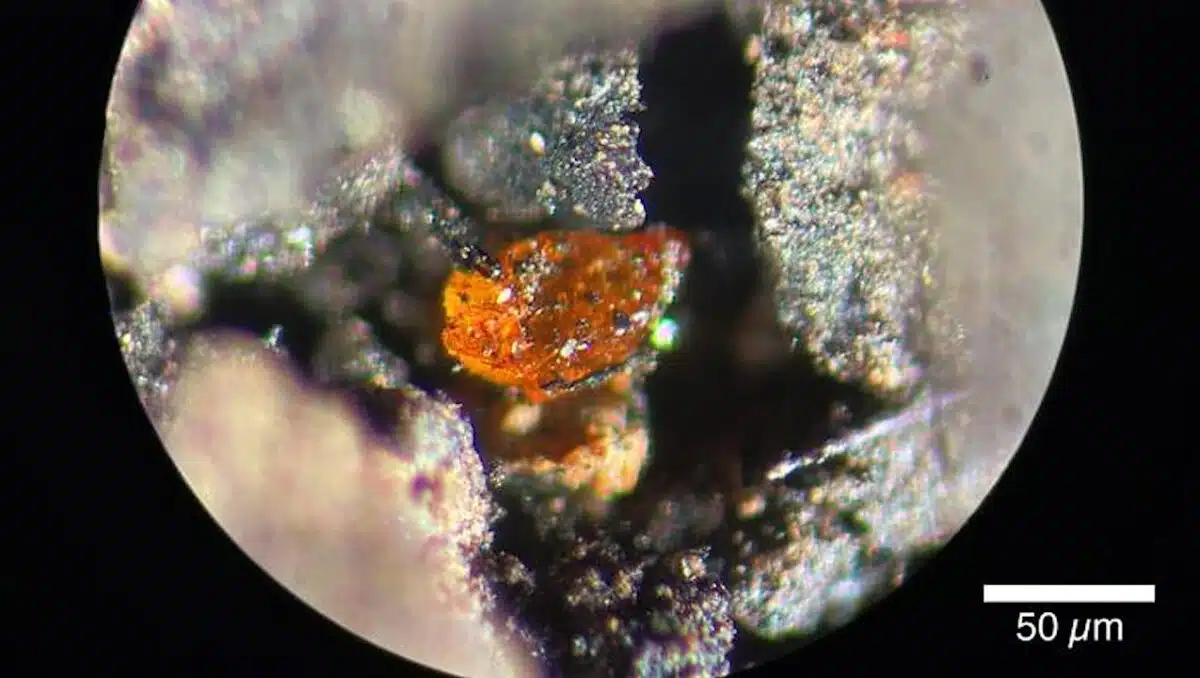 Microscopic view of a tiny Antarctic amber fragment. Credit: Alfred Wegener Institute / V. Schumacher
The fossilized resin sample came from the mid-shelf section of the trough, an area that preserves ancient sediments. Recovering it was not straightforward. Deep-sea drilling in Antarctic conditions is complex, and that adds weight to the discovery itself.
A Hidden Ancient Forest Beneath the South Pole
Amber forms from plant resin, typically exuded by gymnosperms. Dr. Klages noted that resin is a lipid‑soluble mixture of compounds capable of fossilizing under favorable conditions.
“Some plant resins are able to fossilize under certain conditions and get preserved in the geological record as amber,” he said.
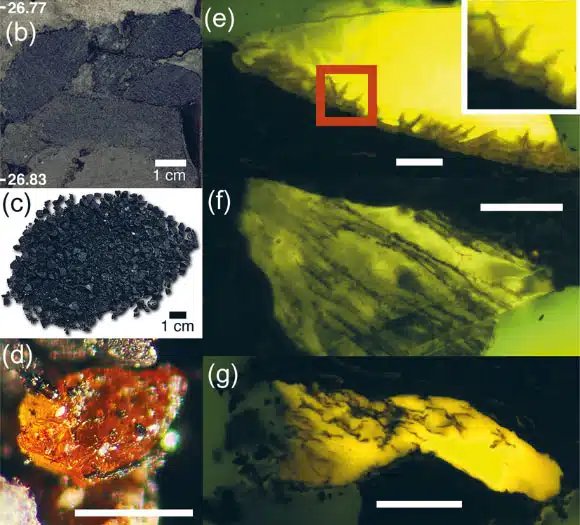 Microscopic and macroscopic views of Antarctic amber fragments, showing resin structure, sediment context, and possible organic inclusions preserved within the fossilized material. Credit: Antarctic Science
The Antarctic specimen indicates that conifer-dominated forests once thrived in a swampy, temperate rainforest environment near the South Pole. This idea may sound surprising, but it fits with other evidence pointing to a much warmer climate during the mid-Cretaceous, when forests could grow even at high latitudes.
“The Antarctic amber likely contains remains of original tree bark as micro-inclusions,” as co-author Dr. Henny Gerschel, a researcher at the Saxon State Office for the Environment, Agriculture and Geology, stated.
Tiny Details Trapped Inside The Amber
The piece itself contains transparent and translucent particles, which point to good preservation. As Dr. Gerschel pointed out, this likely means the amber was buried at shallow depth, avoiding the kind of heat and pressure that would damage it.
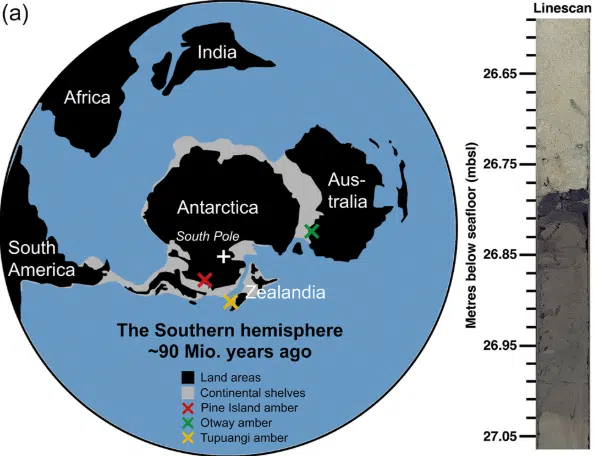 Map of the southern hemisphere 90 million years ago showing the Antarctic amber discovery site and comparable deposits in Australia and New Zealand. Credit: Antarctic Science
Researchers also noticed signs of pathological resin flow, a response trees use when they are damaged by parasites or wildfires. This process helps seal the bark and can trap bits of material inside the resin.
These details matter because amber can act like a time capsule. Even a small fragment can hold clues about the environment it formed in.
“It was very exciting to realize that, at some point in their history, all seven continents had climatic conditions allowing resin-producing trees to survive,” Dr. Klages said. “Our goal now is to learn more about the forest ecosystem — if it burned down, if we can find traces of life included in the amber. This discovery allows a journey to the past in yet another more direct way.”