
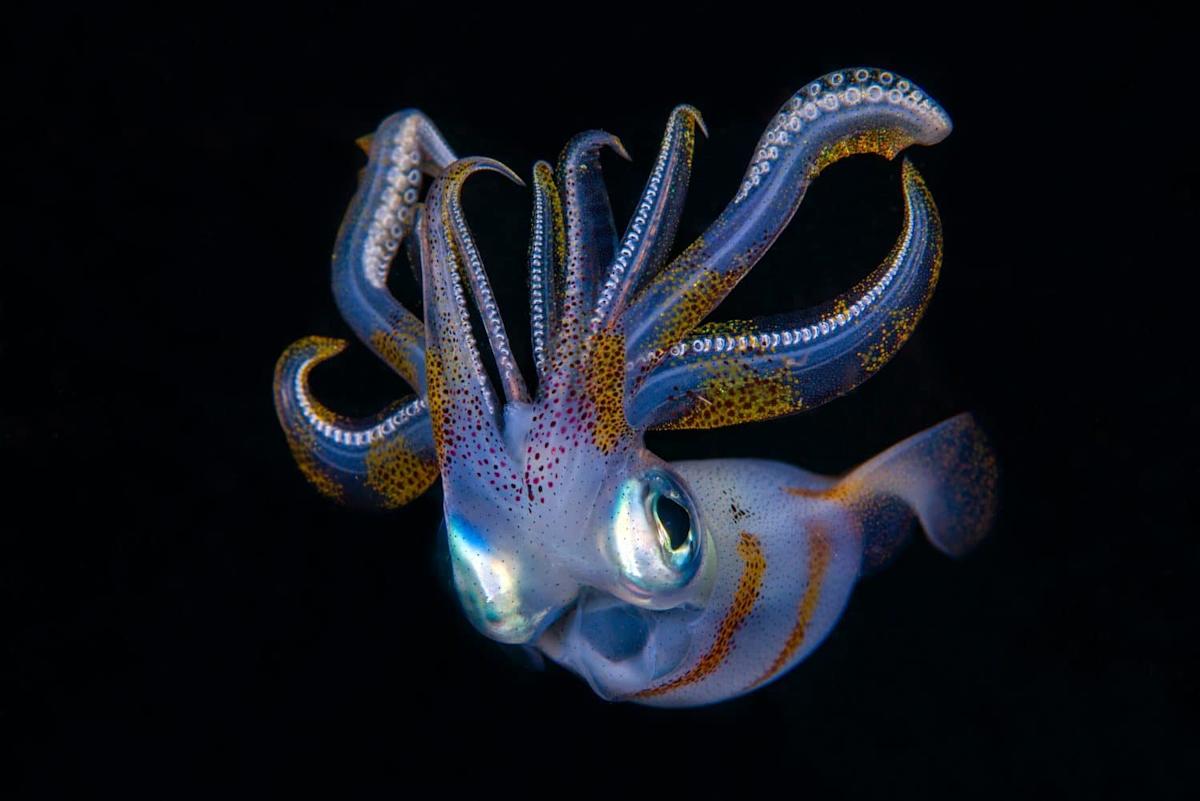
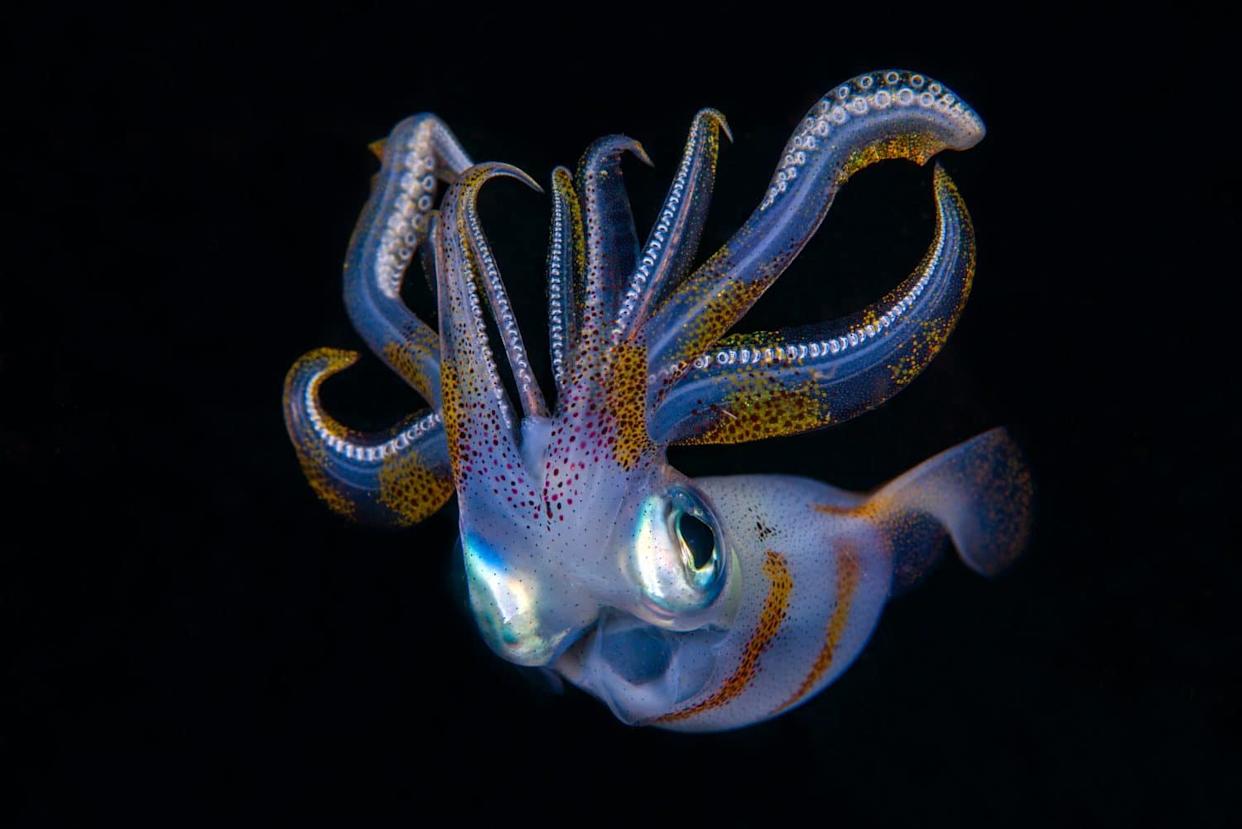
Bigfin Reef Squid – Sepioteuthis lessoniana in the night. Underwater world of Tulamben, Bali, Indonesia.© DiveIvanov/Shutterstock.com
Most people have encountered squid through their local seafood menu or field trip to an aquarium. Unlike octopuses, which are named for their eight arms, squid have 10 individual appendages. They most closely resemble their cuttlefish cousins, which also have 10 “arms,” two of which serve as tentacles to grab prey. Together, squid and cuttlefish are aptly called Decapodiforms (“ten-limbed”). Yet, despite their similarities, they have distinct differences that warrant classification into two separate scientific orders.
Squid (order Teuthida) have a feather-like “pen” inside their bodies, whereas cuttlefish (order Sepiida) have a wider, hard cuttlebone. This porous bone may help cuttlefish stay afloat while they cruise slowly through the water. Virginia Tech mechanical engineer Ling Li, in a 2020 study, described how a cuttlefish can adjust its buoyancy by regulating the “gas-to-liquid ratio” in the cuttlebone. In contrast, a squid’s pen anchors the muscles necessary for darting around quickly like a torpedo. In a 2019 study, biologists described how the pen “serves as a site of attachment for important muscle groups and as a protective barrier for the visceral organs.” Squid have round pupils, while cuttlefish have W-shaped pupils.
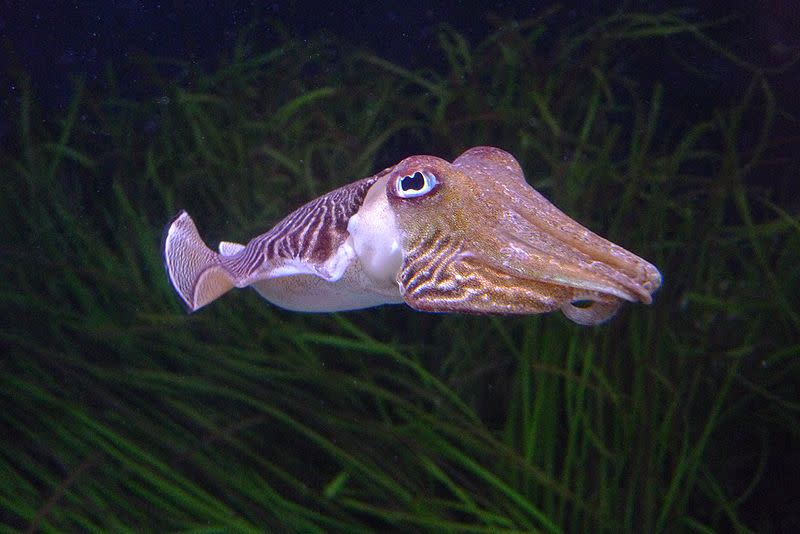
Note the cuttlefish’s unusual w-shaped pupil, which is sensitive to polarized light.
©David Sim from London, United Kingdom, CC BY 2.0, via Wikimedia Commons – Original / License
Today, there are more than 300 known species of squid, while cuttlefish have about 120 species, jointly making them some of the most diverse marine predators on the planet. Yet, how and when these two related organisms diverged into separate groups has been a source of scientific mystery. A new Nature Ecology & Evolution study harnessed DNA to help sort out the origins of squid and cuttlefish in the context of the broader group they belong to, the cephalopods. Researchers from Japan, Spain, the U.S., France, Austria, and Ireland collaborated to understand when they took their own evolutionary paths and became so diverse.
“Squid and cuttlefish are remarkable creatures, yet their evolution has been notoriously difficult to study …With our new genomic information, we have been able to resolve some of the mysteries surrounding their origins,” says lead study author, molecular geneticist Gustavo Sanchez at Okinawa Institute of Science and Technology, in a press release.
Cephalopods (a scientific class that includes octopus, squid, cuttlefish, and nautilus) are known to have emerged at least 500 million years ago during the Cambrian period. Early cephalopods looked like squid with shells, and included an estimated 17,000 species, making them even more diverse than today’s cephalopods. Although their soft bodies did not fossilize, their shells were preserved, with some fossils dating back to 530 million years ago.
It’s thought that these ancient, shelled cephalopods evolved from a group of bottom-dwelling animals (monoplacophorans) with tall, conical shells. Some of these creatures acquired ways to regulate buoyancy, which allowed them to colonize new habitats and perhaps spurred the adaptations of cephalopods, which can hunt in the open water column. These exploratory, shelled cephalopods then came to dominate ocean life for several hundred million years.
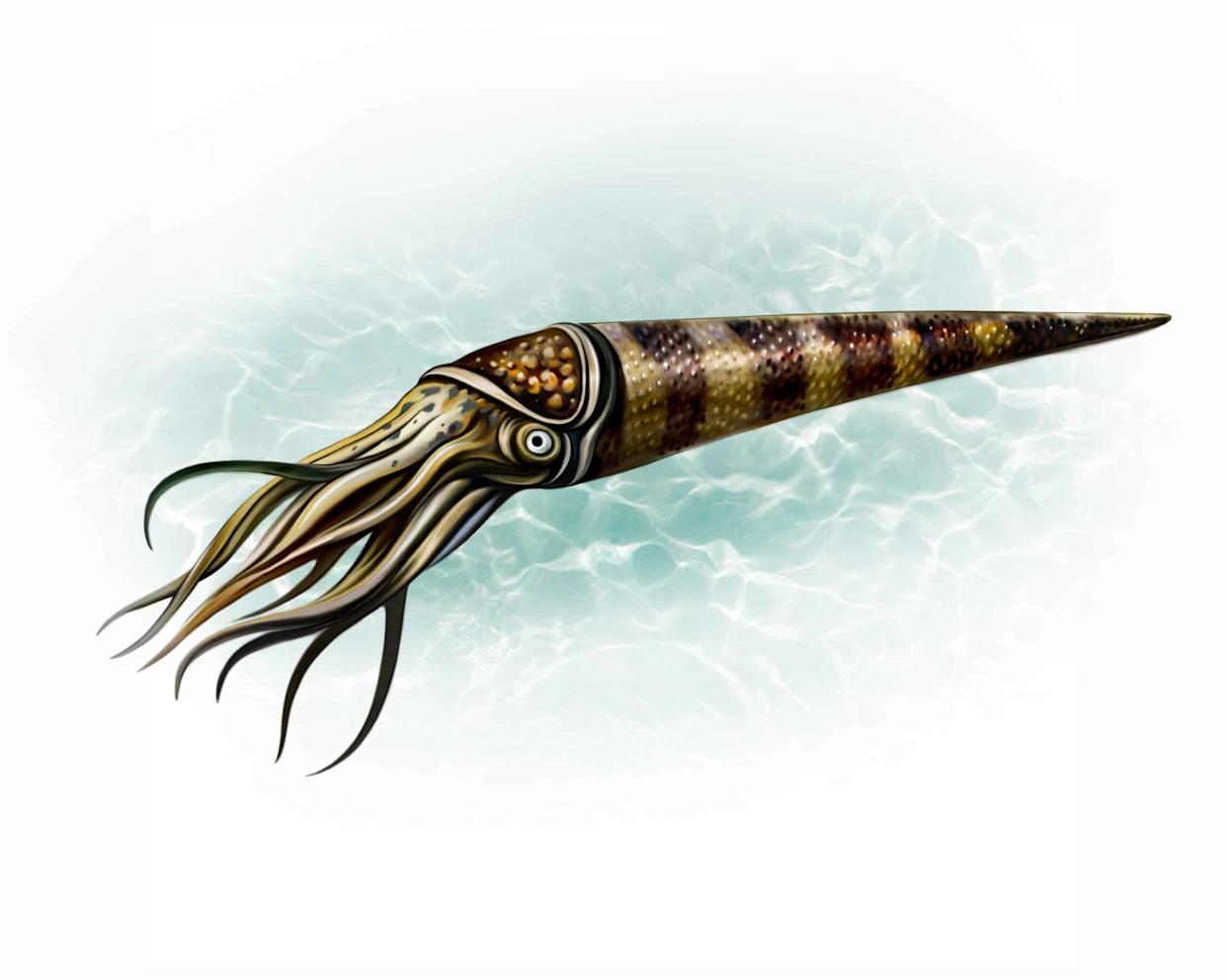
The
Orthoceras
was a major new species of cephalopod to emerge during the Ordovician Period.
©Liliya Butenko/Shutterstock.com
By considering whole genome data from squid and cuttlefish lineages and adding several more squid species’ genomes into the mix, the new study created the first evolutionary tree for the Decapodiform cephalopods. The results suggest that squid and cuttlefish set off on their own paths approximately 100 million years ago, during the Mid-Cretaceous period. Their diversification was rapid, at least from a geological perspective. However, after this initial branching into their unique scientific orders, not much changed for a long time.
“Following the initial lineage splits in the Cretaceous, we don’t see much branching for many tens of millions of years,” says lead author Sanchez.
Then, 66 million years ago, an asteroid collided with Earth and caused the extinction event best known for wiping out large dinosaurs (the End-Cretaceous extinction). Although it also obliterated many marine species, the Decapodiforms survived. Researchers hypothesize that the ancestors of squid and cuttlefish survived massive changes on Earth by hunkering down in their deep-water habitats, likely taking refuge in oxygen-rich patches of the deep ocean. “The sea surface would have been a very harsh environment for cephalopods,” says Sanchez in the press release. “Intense ocean acidification in shallower waters would also likely have degraded their shells.”
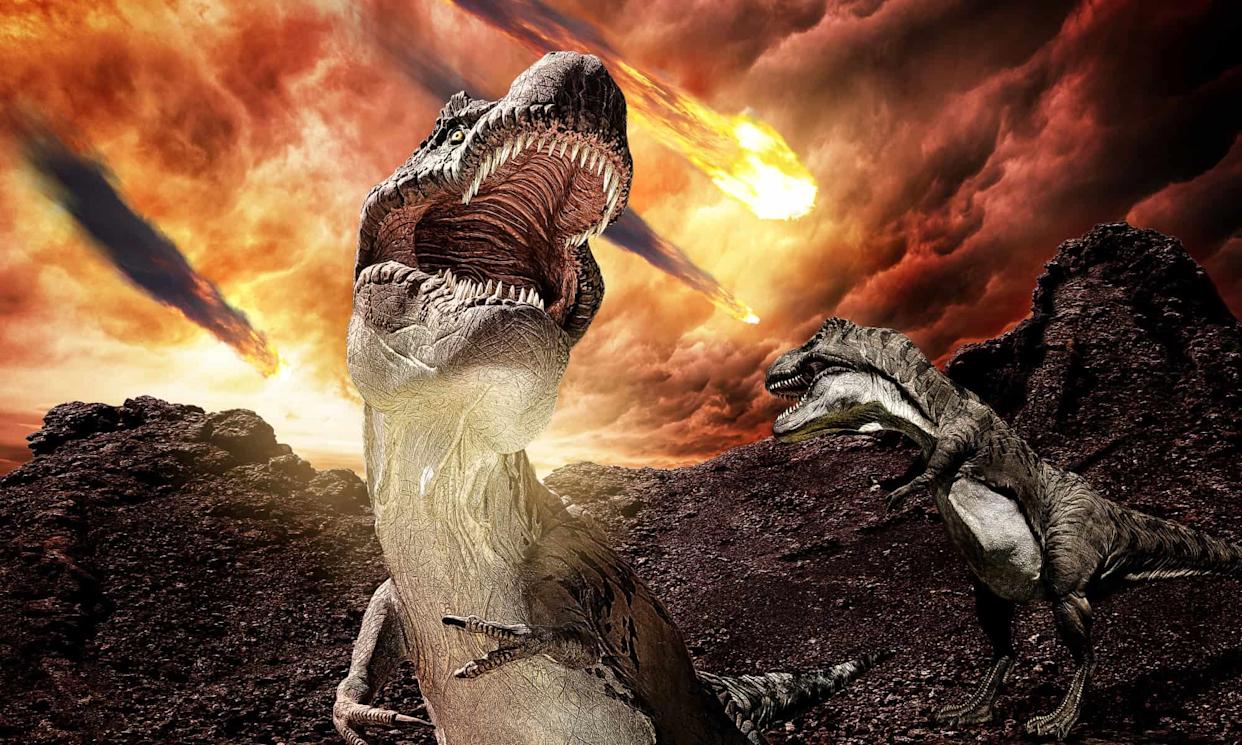
The asteroid hit that eliminated large, terrestrial dinosaurs also dramatically altered life in the oceans.
©serpeblu/Shutterstock.com
Thus, the deep-water habits of these ancient cephalopods likely allowed them to endure the changes wrought by the asteroid collision that ended the Cretaceous period. Afterward came a long process of recovery for ocean ecosystems. Shelled cephalopods suffered from continued damaging ocean acidity in surface waters. But as coral reefs started to rebuild along coastlines and became more complex, squid and cuttlefish species without shells could better exploit the shallower ecosystems. With the extinction of many of their fish competitors, soft-bodied cephalopods may have found more habitat niches.
During the recovery period, says lead author Sanchez, “we suddenly see rapid diversification, as [cephalopod] species adapt and evolve to new and changing ecosystems.” In some species, shells became smaller or disappeared altogether, which “may have been an adaptation against acidification that allowed them to persist through a prolonged period of ecological restructuring of shallow coastal habitats,” according to the study authors.
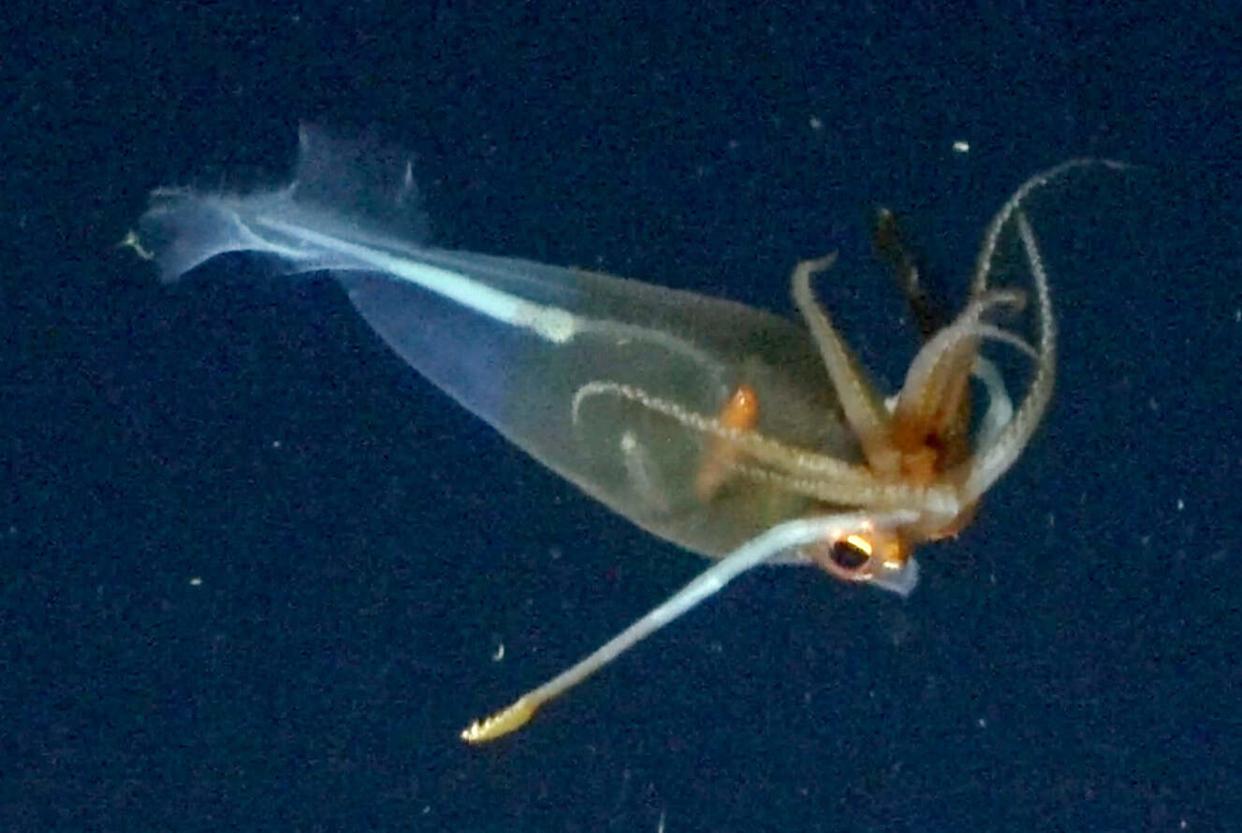
After the End-Cretaceous extinction, squid diversified into new niches, while maintaining a presence in the deep ocean (like this glacial glass squid,
Galiteuthis glacialis
in the Bellingshausen Sea near Antarctica).
©Schmidt Ocean Institute
After millions of years of stability, squid and cuttlefish moved into new ecological niches, generating the diversity of species we see today. Once freed of their dependence on the deep ocean, these 10-legged creatures became more adaptable, varied, and widespread. The End-Cretaceous extinction cleared the way for the evolution of many of the unusual features these animals have today, like strange organs, specialized eyes, and camouflage.
“Squids and cuttlefish have so many unique features compared to other animal groups, making them an endless source of inspiration for scientists,” says molecular geneticist Daniel Rokhsar at the Okinawa Institute of Science and Technology.
Today, spiral-shelled cephalopods called nautiloids, which are restricted to deep waters of the tropical Indo-Pacific region, are the only reminder of their ancient, shelled ancestors.
The post How Squid and Cuttlefish Took Over the Oceans After an Evolutionary Breakthrough appeared first on A-Z Animals.