
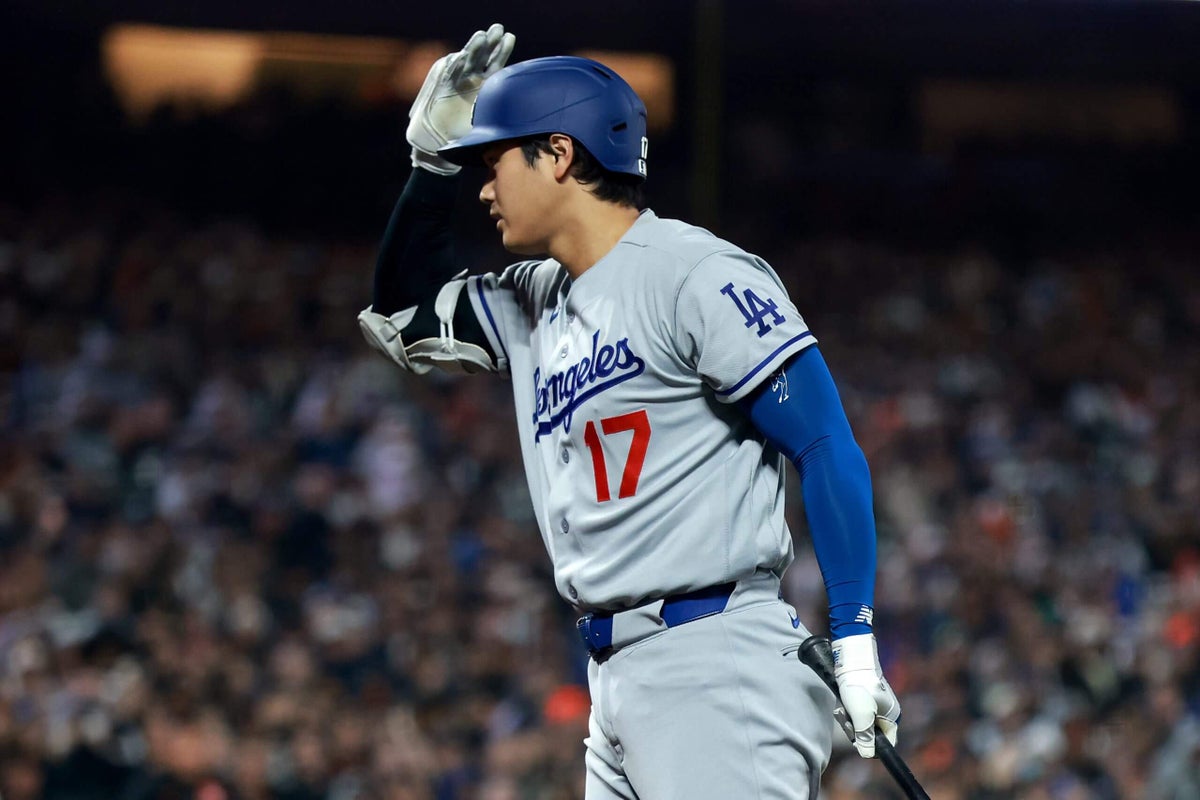
On the 265th pitch of their April 17 game, when the Baltimore Orioles needed some late-inning fortune, Leody Taveras tapped his helmet.
For a few seconds, everyone at Progressive Field — players, umpires, fans, cotton candy vendors — stared at the video board, awaiting the handy diagram that would determine whether the Cleveland Guardians’ lead was in jeopardy. Erik Sabrowski’s 95-mph heater, the image revealed, had crossed the plate 1.2 inches beneath the strike zone. A rally-threatening strikeout was reversed into a rally-bolstering walk, which loaded the bases and spurred a six-run inning.
The challenge ultimately helped the Orioles steal a victory. It also provided a shining example of why the league instituted the ABS challenge system and every team’s ideal scenario for deploying the new tool. Taveras unleashed a lifeline in a high-leverage spot, late in a game and with a full count.
“Even if he didn’t get it right,” said Orioles manager Craig Albernaz, “that’s a perfect time to use it.”
If only it were as simple as saving every challenge for a game-changing moment. One month into the 2026 season and one month into this new endeavor, teams are still feeling out the best ways to teach it, train it, use it, evaluate it and learn from it.
At the same time, defining which teams are good, which are bad, and what approach is best isn’t anything close to simple. Does being successful mean you challenge the most often? Win the highest percentage of challenges? Save challenges for the most important moments? Some teams have been more effective when their catchers are challenging, and restrict their hitters. Others are the opposite.
From a certain point of view, the Twins might be the gold standard so far, challenging anything and everything. They have been correct more than half the time, at roughly 55 percent. Twins hitters have challenged at least twice as many calls as eight other teams’ hitters have.
“It’s a use-or-lose-it situation,” Twins coach Mike Rabelo said earlier this season, “and lucky for us, they have been nails.”
The Rockies and Marlins have followed suit. Miami’s catchers have challenged more than three times as many calls as Boston’s catchers have; both Liam Hicks and Agustin Ramirez rank in the top eight in catcher challenges.
Then there’s the school of thought that doing it right means having the highest percentage of successful challenges. The Royals rank fourth in overturned calls but, since they’ve been a bit more selective, they’re tied for first in success rate, at 63 percent.
How teams have fared (thru 4/25)
Team
Challenges
Overturned calls
Success rate
78
43
55%
77
42
55%
72
38
53%
68
32
47%
65
37
57%
64
32
50%
62
33
53%
61
35
57%
61
31
51%
60
33
55%
60
31
52%
60
27
45%
59
37
63%
55
28
51%
55
27
49%
54
34
63%
53
26
49%
52
23
44%
50
30
60%
50
29
58%
50
21
42%
49
29
59%
49
19
39%
46
29
63%
46
27
59%
45
28
62%
45
27
60%
45
24
53%
40
23
57%
32
17
53%
“One of the real keys with ABS is confidence,” said Brewers manager Pat Murphy, whose catchers rank third in calls overturned.
Murphy sorted through a few papers and pulled out a white sheet featuring a grid with boxes highlighted green, yellow or red. The matrix spells out instances when Milwaukee’s catcher should or should not have challenged. The club’s hitters receive a printout after each game that plots every pitch they saw.
“So they know, ‘I got this pitch. I got that pitch,’” Murphy said. “’Let me look at this one.’ ‘Gah, that was a ball. I thought it was a strike.’ Or, ‘Ehh, I should have challenged that. I could have challenged that.’
“I think everybody will be pretty good at it by the end. But not so much yet. Hitters are a little tentative doing it, too, because they understand the ramifications.”
If the challenge is viewed as a strategic weapon, then even a low challenge rate or low success rate is not necessarily an indictment. The Red Sox have issued eight fewer challenges than any other team, but Alex Cora, who was fired on Saturday, said before his firing that he wasn’t bothered by the low rates. Cora preferred his players targeted high-pressure spots, even if it meant swallowing a potential challenge early in the game.
“We have challenged when we needed to challenge,” Cora said earlier this month. “There are teams that are challenging 0-0 counts in the first inning. If they believe in that and if they feel like going from 1-0 to 0-1 in the first at-bat of the game makes sense for them, then they’re going to do it. It doesn’t make sense for me.
“It’s very important to have them in the last part of the game.”
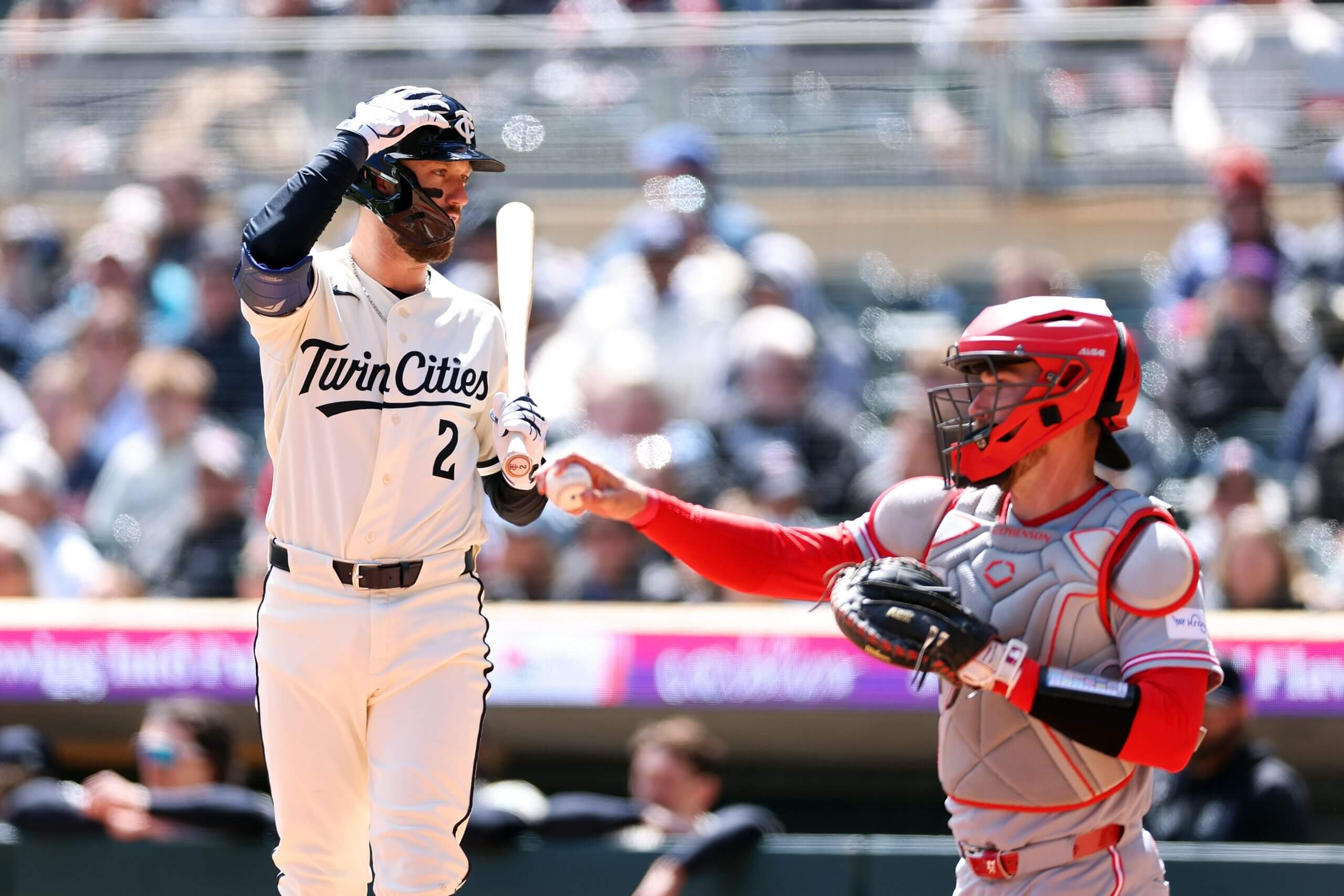
Kody Clemens and the Minnesota Twins are the most aggressively challenging club in baseball. (David Berding / Getty Images)
Angels shortstop Zach Neto did precisely what Cora described. On the first pitch of a game on April 11, when fans were still passing through the turnstiles, Neto tapped his helmet.
Brandon Williamson’s cutter nicked the top, outside corner of the zone. Thirty seconds into the game, the Angels were down to one challenge.
The Angels are tied for seventh in total challenges and eighth in calls reversed. Manager Kurt Suzuki said he has offered “recommendations” and “not rules” to his players, mostly to flex that muscle in a key moment. The first pitch of a game wouldn’t fall in that category, but Suzuki deferred to his hitter’s whims.
“If you feel 100% strongly that it’s a ball,” Suzuki said, “go ahead and challenge it.”
The Nationals sit on the other end of the spectrum, producing an overturned call on a league-low 39% of their challenges. Their catcher, Keibert Ruiz, is 6-for-12, but he admitted he has tricked himself this season because he has improved his framing.
“If I catch it good,” he said, “I think it’s a strike sometimes.”
That might also be the case for Giants catcher Patrick Bailey, who annually rates as the best framer in the business. Expert framing can convince a hitter not to challenge. Or, it can fool a catcher into underestimating their own ability to make a borderline pitch resemble a strike.
“I think that makes sense,” said Bailey, who is 10-for-22 on challenges. “I definitely haven’t been as good as I wanted to be with the ABS.”
Conversely, Royals veteran Salvador Pérez, historically a below-average framer, leads the league with 19 overturned calls in 24 challenges.
“It really comes down to having a catcher who’s confident enough to challenge,” said pitcher Seth Lugo, “and Salvy’s done a really good job for us on that.”
Catchers have proven successful on 61% of challenges this season, compared to 46% for hitters.
ABS challenges breakdown (thru 4/25)
ChallengesTotalSuccessfulUnsuccessfulSuccess rate
Overall
1663
892
771
54%
Batters
764
355
409
46%
Catchers
861
521
340
61%
Pitchers
38
16
22
42%
“The catcher,” said Tigers manager A.J. Hinch, “we have the best seat in the house. It’s right there for you.”
Tigers catcher Dillon Dingler owns an 87% success rate behind the plate (13-for-15), but manager A.J. Hinch is urging him to take more initiative. Detroit’s catchers have issued the third-fewest challenges in the league, despite boasting the highest success rate. Catching coach Ryan Sienko provides feedback each inning on pitches that could have been questioned.
“The ones that are toughest are the ones up and down,” Dingler said. “I’ve started to be a little bit more confident in it because we can check when we go back in the dugout. It’s mostly just trusting yourself in that situation to know the zone.”
The Dodgers have been far more liberal with it when behind the plate than at the plate. Manager Dave Roberts encouraged his hitters to be more aggressive after they neglected to protest several fringy pitches in the ninth inning of their April 19 game, despite having challenges available. They rank second-last in hitter challenges. Shohei Ohtani waited until this past week to issue his first two of the season. (He went 1-for-2.)
The Guardians are aiming to push the envelope more, too. They own the second-worst success rate in the league (42%), but they insist they don’t care about that.
“(Coaches) even told us,” said outfielder Steven Kwan, “‘There’s gonna be a lot of media coverage on accuracy and accuracy is just a sexy number that shouldn’t really mean anything.’ Because it doesn’t matter how many you get right out of how many you challenge, it’s how many you get right in the aggregate.”
Well, as Kwan later acknowledged, the Guardians rank 28th in the aggregate.
“We’re just not aggressive enough,” said Cleveland hitting coach Grant Fink. … “We do not want to be tentative with it. It’s OK to miss some as long as we’re ripping them off at the right times.”
Fink noted several instances in which hitters simply forgot they had the option to challenge, either because they were so engrossed in the at-bat or because they’ve spent years resigned to accepting the umpire’s verdict. Guardians star José Ramírez didn’t issue his first challenge until last Monday.
For hitters, there’s game theory behind the decision, based on the situation. Is it the right count and inning and score? Are there runners on base? Does the team have two challenges left, or only one? Is the hitter completely convicted in the call being incorrect?
That’s a lot of information to cycle through in a split second. It’s why, with two runners aboard and two outs in the bottom of the ninth of a 2-0 game on Wednesday, Kwan left the on-deck circle as the Astros held a mound meeting so he could remind Brayan Rocchio, who was about to bat, that the Guardians still had a challenge in their pocket.
“Runners on, if it flips an at-bat, if it turns a walk into a strikeout, any of those kinds of things, those are no-brainers,” Kwan said. “And the egregious ones, obviously.”
What’s considered egregious, of course, could vary from hitter to hitter or catcher to catcher.
There’s plenty of nuance to this, which is where certain metrics can offer context. Statcast measures how many overturned calls a particular team achieves compared to how the average team would fare seeing the same pitches. The Royals, Cubs and Mets have thrived in that regard, while the White Sox, Yankees and Giants rank at the bottom.
Kwan said a 50-50 pitch could be worth a challenge, but added “if it’s like a 30% chance that it could be right, in a big moment, you should still do it, because you can never trust your eyes completely.”
“You don’t have time to go, ‘The pitch happens… what’s the count… can I do it right now… Oh. It’s too late,’” said Nationals manager Blake Butera. “These guys need to figure it out as they go.”
After all, the pitch could breathe on the corner of the zone and it qualifies as a strike. Many of the calls in question boil down to a couple of tenths of an inch.
“It’s the most beautiful thing ever when it’s a clipper,” said Reds starter Andrew Abbott, who has had two pitches converted into strikes that nicked the zone by 0.9 and 0.4 inches, respectively.
That’s why many teams don’t want their players resorting to a challenge any time they feel aggrieved. It should be strategic, not hubris-driven.
“The emotion is what messes it up,” Murphy said.
Reds manager Terry Francona has appreciated his hitters’ early-game discipline. The Reds rank 26th in total challenges, but they have nailed 60% of them.
“You have to take your pride out of it,” said Reds catcher Tyler Stephenson. “Yeah, it might be a ball, but is it worth challenging and risking losing a challenge if it’s the third inning and you’re leading off the inning?”
In the first inning on April 18, Orioles catcher Samuel Basallo challenged an 0-1 splitter that the umpire ruled a ball. The scoreboard visual revealed that the pitch sailed 1.9 inches below the zone. Basallo shook his head and returned to his crouch, but Dean Kremer was then called for a pitch clock violation. In a matter of seconds, Kremer went from a possible 0-2 count to 2-1.
“Where we get hurt on it,” Albernaz said, “is when our guys become emotional and use challenges at the wrong time, where it’s not ending the at-bat. It’s mid-at-bat and it’s not an egregious ball. That’s something where, with any hitter, there are always emotions when you’re in the heat of the moment. It’s tough to regulate that, but those are the constant conversations that we’re having with guys.”
One month in, it’s still a learning process for everyone, as teams search for the optimal strategies to capitalize on a new wrinkle.
“In a vacuum, it should be simple,” Kwan said, “but I think we’re discovering now, it’s not so simple.”
With contributions from The Athletic’s Cody Stavenhagen, Spencer Nusbaum, Jen McCaffrey, Andrew Baggarly and C. Trent Rosecrans