
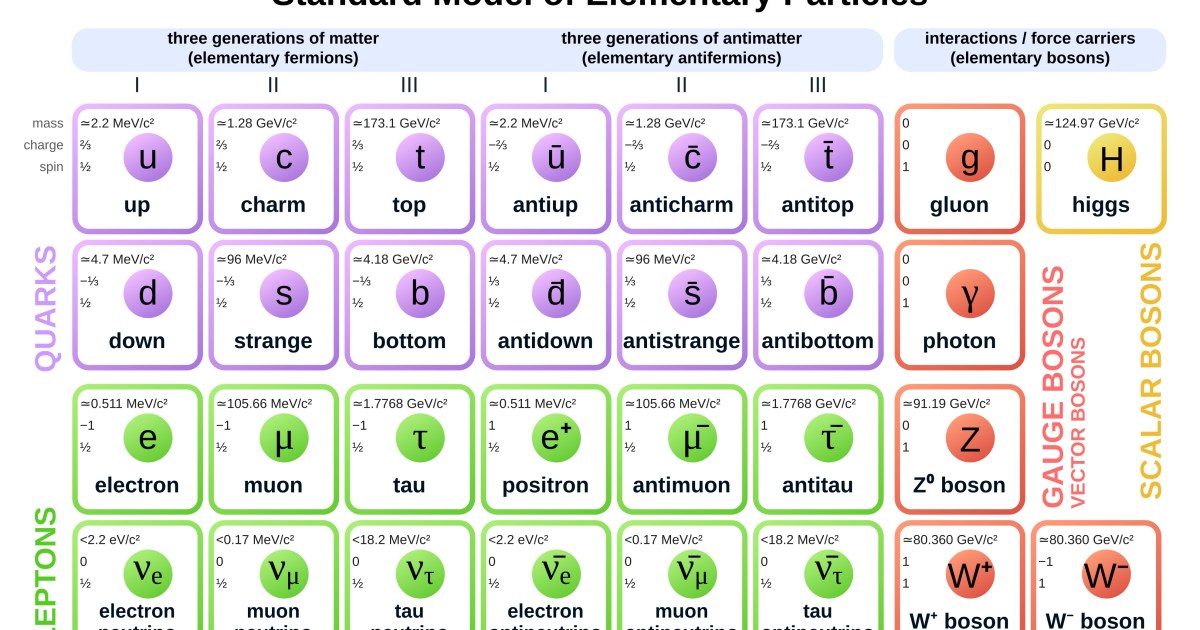
Today’s Standard Model describes our Universe’s particles and forces.
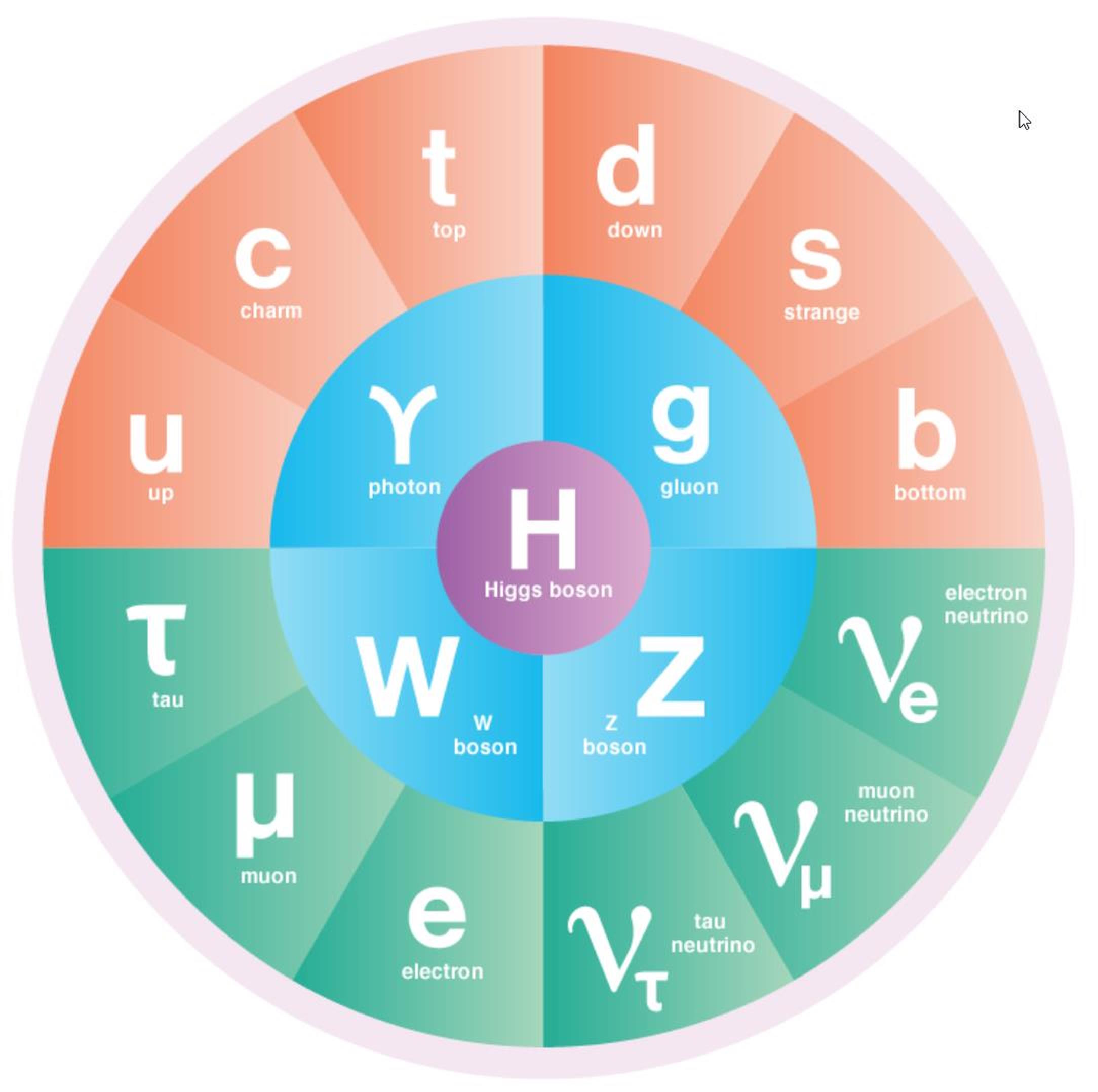
Although there are many similarities and differences within the Standard Model: between quarks and leptons, between fermions and bosons, between particles and antiparticles, etc., displaying the Standard Model’s particle content in this fashion is oversimplified. The six quarks can take on three colors each and all have fractional charges. The tau, muon, and electron are charged leptons, while the three neutrinos are uncharged. Quarks and leptons have antiparticle counterparts, but of the bosons (on the interior), only the W comes in two types: W+ and W-, which are each other’s antiparticle.
Credit: Symmetry Magazine
Six quarks, six leptons, and antiparticles comprise the fermions.
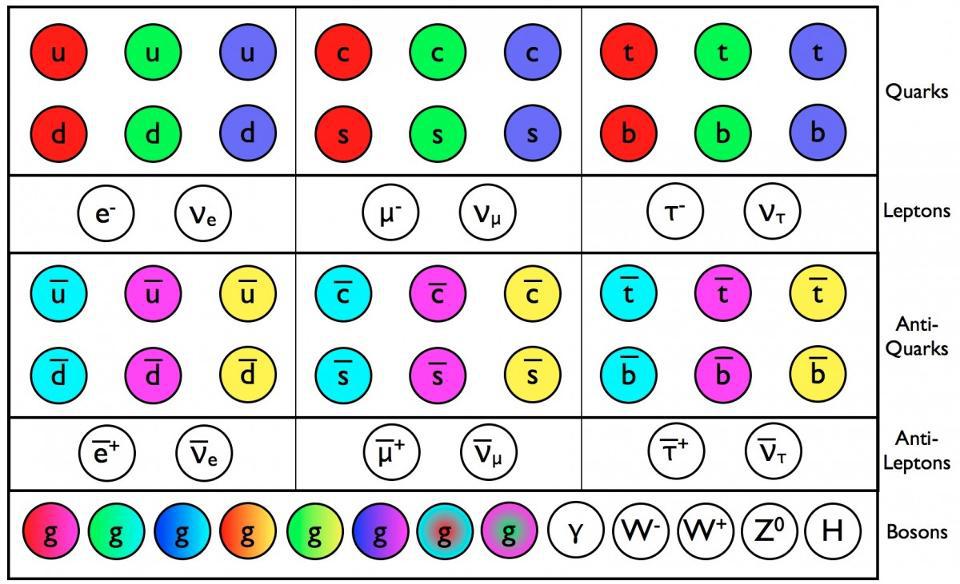
The quarks, antiquarks, and gluons of the Standard Model have a color charge, in addition to all the other properties like mass and electric charge. All of these particles, except gluons and photons, experience the weak interaction. Only the gluons and photons are massless; everyone else, even the neutrinos, have a non-zero rest mass.
Credit: E. Siegel/Beyond the Galaxy
Eight gluons, one photon, the weak W-and-Z, plus one Higgs represent our bosons.
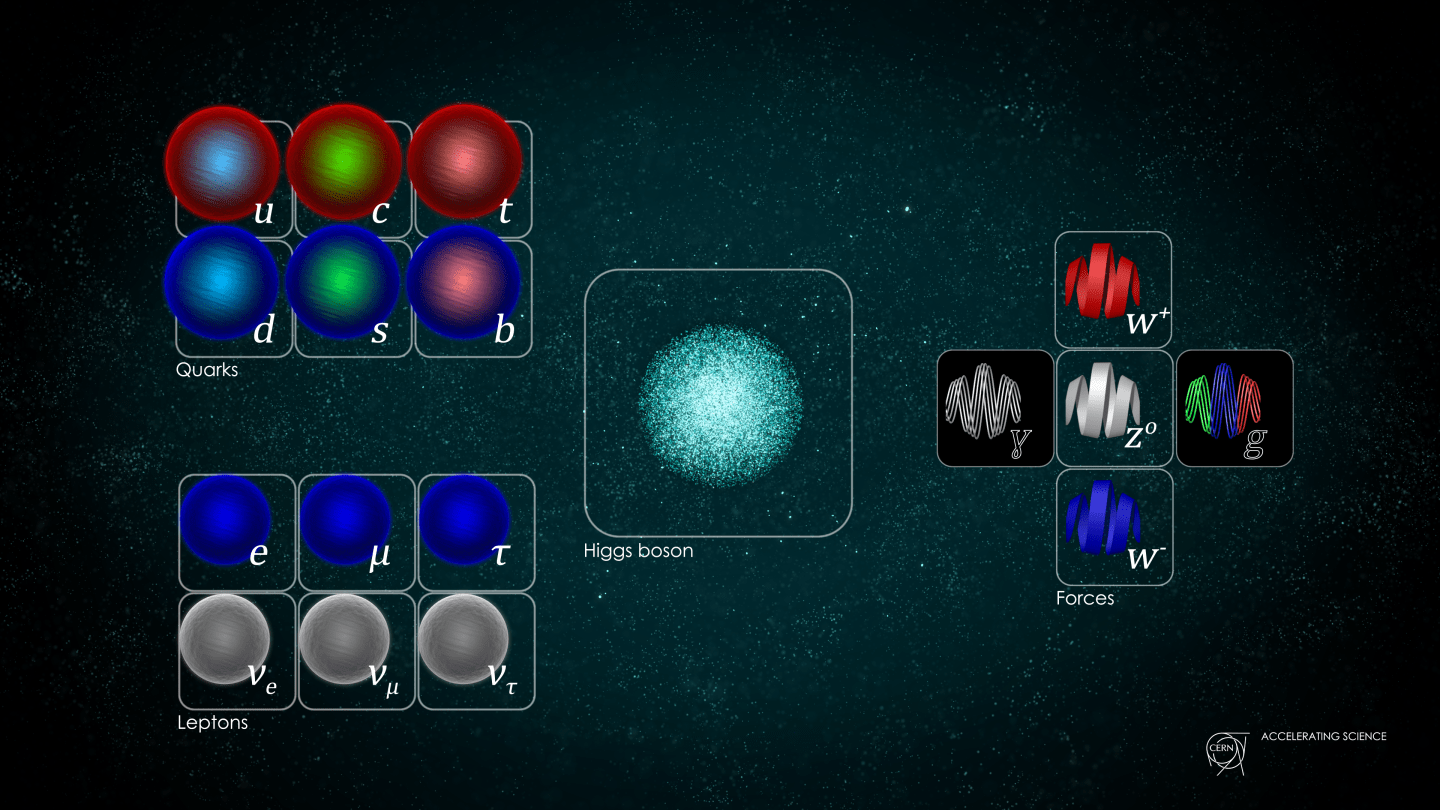
On the right, the gauge bosons, which mediate the three fundamental quantum forces of our Universe, are illustrated. There is only one photon to mediate the electromagnetic force, there are three bosons mediating the weak force, and eight mediating the strong force. This suggests that the Standard Model is a combination of three groups: U(1), SU(2), and SU(3), whose interactions and particles combine to make up everything known in existence. Despite the success of this picture, many puzzles still remain.
Credit: Daniel Domingues/CERN
Gravity, electromagnetism, and strong and weak nuclear constitute the forces.
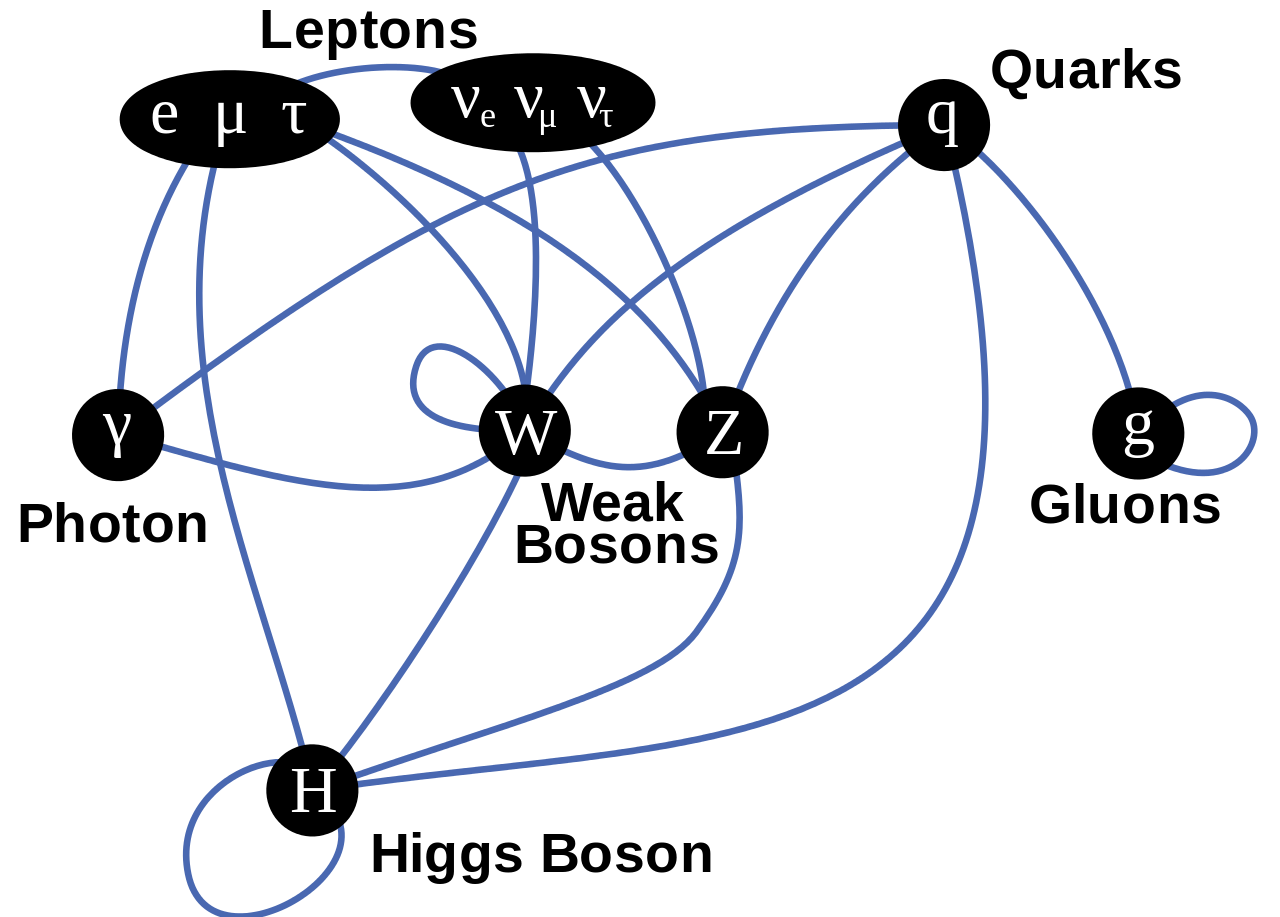
This diagram of the Standard Model particles shows the fermions in the top row, the gauge bosons in the middle row, and the Higgs on the bottom. The lines indicate couplings, and you can see which fermionic particles couple to which of the forces by the blue lines. Everything with mass couples to the Higgs; the only particles which are massless (and hence, do not) are the photon and the gluons. The theoretical graviton, not shown here, couples to everything with energy: all particles and antiparticles. If there are new particles out there, their couplings may reveal their presence, indirectly, through precision measurements that compare the particles’ observed properties with those predicted by the Standard Model.
Credit: TriTertButoxy/Stannered at English Wikipedia
Most particles possess non-zero rest masses.
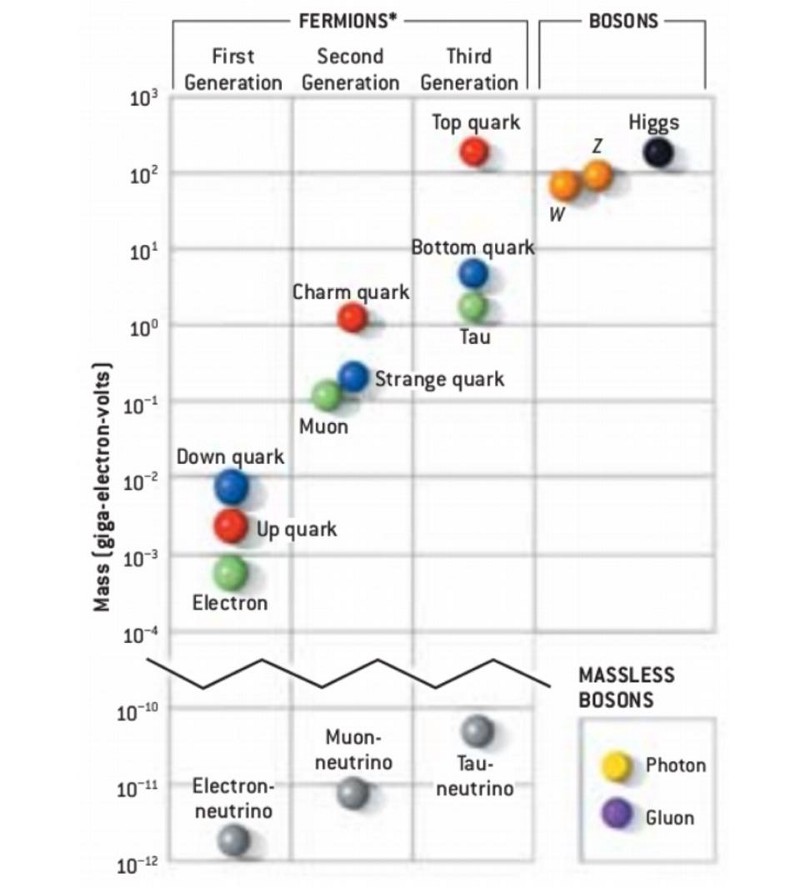
The rest masses of the fundamental particles in the Universe determine when and under what conditions they can be created, and also relate to how long they can survive after their creation during the hot Big Bang. The more massive a particle is, the less time it can spontaneously be created in the early Universe, and the shorter its lifetime will be. Although we can explain particle masses through a coupling to the Higgs, we have no way of successfully predicting their values; they must be experimentally measured in order to be determined.
Credit: Universe-review
Today’s particle and field structure only emerges after electroweak symmetry breaking.
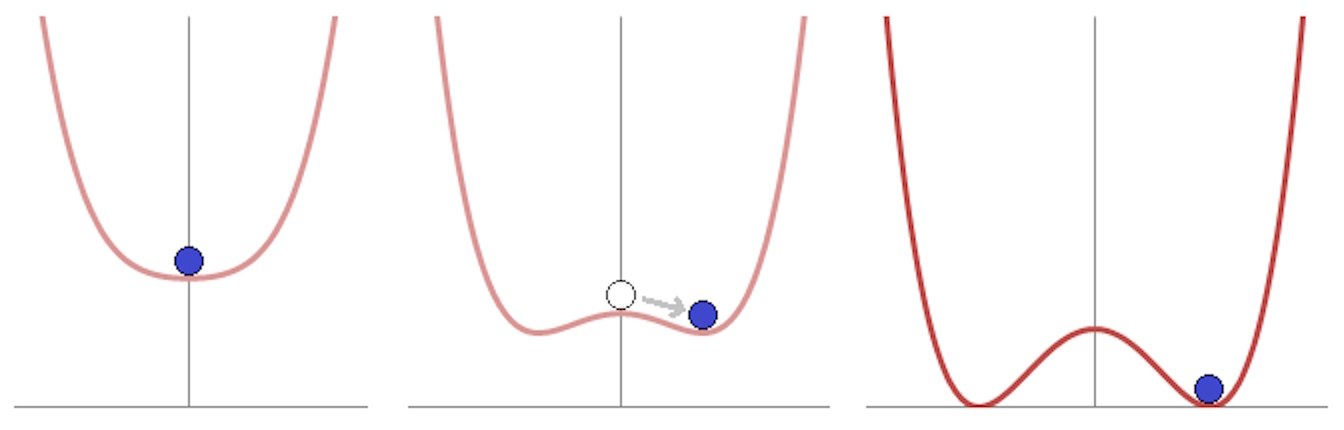
Explanatory diagram showing how symmetry breaking works. At a high enough energy level, a ball settled in the center (lowest point), and the result has symmetry. At lower energy levels, the center becomes unstable, the ball rolls to a lower point – but in doing so, it settles on an (arbitrary) position and the result is that symmetry is broken – the resulting position is not symmetrical.
Credit: FT2/Wikimedia Commons
Above energies of ~100 GeV, electroweak symmetry was restored.
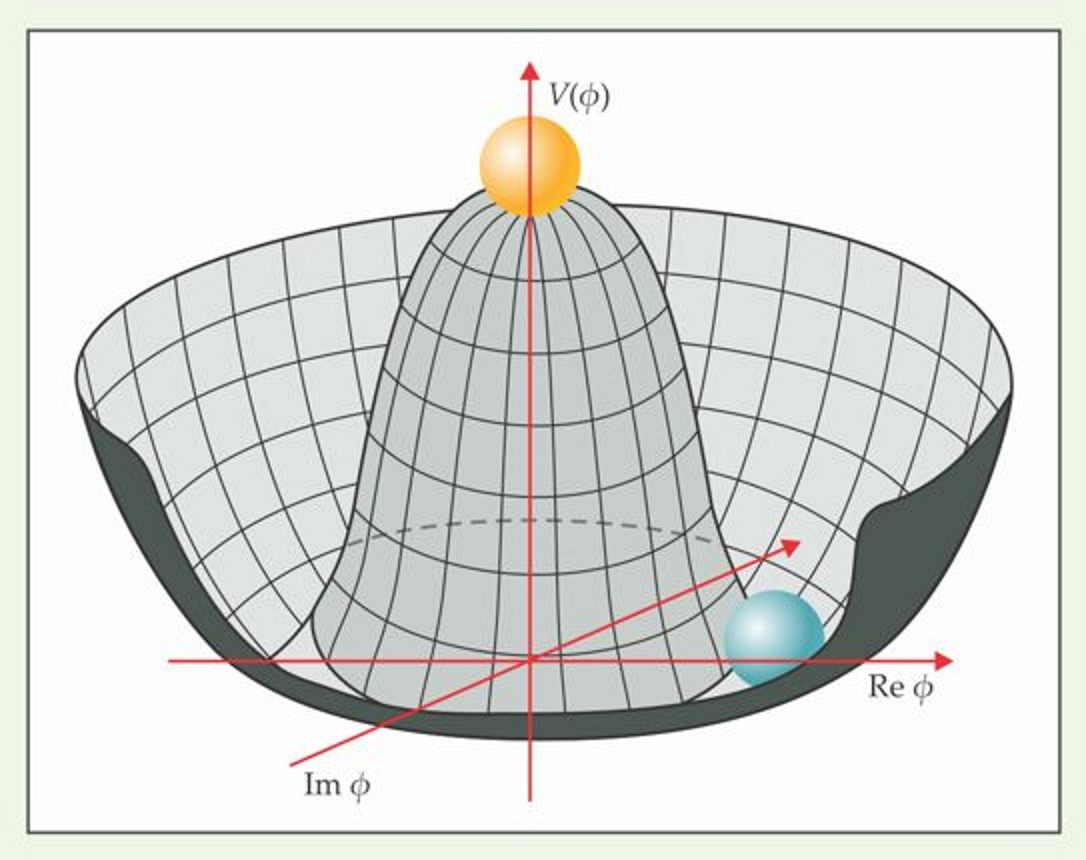
When a symmetry is restored (yellow ball at the top), everything is symmetric, and there is no preferred state. When the symmetry is broken at lower energies (blue ball, bottom), the same freedom, of all directions being the same, is no longer present. In the case of the electroweak (or Higgs) symmetry, when it breaks, there’s a spontaneous process that occurs, giving mass to the particles in the Universe.
Credit: J. Lykken & M. Spiropulu, Physics Today, 2013
Those energies were exceeded during the cosmos’s first 100 picoseconds (10-10 seconds).
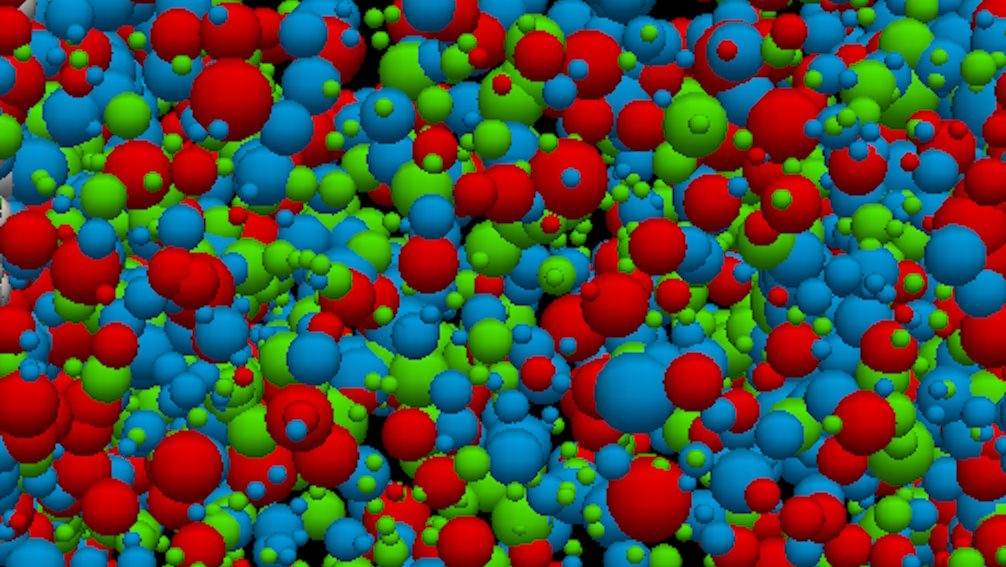
The early Universe was full of matter and radiation, and was so hot and dense that it prevented all composite particles, like protons and neutrons from stably forming for the first fraction-of-a-second. There was only a quark-gluon plasma, as well as other particles (such as charged leptons, neutrinos, and other bosons) zipping around at nearly the speed of light. This primordial soup consisted of particles, antiparticles, and radiation: a highly symmetric state. Today’s Universe, by comparison, is more asymmetric, with more matter than antimatter. Presently known physics does not account for this, and we also do not know what the hottest temperatures achieved during the hot Big Bang were.
Credit: Models and Data Analysis Initiative/Duke University
Three key properties differed back then.
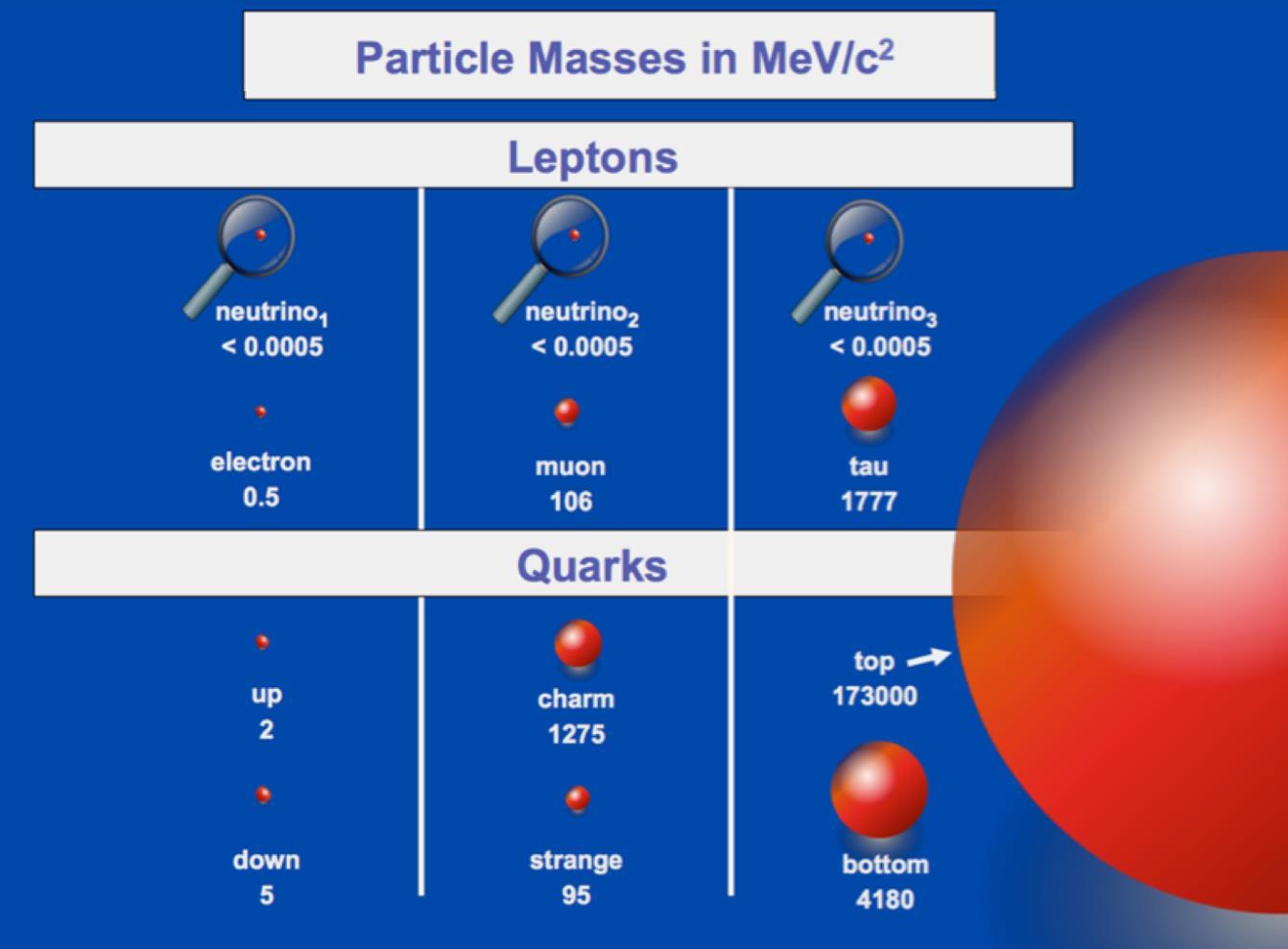
This to-scale diagram shows the relative masses of the quarks and leptons, with neutrinos being the lightest particles and the top quark being the heaviest. No explanation, within the Standard Model alone, can account for these mass values. We now know that neutrinos can be no more massive than 0.45 eV/c² apiece, meaning that the difference between a neutrino’s mass and an electron’s mass is more than three times as large as the difference between the electron’s mass and the top quark’s mass. All of these rest masses are only non-zero after the electroweak symmetry breaks.
Credit: Luis Álvarez-Gaumé/CERN Latin American School of HEP, 2019
1.) All fermions and bosons were massless: with zero rest mass.
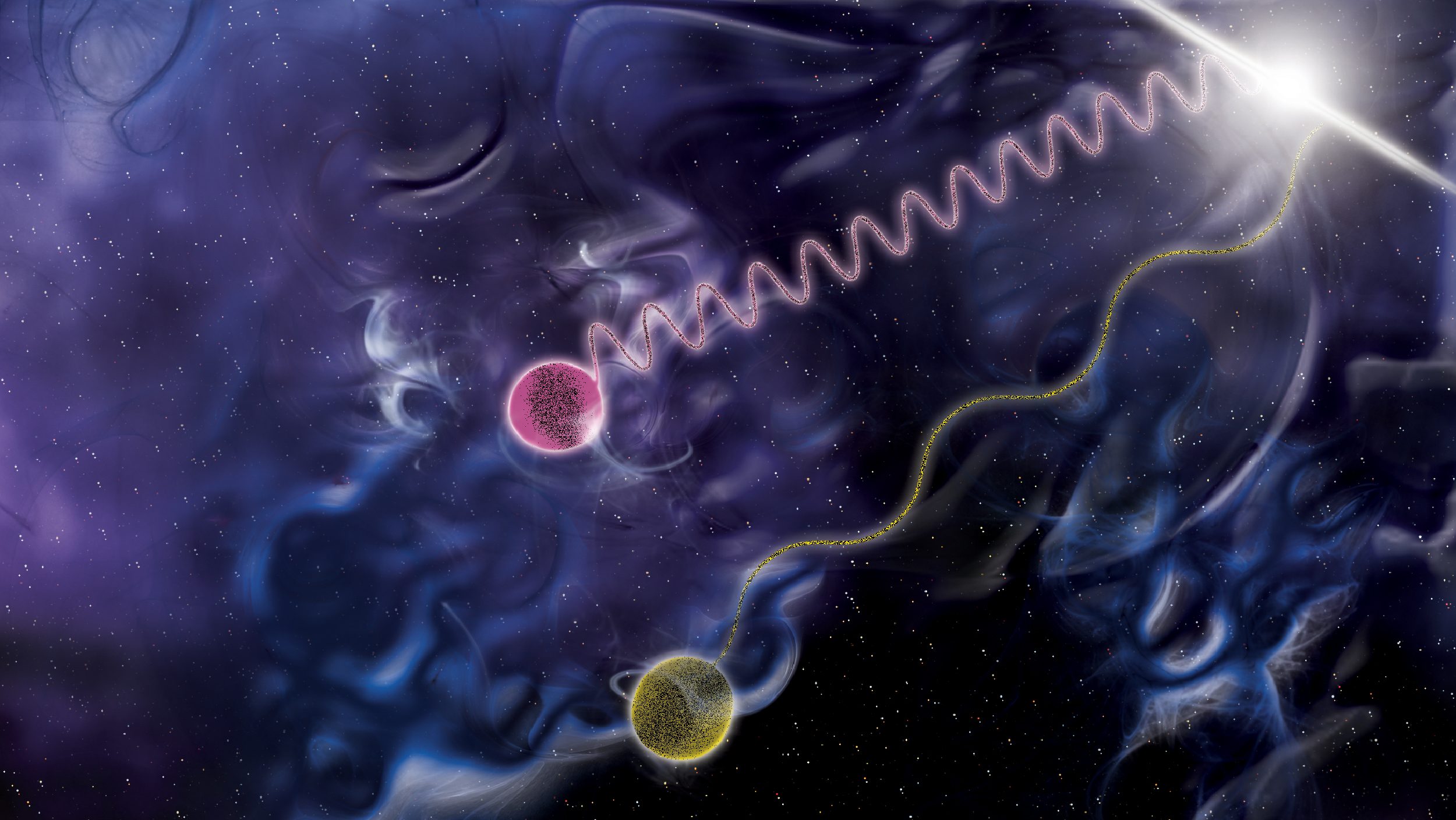
When particles have a rest mass, they can move through space at any speed up to, but not including, the speed of light. When particles are massless, they are compelled to only move through space at the speed of light, with a loss or gain of energy changing the particle’s wavelength, but not its speed.
Credit: NASA/Sonoma State University/Aurore Simonnet
Only neutrinos could’ve possessed mass, potentially from a separate mechanism.
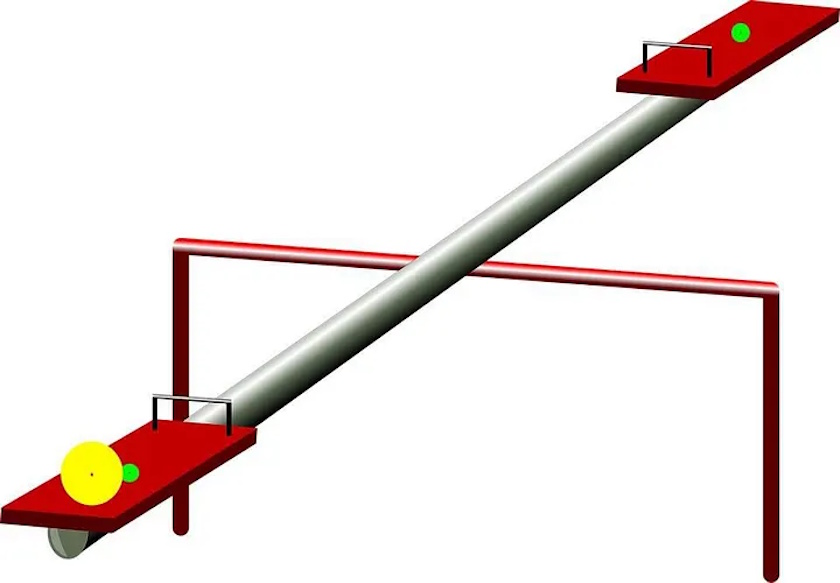
This graphic indicates the see-saw mechanism, which could explain the very light (but non-zero) nature of neutrino masses. If you begin with equal left-and-right handed masses (green dots) but a large, heavy mass falls on one side of the see-saw, it creates a super-heavy particle that can serve as a dark matter candidate (acting as a right handed neutrino) and a very light normal neutrino (acting as a left handed neutrino). This mechanism would cause left-handed neutrinos to behave as Majorana particles.
Credit: E. Siegel/public domain
2.) The W-and-Z, photon, and Higgs bosons didn’t yet exist.
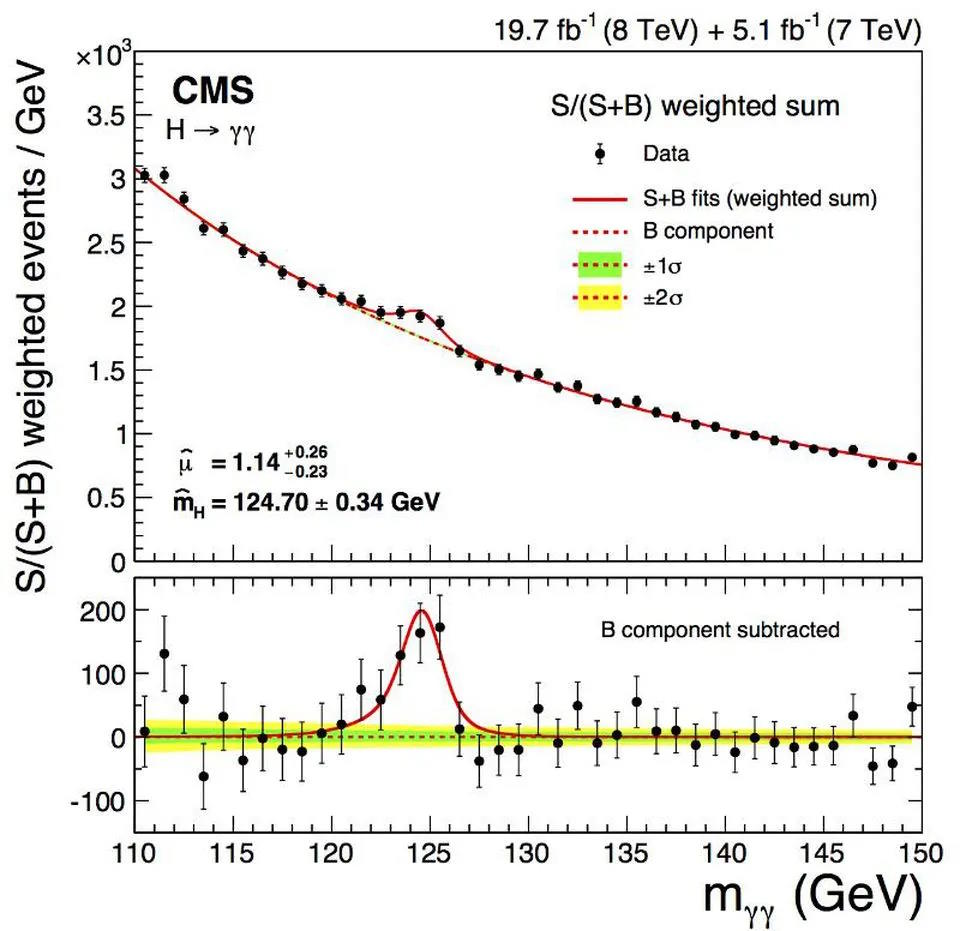
The first robust, 5-sigma detection of the Higgs boson was announced a few years ago by both the CMS and ATLAS collaborations. But the Higgs boson doesn’t make a single ‘spike’ in the data, but rather a spread-out bump, due to its inherent uncertainty in mass. Its mass of 125 GeV/c² is a puzzle for theoretical physics, but experimentalists need not worry: it exists, we can create it, and now we can measure and study its properties as well. In the very early Universe, when the electroweak symmetry was restored, there was no Higgs boson, and all other bosons were massless.
Credit: CMS Collaboration/CERN
Instead, four massless bosons, W1, W2, W3, and the B, plus a Higgs field, existed.

The massless W and B bosons, instead of the W+, W-, the Z, and the photon, were the electroweak bosons that existed as the force carriers back before the electroweak symmetry was broken in the early Universe. When the electroweak symmetry was restored, there was only the unbroken Higgs field present, not the Higgs boson (or any Higgs bosons).
Credit: Flip Tanedo/Quantum Diaries
3.) The electromagnetic and weak forces were replaced.
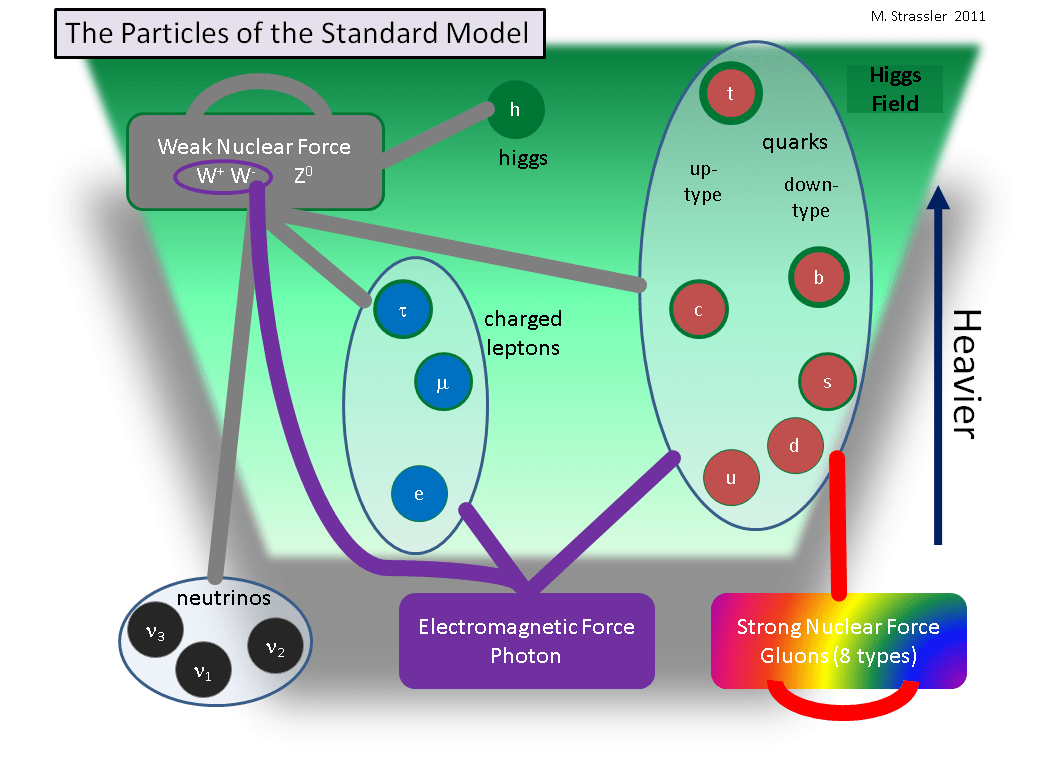
This illustration shows the conventional Standard Model, where the neutrinos, quarks, charged leptons, Higgs, and electromagnetic force all experiences the weak nuclear interaction, while only the electrically charged particles experience the electromagnetic interaction. Although this is the case today, the weak nuclear and electromagnetic forces did not exist in their current form before electroweak symmetry breaking.
Credit: Matt Strassler
Rather, we had electroweak nuclear (W1, W2, W3) and hypercharge (B) forces.
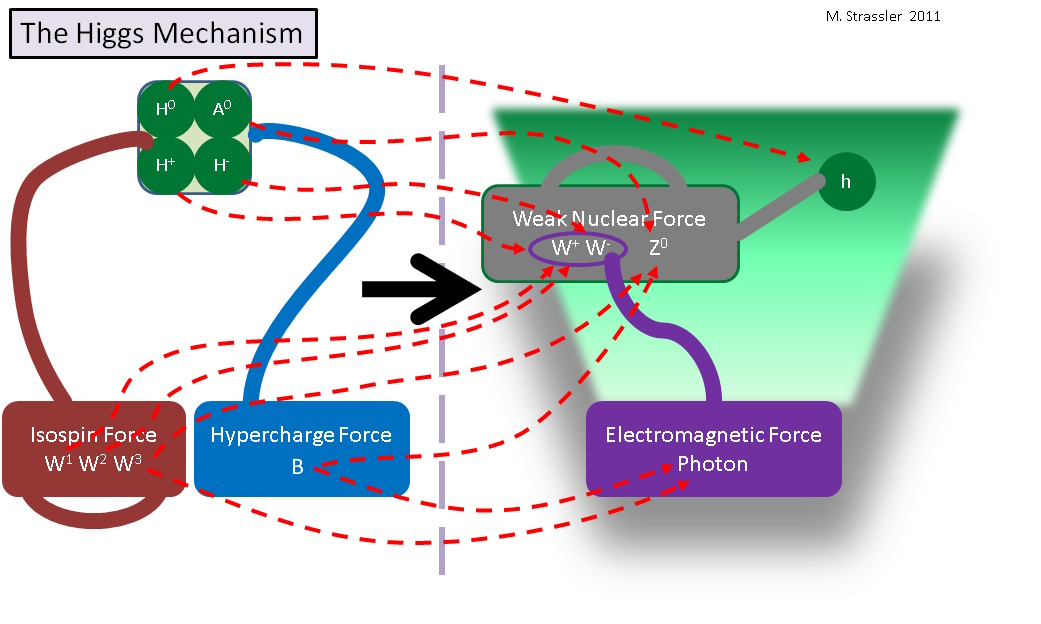
When the electroweak symmetry breaks, the Higgs mechanism transforms the previously symmetric Higgs field into a broken state, transforming the isospin (electroweak) force and the hypercharge force into the modern weak nuclear and electromagnetic forces, while giving rise to a single massive Higgs boson. The originally massless W1, W2, W3, and B bosons are transformed into the W+, W-, and Z0 bosons, plus the massless photon.
Credit: Matt Strassler; slight modification by E. Siegel
The Higgs field also possesses electroweak and hypercharge.
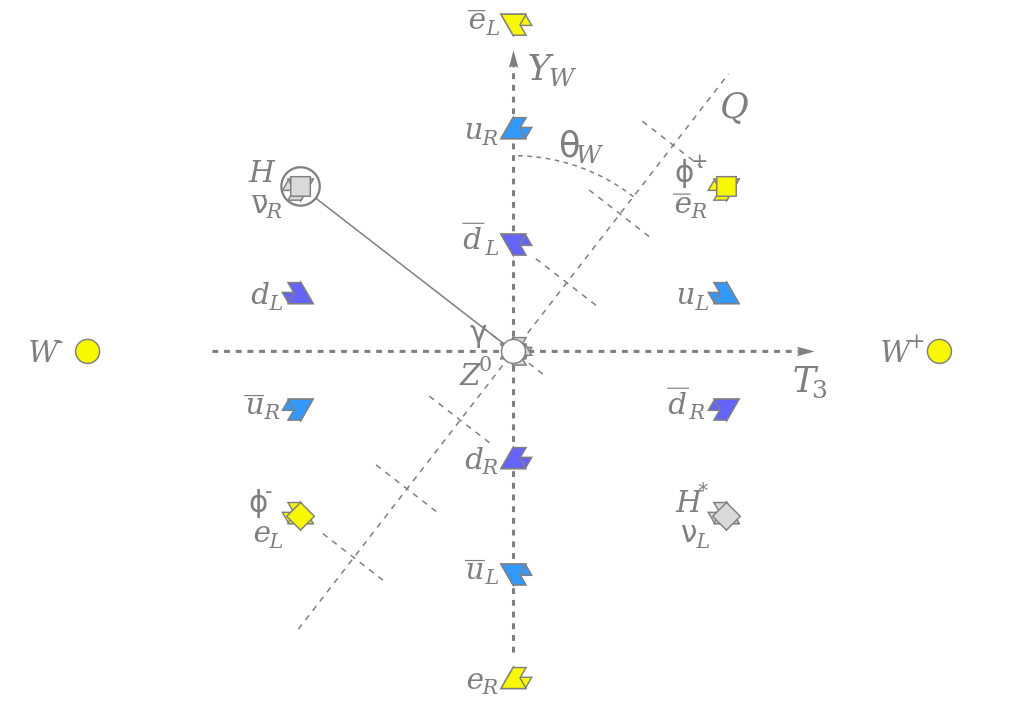
The pattern of weak isospin, T3, and weak hypercharge, Y_W, and color charge of all known elementary particles, rotated by the weak mixing angle to show electric charge, Q, roughly along the vertical. The neutral Higgs field (gray square) breaks the electroweak symmetry and interacts with other particles to give them mass. This diagram shows the structure of particles, but is rooted in both mathematics and physics.
Credit: Cjean42/Wikimedia Commons
When electroweak symmetry breaks, W1 and W2 gain mass and charge, becoming W+ and W–.
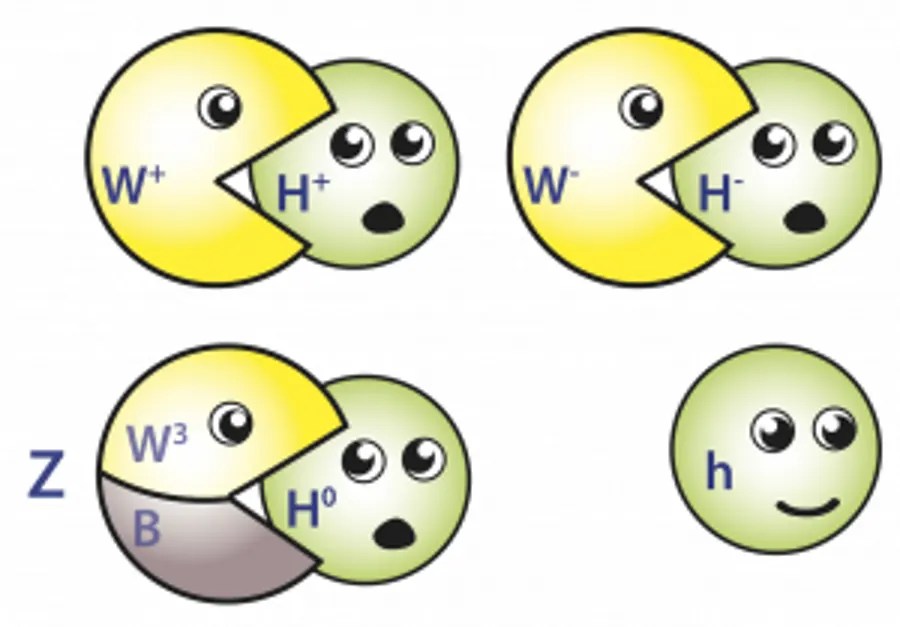
When the electroweak symmetry is broken, the W+ gets its mass by one combination of the W1 and W2 eating the positively charged Higgs, the W- by the other W1-W2 combination eating the negatively charged Higgs, and the Z0 by a combination of the B and W3 eating the neutral Higgs. The other neutral Higgs becomes the Higgs boson, detected and discovered earlier this decade at the LHC. The photon, the other combination of the W3 and the B boson, remains massless.
Credit: Flip Tanedo/Quantum Diaries
The B and W3 combine to become the (massive) Z0 and (massless) photon, with one (massive) Higgs boson emerging.
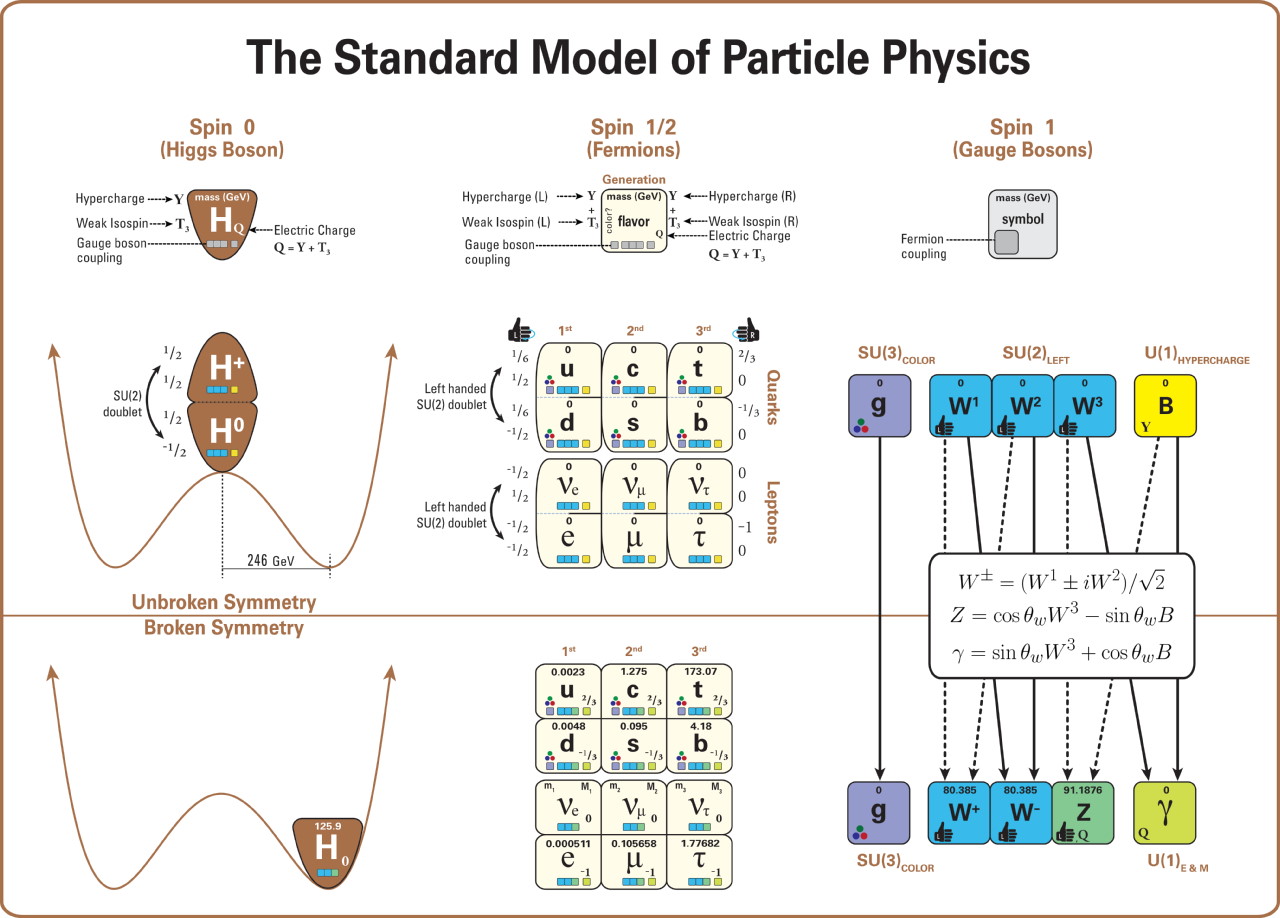
This diagram displays the structure of the Standard Model (in a way that displays the key relationships and patterns more completely, and less misleadingly, than in the more familiar image based on a 4×4 square of particles). In particular, this diagram depicts all of the particles in the Standard Model (including their letter names, masses, spins, handedness, charges, and interactions with the gauge bosons: i.e., with the strong and electroweak forces). It also depicts the role of the Higgs boson, and the structure of electroweak symmetry breaking, indicating how the Higgs vacuum expectation value breaks electroweak symmetry and how the properties of the remaining particles change as a consequence. Neutrino masses remain unexplained.
Credit: Latham Boyle and Mardus/Wikimedia Commons
These unbroken symmetries were short-lived, but existentially important.

When a wine bottle is either completely or partially filled, a drop of oil or a ping pong ball would float on the wine’s surface inside the bottle. At any location, the wine-level, and hence what’s floating atop it, will remain at the same level. This corresponds to a restored-symmetry state, where all locations and positions lead to equivalent values for whatever field this analogy applies to. Once the level of wine exposes the peak at the bottom of the bottle, the symmetry is no longer restored, and is instead broken. The level of the wine is analogous to the energy of the early Universe, and the bottom of the bottle’s peak corresponds to the Higgs field’s potential.
Credit: Brett Jordan/Pexels
Mostly Mute Monday tells a scientific story in images, visuals, and no more than 200 words.