
OWINGS MILLS, Md. — Eric DeCosta was on the clock, and for a few awkward seconds, he struggled with his decision.
The Baltimore Ravens’ polarizing general manager had just ordered a chile chorizo omelette at a breakfast spot near the team’s training facility Thursday morning. When asked about the accompanying side dish, he momentarily froze.
“Sure,” DeCosta finally said to the hovering waitress, offering an apologetic smile. “I’ll have the potatoes.”
Having mapped out the most important meal of the day, DeCosta could now focus on what mattered most. Next up on his plate: Making what amounted to a bonus pick in the first round of the 2026 draft, a selection that once seemed certain to be held by the Las Vegas Raiders. That was the plan until DeCosta called off a blockbuster trade and all hell broke loose, with much of the public vitriol directed his way.
“You have to move forward quickly in this business, and here we are,” DeCosta said. “This is what we’re known for. This is the Ravens’ DNA — the draft — and we’re ready to get this thing done.”
After a trying three-and-a-half month stretch that ranked as perhaps the most challenging of his three-decade stint with the organization, DeCosta was back in his happy place. All the drama of this calendar year — the sudden and painful season-ending defeat to the Steelers; the firing of coach John Harbaugh after 18 seasons; the aborted trade for Raiders star Maxx Crosby — had finally been relegated to the secondary-storyline department.
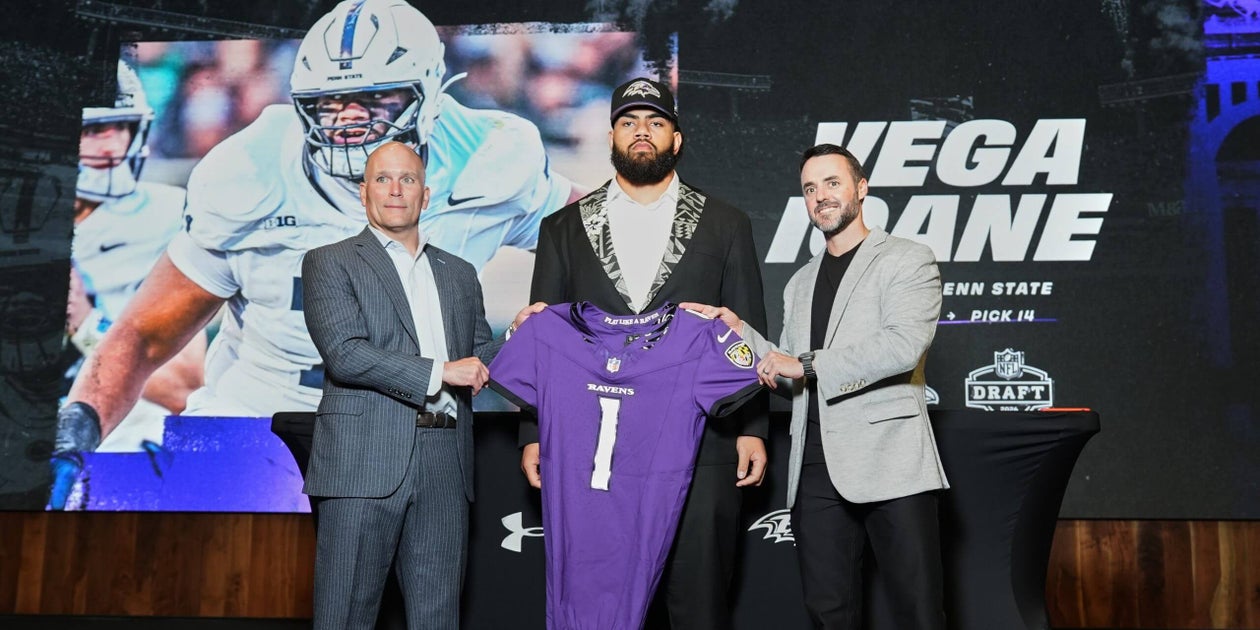
In another 12 hours or so, DeCosta would be back in the chair where he’s most comfortable, doing what he does at a critically acclaimed level. On Thursday night, after shaking off a deal that was short-circuited by another team, the Ravens would make a pick (Penn State guard Vega Ioane) that symbolically spoke to the franchise’s core values.
Then, on Friday and Saturday, DeCosta would methodically attempt to upgrade his roster at numerous positions — with much of that energy geared toward enhancing star quarterback Lamar Jackson’s reality — a prospect that excited him as the three-day marathon approached. His comfort zone was such that he’d even ceded one of his selections to an obsessive draftnik who is fond of telling the GM, “I’m one of your best scouts” — more on that later.
“I think I’m in my sweet spot, which is the draft,” DeCosta said between bites of eggs. “It’s my comfort zone. It’s what I love and it’s what I know the best. It brings me great enjoyment working with the coaches and the scouts, looking at these players and getting ready.
“Something we’ve always been known for is the draft in Baltimore, of course, and we take that very seriously.”
Last month, the 55-year-old DeCosta became known to legions of fans — especially those who revere the Raiders — for something far less flattering. After backing out of an agreement to trade first-round picks in 2026 and 2027 for Crosby, DeCosta was decried as dishonorable, dirty and duplicitous, especially after Baltimore signed another accomplished edge rusher, Trey Hendrickson, to a free-agent deal the following day.
The blowback was so bad that one Ravens executive told DeCosta he had “turned heel” — a pro wrestling term denoting a formerly sympathetic character who is abruptly recast as a villain. That resonated with DeCosta, who grew up in Taunton, Mass. as a WWF fan.
“Wrestling was huge in the ’80s in Massachusetts,” DeCosta said. “I loved wrestling. I remember when I was 11 and Jimmy Snuka got hit in the head with a coconut by Rowdy Roddy Piper, and I started crying. I thought it was real. I think (eventually) even Jimmy Snuka, who was one of my favorite guys, turned heel. So that expression really resonated with me. Someone said, ‘You turned heel,’ and I’m like, ‘Holy s—, I did! I’m reviled now by a lot of the football fans.’”
Despicable Eric DeCosta did what he had to do because, after reviewing three doctors’ assessments of Crosby’s recently repaired left knee, he believed acquiring the five-time Pro Bowl defensive end posed too much of a risk.
“We knew we were going to take a huge hit, so we did not do it lightly,” recalled Ravens owner Steve Bisciotti, who was on a golf course in the Bahamas when he learned of DeCosta’s trepidation. “I said, ‘I understand the firestorm you’re walking into.’ It was very tough for him, because he’s the one that takes the bullets.”
In January, after his surprising decision to fire Harbaugh, Bisciotti stood in the line of fire, owning the decision during a lengthy press conference that, because of the owner’s candor, was largely well received. Harbaugh, whose achievements included 12 playoff appearances, four AFC Championship Game appearances and a Super Bowl victory, immediately became the league’s hottest coaching candidate, ultimately choosing the New York Giants. The Ravens conducted a protracted search, hiring Los Angeles Chargers defensive coordinator Jesse Minter — one of Harbaugh’s former assistants — as the franchise’s fourth head coach.
It was a hectic stretch for DeCosta, and an emotionally charged one. He and Harbaugh, neighbors whose houses were only about a football field apart (they famously converged in their respective backyards to celebrate the end of the 2020 draft during the pandemic lockdown), had worked together for nearly two decades, and DeCosta said he was blindsided by a close friend’s dismissal. Two nights earlier in Pittsburgh, in a game to decide the AFC North, the Ravens had appeared headed for the playoffs thanks to Jackson’s late heroics before rookie Tyler Loop sprayed a 44-yard field goal attempt on the final play.
In DeCosta’s words: “The kick goes sideways, and then the offseason goes sideways, in a lot ways.”
Harbaugh’s dismissal came at the end of a long day that DeCosta had spent mostly at the Johns Hopkins Hospital waiting nervously as two family members underwent procedures: His 22-year-old daughter, Jane, donated bone marrow to her maternal grandmother, who is battling leukemia.
Both are doing well now, but there were some initial complications, and DeCosta’s wife, Lacie, had a hard time reaching him as he navigated the evolving situation back at the team’s training facility. “That was a really long day, with poor communication probably by me,” DeCosta admitted. “It was one of those years. I lost a couple of people in my life — my neighbor and dear friend, and my cousin, Bobby, who’s like my dad’s best friend. We had a couple of long days this year.”
One of those, of course, occurred on Tuesday, March 10, during the “legal tampering” period that preceded the following day’s start of the league year — and four days after the Ravens and Raiders had agreed to the seismic trade for Crosby, which had been widely reported after its completion. Technically, the trade couldn’t become official until the league year began, meaning either side could change its mind for any reason.
Upon arriving in Maryland that Tuesday Crosby, who’d had surgery in January to repair a torn meniscus in his left knee, underwent a physical exam that included a series of imaging tests. After consulting with the Ravens’ team physician — and those of the Dallas Cowboys and New York Giants — DeCosta became uncomfortable with the prognosis. He sat in his office, struggling with the choice that awaited him: Honor the deal, and assume what he now viewed as a significant risk, or be the bogeyman who blew it up.
He called Bisciotti in the Bahamas, telling him, “I’m not sure if you want to sit down for this, but it’s not good news.” Bisciotti gulped and asked for half an hour to consider the situation, after which he called back and agreed with his GM that the best course of action was to renege.
DeCosta sat in his office, dreading what came next. He’d viewed the Crosby acquisition as potentially transformative, akin to the Green Bay Packers’ 1993 signing of future first-ballot Hall of Fame defensive end Reggie White during the first unrestricted free agency class. The lowest moment, he said, was “trying to find the strength to tell Maxx. It was not an easy thing.”
After he and Minter delivered the news to a devastated Crosby, more unpleasantness awaited. “I knew that it was going to be a s—storm,” DeCosta conceded. The Raiders soon issued a curt statement saying the Ravens had “backed out” of the trade, and enmity ensued.
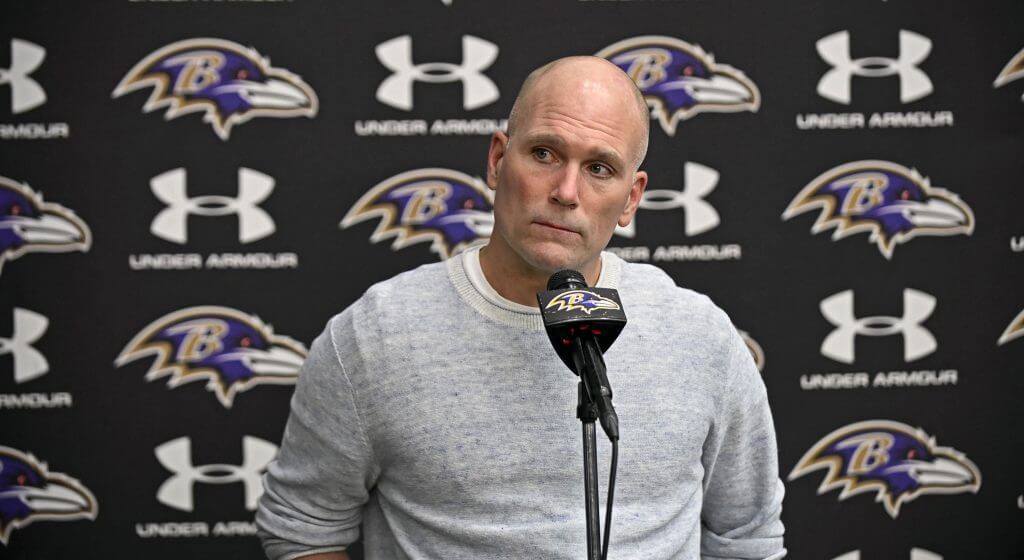
Baltimore Ravens general manager Eric DeCosta was under a microscope after an agreed-upon deal to acquire Maxx Crosby fell through. (Kenneth K. Lam / Getty Images)
The newly hired Minter was struck by DeCosta’s decisiveness and resolve. “He stood out there and did what he needed to do as the general manager of this organization and handled it, like, unbelievably well,” Minter said while sitting in his office shortly before the start of Thursday night’s first round. “And it’s in a way it’s kind of like, ‘That’s fine. That’s what you guys think about us? Whatever.’”
The Ravens’ organizational defiance, and chutzpah, was underscored when it was announced the next morning that Hendrickson, a four-time Pro Bowl defensive end with the AFC North rival Cincinnati Bengals, had agreed to a four-year, $112 million deal. DeCosta, like most other GMs, had expected Hendrickson to be off the board by then, but a surprisingly soft market dropped the player’s asking price. Hendrickson met with Ravens coaches on a video call on Tuesday the 10th, even as Crosby was in the building. Theoretically, Baltimore could have landed both players to shore up an ailing pass rush; after bailing on the Crosby trade, he became a pretty convenient fallback.
“You have to pivot,” DeCosta said. “It’s like with the draft. You have a name on the card. That guy gets picked. You go to the next guy. The only way I really know how to operate is to have a plan and to move forward as strategically and quickly as possible. And that was Trey, and we were absolutely fired up. He just seems like a classic Raven.”
The outraged reactions only intensified, including claims that teams would be reticent to do business with the Ravens in the future. Asked Thursday morning whether he’d noticed any change in the six weeks that followed, DeCosta laughed and said, “I do get phone calls from GMs. I do talk to agents often about deals. I have GMs who are calling me about trades. So I think maybe that storm has subsided, and we’re open for business again.”
DeCosta has “known since I was 8 years old that I wanted to be an NFL GM,” and the Ravens are the only franchise he has ever known. He had the good fortune of being mentored by legendary Baltimore GM Ozzie Newsome, a Hall of Fame tight end who, as Baltimore’s general manager from 2002 to 2019, may have been even more accomplished than he was as a player. Newsome made DeCosta the draft room’s point person on trades as a 26-year-old player personnel assistant in 1997, and Bisciotti told DeCosta in 2007 that he’d be Newsome’s successor. After rebuffing numerous overtures from other teams seeking general managers, DeCosta finally took over after the 2018 season. Newsome, 70, stayed on as a Ravens executive vice president and remains in that role.
Bisciotti’s succession plan, the owner explained late Thursday night, was based on his observation that DeCosta was “adored by his boss. Trust me, it was Ozzie’s belief in Eric that (convinced me); he was going to be The One. And, you know, they’re completely different people. Eric’s feisty, and Ozzie is really measured. And that’s why I wouldn’t let Ozzie retire. I want both.”
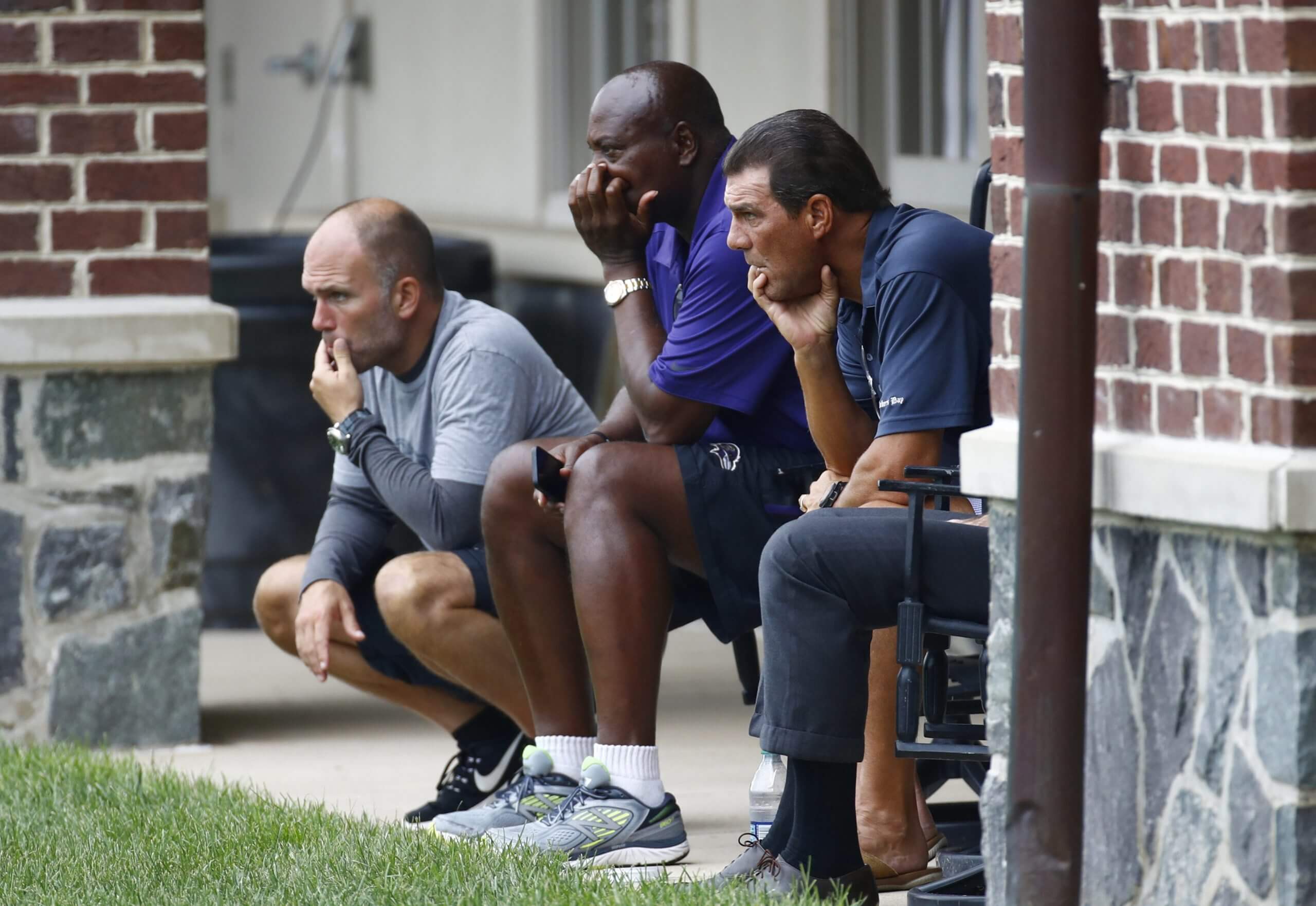
Eric DeCosta, far left, was tagged as legendary Ravens GM Ozzie Newsome’s by owner Steve Bisciotti, right. (Patrick Semansky / AP)
Many of DeCosta’s peers revere his talent-evaluation skills, roster-building approach and intensity.
“Eric has become one of the best in the NFL at building and sustaining a championship-caliber roster,” said Eagles executive vice president and general manager Howie Roseman, one of the sport’s most successful GMs. “He was patient throughout the years, even when presented with other opportunities, because he knew the value of working with and learning from Ozzie Newsome, one of the greatest general managers in the history of this league — so that when he got his shot, he could be great. Eric has carried on the standard Ozzie set but has also put his own stamp on the Ravens.”
Said a high-ranking personnel executive for another NFC team: “He’s unique in that he’s got exceptional intelligence, but he also has that Boston grit and toughness bred in him. He’s a true Masshole that is afraid of no one, and I say that as a huge compliment.”
Whether cast as an endearing tough guy or a wrestling villain, DeCosta is ultimately judged on performance — and the draft is his headlining gig. After 18 years of collaborating with Harbaugh, he was energized by the opportunity to experience a draft with Minter and his assistants for the first time, saying it “sharpens you a little bit and creates a little more urgency.”
The Ravens went into this draft with obvious needs — interior offensive linemen, pass-catching targets and edge rusher being the most glaring — but what DeCosta craved most of all was a return to the team’s hard-nosed roots. With the 14th selection, he targeted a cluster of players that included offensive linemen (Spencer Fano, Francis Mauigoa and Ioane), wide receivers (Carnell Tate and Jordyn Tyson) and tight end Kenyon Sadiq. As the pick approached, both Ioane and Sadiq remained available; surprisingly, another player he coveted, former Miami edge rusher Rueben Bain Jr., was also there for the taking.
With three enticing options, DeCosta was willing to trade back — and he thought he had a deal worked out with a team (which he declined to name) that would keep the Ravens picking in the teens and allow them to pick up extra fourth-round picks in each of the next two drafts. Once on the clock, however, the trade fell through. This time, it was not DeCosta’s doing. “We had something on the table, but inexplicably they told us they’d changed their mind,” he said Friday morning. “They changed the deal (and made another offer that wasn’t as good), and we passed.”
In making his choice, DeCosta gave a lot of weight to the desires of Minter and his assistants. “Jesse had a really strong opinion (about wanting Ioane),” DeCosta said. “That really resonated with me.”
DeCosta had last used a first-round draft pick on an offensive lineman in 2022, when he selected center Tyler Linderbaum 25th overall. Linderbaum, a Pro Bowl selection in each of the past three seasons, signed a three-year, $81 million deal with the Raiders at the start of free agency, which added additional intrigue to the commotion surrounding Baltimore’s abandonment of the Crosby trade.
In his initial video news conference with reporters Thursday night, Ioane sounded like a mauler out of central casting, saying he hadn’t wanted to go to a team that played “soft football” and that “nobody is going to touch my quarterback.” Added Ioane: “When I’m on the field, nobody is going to stand in front of me and survive.”
The “size matters” theme continued Friday, as Baltimore selected an edge-setting defensive lineman (Missouri’s Zion Young) and a tall, athletic wide receiver (USC’s Ja’Kobi Lane) with its second- and third-round picks. More targets for Jackson arrived Saturday, with DeCosta nabbing another bigger receiver (Indiana’s Elijah Sarratt) in the fourth round and adding tight ends (SMU’s Matthew Hibner and Alabama’s Josh Cuevas) in the fourth and fifth rounds, respectively.
All in all, Baltimore would select 11 players — but DeCosta would only make 10 of those picks. That’s because one of the Ravens’ compensatory picks in the fifth round (the 174th overall selection, which immediately followed the one used to acquire Cuevas) was decided by perhaps the most draft-obsessed person in the organization: Bisciotti.
For years the owner, now 66, has watched tape, done his own player evaluations and sent observations and suggestions to DeCosta, mostly about players who might be available in later rounds — without exerting any actual decision-making power. This time, however, Bisciotti found a way to flex, with his GM’s blessing.
The seed was planted just before the start of free agency, on the same day the Crosby trade was consummated, when Bisciotti, as per custom, conducted meetings with DeCosta and other members of the team’s braintrust at his Jupiter, Fla. home. Eventually, the meetings adjourned and turned into a social occasion. As drinks flowed, Bisciotti began playfully lobbying DeCosta, saying, “We have four fifth-round picks. You should let me make one of them.”
Recalled DeCosta: “We were joking back and forth about how he’d never gotten a pick. Way back in 1998, David Modell, who was our team president, got to make the last pick. It was the ‘Mr. Irrelevant’ pick, and he took a tight end named Cam Quayle from Weber State. I finally said to Steve, ‘You know what? You can make that (174th overall) pick.’”
From that point on, the owner began plotting a course of action with his “assistant GM” — DeCosta’s 15-year-old son, Jackson.
Explained Bisciotti: “We were communicating through Eric, but we were afraid that he was going to steal our intel and take our guy (with the 173rd pick). So I asked him for Jackson’s number, so we could work in private.”
DeCosta sent the owner his son’s contact card via text, adding with a touch of dry humor: “He only asks one thing — that you not share his number with anyone.’”
As the fifth round played out Saturday, the tension built. Would the owner choose a center who might enter the competition to replace Linderbaum? Would he try to shore up the interior of the Ravens’ defensive line? The elder DeCosta had other suspicions. Bisciotti is friendly with Clemson coach Dabo Sweeney (who also has a home in Florida), and, DeCosta said, “He and my son both love the workout warriors.”
The GM’s instincts were good: Bisciotti was locked in on running back Adam Randall, a converted receiver projected as a potential third-down specialist.
In the draft room, Bisciotti looked nervous as the pick approached, worried another team — or even his own GM — might snag Randall. “I don’t know that he really had a backup plan,” DeCosta said Sunday, laughing. He didn’t need one, but once the Ravens were on the clock, Bisciotti became visibly stressed as he second-guessed his decision.
“This s— is hard,” he admitted, before officially deciding on Randall as his choice.
DeCosta could relate: “When you actually make the pick, that’s a bare feeling.”
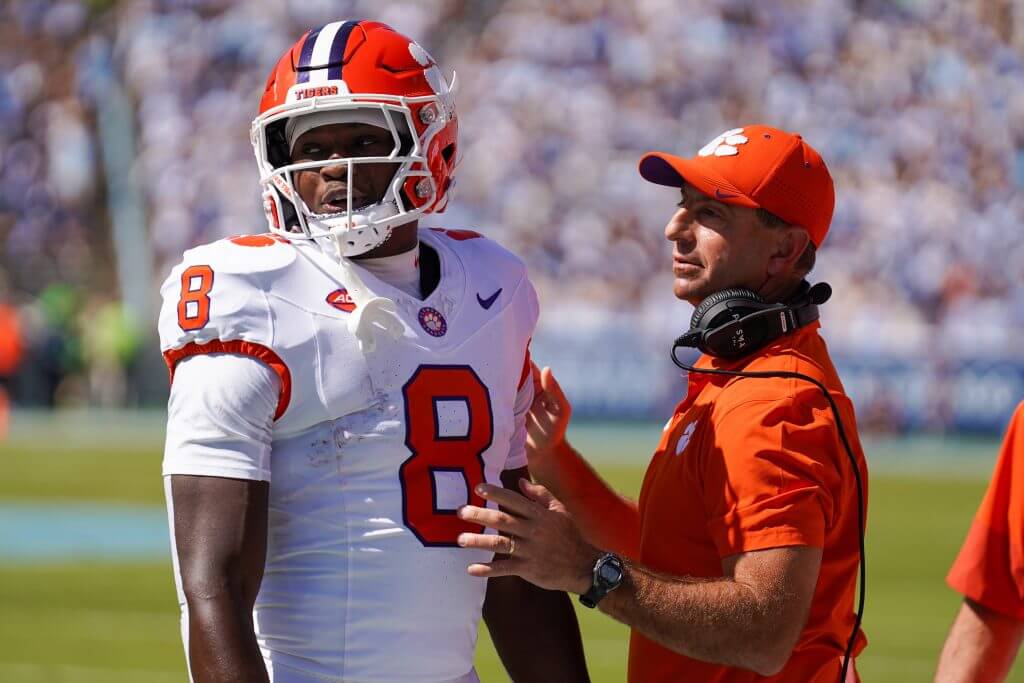
The Ravens drafted running back Adam Randall, after owner Steve Bisciotti consulted with Clemson coach Dabo Swinney. (Alex Halloway / Getty Images)
With the age-defying Derrick Henry as the Ravens’ lead running back, it’s unlikely that Randall will “eat” anytime soon. Jackson DeCosta, a tall and slender teenager with a metabolism faster than Lamar Jackson’s 40 time, had no such worries during a long Saturday in the draft room, according to his father.
“In a span of seven hours, he probably consumed 7,000 calories,” Eric DeCosta recalled Sunday. “Pulled pork, pulled chicken, multiple Cokes, two smoothies, Skittles, chocolate, an egg sandwich, chips and salsa, chicken tenders — he was a machine.”
All in all, as he looked back on the three-day event he lives for, DeCosta was extremely pleased. Sure, he had his regrets, including not drafting a center to replace Linderbaum (two targets went earlier than expected in the second round, after he’d selected Young, who was at the top of Baltimore’s board at the time), but things had largely played out to his satisfaction. That included using a sixth-round selection on his highest-rated punter, Michigan State’s Ryan Eckley, to replace departed All-Pro Jordan Stout, and sweating out numerous other teams’ selections — and avoiding the temptation to trade up — to land a fifth-round target (Duke cornerback Chandler Rivers).
DeCosta did make one trade, sending one of his fifth-round picks and a 2027 sixth-rounder to the San Francisco 49ers to grab Hibner in the fourth round. He’s excited by Hibner’s potential — and also gratified by the transaction’s emblematic significance.
No one will ever do business with DeCosta or the Ravens again?
“That narrative,” the GM said, “can no longer be repeated.”