
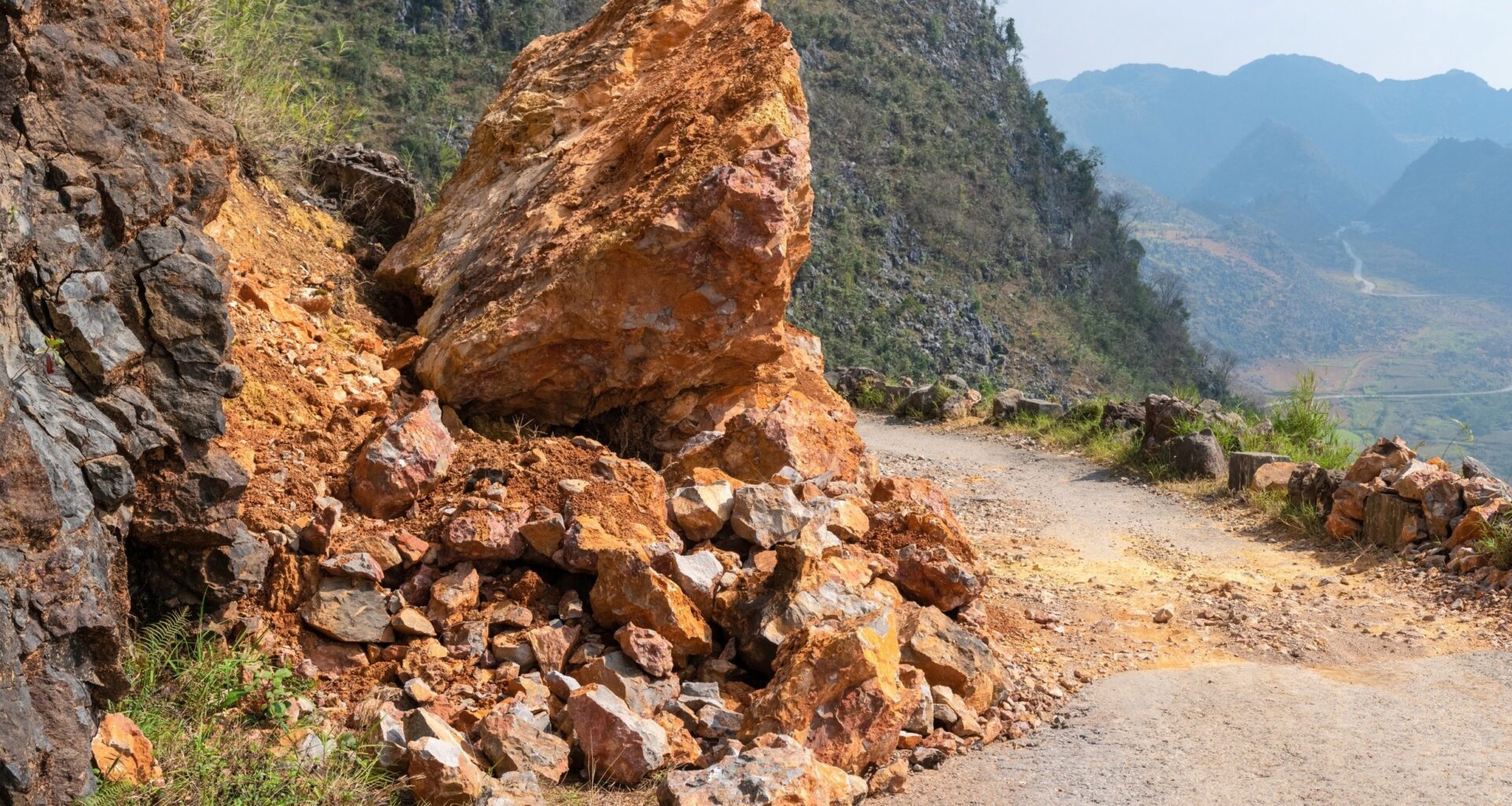
Rocks look solid and silent, as if nothing could disturb them. But deep inside, they react to stress in ways we are only beginning to understand.
Before a rock finally breaks, it gives off tiny chemical signals. You could think of it as a quiet warning, long before anything visible happens.

These signals come from atoms called nuclides. As pressure builds, rocks release small amounts of gases like radon and helium.
Scientists have known about this for decades. The hard part has always been timing. When exactly do these signals mean a rock is about to fail?
Warning signs of breaking rocks
For years, researchers noticed odd bursts of these gases before earthquakes or landslides. Still, they could not clearly link those bursts to the actual moment when rocks crack. That gap made it difficult to use the signals for real-world warnings.
A new study has taken a big step forward. It connects changes in these chemical signals to the physical process of rocks breaking apart.
The work comes from a team led by scientists at Hong Kong University, Wuhan University, and the University of California, Berkeley.
“We explicitly link these structural changes to measurable features of nuclide signals. To our knowledge, this is the first study to establish a quantitative theory for diagnosing rock rupture using naturally occurring nuclide signals,” said Rong Mao, a co-first author of the study at New Jersey Institute of Technology.
What happens inside a stressed rock
As stress builds, rocks do not fail all at once. They go through stages. Tiny cracks form first. Then those cracks open, grow wider, and begin to connect. Eventually, the structure gives way.
During this process, gases trapped inside minerals escape into small spaces and fractures. As the cracks expand, more gas can move through the rock and reach the surface. This creates unusual patterns in the signals scientists can measure.
Earlier lab experiments showed this clearly. Researchers saw that as rocks cracked, the release of gases changed in ways that could be tracked.
Field observations told a similar story. In Kobe, Japan, radon levels rose about nine days before a magnitude 7.2 earthquake in 1995.
In the French Alps, radon bursts appeared near reservoirs where water levels kept shifting the surrounding rock.
The new study pulled together data from both controlled experiments and real-world settings.
One experiment followed a granite cylinder for a month as it slowly weakened and broke. Another tracked radon emissions for three years from a hillside near a reservoir.
Using this data, the team built a model that maps how signals change as rocks move through different stages of failure.
“Our model shows how nuclide signals evolve as rock rupture progresses through four stages: crack initiation, crack opening, crack dilation, and crack propagation,” said Mao.
“These stages correspond to distinct signal characteristics that can be quantitatively interpreted.”
The model matched what scientists saw in the lab. It also worked in natural settings, where conditions are far more complicated.
That matters, because real landscapes are messy. Rocks interact with water, temperature changes, and other forces that can affect the signals.
Early warning and risk management
When rocks fail, the results can be serious. Landslides, avalanches, and even stronger impacts during earthquakes and volcanic eruptions can follow. Being able to spot early warning signs could save lives and reduce damage.
Nuclide signals offer a promising way to do that. They can travel from deep underground to the surface, where instruments can detect them. That makes them useful even when the source of the stress is hidden.
“In such settings, nuclide signals provide a sensitive and potentially real-time indicator of subsurface structural changes, offering valuable information for early warning and risk management,” Mao said.
The complications beneath the surface
Nature rarely keeps things simple. The study found that other factors can influence these signals. Fluids deep underground, such as hot water or salty brines, can boost the release and movement of gases.
“For example, deep fluids, such as thermal waters or brines, often have higher salinity or temperature, which can enhance nuclide release and transmission, leading to amplified signals,” explained Mao.
“When rock rupture connects to these deep fluid pathways, the observed signals may reflect both structural changes and fluid mixing processes. Incorporating these effects into the model will be an important direction for future work.”
These added layers mean scientists still need to refine their models. They must separate signals caused by cracking from those influenced by fluids and other conditions.
The research will continue
The research team is already putting their ideas to the test. They have set up radon monitoring stations in several high-risk areas in China, including landslide-prone zones near major reservoirs.
“These facilities are deployed to capture hydrogeochemical precursors of potential geohazards, to further validate and refine our theory. Our research journey is far from over,” said Jia-Qing Zhou, a co-first author and associate professor at Wuhan University.
There is still work to do, especially in figuring out how quickly signals move and how early they can be detected before a failure.
“While our model begins to quantify the timescales of signal genesis and transmission, this aspect has not yet been fully validated in field conditions,” said Mao.
“Addressing this gap will be critical for translating our framework into practical geohazard early warning systems.”
Rocks may seem quiet, but they are not silent. With the right tools, scientists are learning to listen.
The full study was published in the journal Proceedings of the National Academy of Sciences.
—–
Like what you read? Subscribe to our newsletter for engaging articles, exclusive content, and the latest updates.
Check us out on EarthSnap, a free app brought to you by Eric Ralls and Earth.com.
—–