
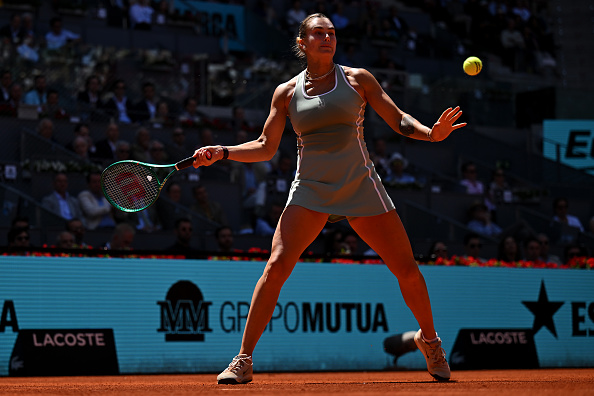
No. 1 seed Aryna Sabalenka survived a barnburner against an inspired Naomi Osaka in the Mutua Madrid Open fourth round, coming from a set and a break down against the No. 14 seed to triumph 6-7(1), 6-3, 6-2 in 2 hours and 20 minutes.
Madrid: Scores | Draws | Order of play
The defending champion, who is bidding to lift the Madrid trophy for a fourth time this year, improved to 2-1 overall against former World No. 1 Osaka, backing up her straight-sets win at the same stage of Indian Wells last month. Sabalenka advanced to her 17th consecutive quarterfinal on the WTA Tour Driven by Mercedes-Benz; she has not lost before that round since falling to Clara Tauson in the 2025 Dubai third round.
“Oh my God, that was incredible level,” Sabalenka said in her on-court interview. “She played incredible tennis. I feel like I just got lucky in a couple shots in the third set, that’s why it went that fast.”
Set one: Battle of the serves
Even by the standards of two of the tour’s most formidable servers, the first set was a serving exhibition. Opportunities to break were few; extended rallies even fewer. Sabalenka conceded four points behind her first serve, Osaka just three. The only break point was faced by Osaka in the third game, which she dismissed in the blink of an eye with a one-two punch.
The inevitable tiebreak was unsurprising. But while Sabalenka has become renowned for her reliability in them, her volleying was unable to withstand the power of Osaka’s passing shots on two key early points, and she emerged with her first tiebreak loss since the final of the 2025 WTA Finals Riyadh, won by Elena Rybakina 6-3, 7-6(0).
Set two: Sabalenka shakes off mini-marathon losses
The contest heated up in a riveting second set, particularly in three multi-deuce tussles that had the Manolo Santana Stadium crowd on the edge of their seats. Those three games were mini-classics that saw Sabalenka and Osaka trade their heaviest baseline blows, each responding to her opponent by finding another gear herself.
But they weren’t how the set was won. Osaka won all three of those games — a six-deuce hold for 1-1, a seven-deuce marathon to hold for 3-3. In between, she came through a two-deuce tussle to break Sabalenka for 2-1, with her backhand down the line proving crucial.
Sabalenka, by contrast, kept her scoreboard moving by winning the less spectacular games. Osaka followed her break for 2-1 by dropping her own serve to love, finishing with a double fault. Sabalenka brushed off the loss of the 3-3 game — in which she had held one break point — with a businesslike hold for 4-3, followed by a break from 40-0 down to reach 5-3. Two aces later, she had levelled the match.
Set three: Sabalenka pulls away
The stage was set for the match to go down to the wire in the third set, and Osaka’s hold for 2-1 — saving two break points — saw the quality of the second set continue. But Sabalenka was once again able to shake off her missed opportunities, posting a love hold for 2-2 — and it was at this point that Osaka’s challenge ran out of steam.
Two backhand errors caused the Japanese player to show frustration with a racquet throw for the first time, and facing a third break point that wing let her down for a third time. There was no route back in: Sabalenka was impenetrable behind her serve in the decider, conceding just three points in total. Appropriately, she finished with her sixth ace — and 31st winner — of the match.
“I think I just dropped my level at the end of the first set and gave her that tiebreak quite easily,” said Sabalenka. “But overall I’m happy with my performance. When someone put me under pressure, I was able to pull out really incredible shots and incredible tennis. So I’m happy. I’m happy that she actually brought that fight, just so I could fight through it, I could struggle a little bit, and find a solution in the match. So, overall happy.”
Baptiste advances to second WTA 1000 quarterfinal — despite wild tiebreak loss
Baptiste recovers after marathon tiebreak loss, tops Bencic in Madrid
Sabalenka will next face No. 30 seed Hailey Baptiste, who came through a wild 6-1, 6-7(14), 6-3 rollercoaster to defeat No. 11 seed Belinda Bencic in 2 hours and 42 minutes. The American held six match points in the second set — one serving at 6-5 and five more in the tiebreak — but was undone by a cascade of double faults. Three came along as she served for the match at 6-5, and another two when up match point. After her third double fault of the tiebreak at 11-11, Baptiste demolished her racquet in frustration.
But for most of the first two sets, Baptiste’s silky net skills and heavy forehand had been the key shots of the match, and she reset impressively in the third set to reach her second consecutive WTA 1000 quarterfinal. In her first, last month in Miami, she fell to Sabalenka 6-4, 6-4 in their first career meeting. The 24-year-old will seek to reverse that result on Tuesday.
The second-set tiebreak was the longest regular (first-to-seven) tiebreak at tour level since Palermo 2024, where Karolina Muchova defeated Katarzyna Kawa 7-6(14), 5-1 retired in the first round. The 2026 season is shaping up to be a good one for tiebreaks. Madrid has already seen the longest regular third-set tiebreak since 2018, Daria Snigur’s 6-3, 3-6, 7-6(13) triumph over Daria Kasatkina in the first round; two months ago, Elina Svitolina defeated Coco Gauff 6-4, 6-7(13), 6-4 in the Dubai semifinals.
“The tiebreak was insane,” Baptiste said afterwards. “It was quite obvious that nerves got a bit in the way when I had some moments to close out the match, but that’s obviously a part of the game. I wasn’t able to get out of that tiebreak, but I was able to turn it around in the third set, so I can be happy about that. Super easy to just leave the match mentally after something like that. Six match points? Outrageous. Having six chances — painful, very, very painful to not get out of that. Then you just start to think, is she going to turn this match around and have that victorious win? I think I told myself that I wasn’t going to allow that.”