
A white shark propels underwater near a beach in Monterey Bay.
Chase Dekker Wild-Life Images/Getty Images
Southern California’s waters appear to be teeming this spring with white sharks, drawing the attention of fishers, surfers and biologists. A reportedly aggressive 10-foot shark off Huntington Beach led to a partial ocean closure and the postponement of a professional surf competition on Thursday.

State experts explain that the extreme marine heat wave baking the Pacific Ocean likely prompted baby white sharks to arrive in February, at least a month earlier than normal, and that older and bigger sharks are now starting to follow.
Article continues below this ad
“Every year about this time, females are coming back from their open ocean migrations to give birth somewhere in Southern California, and then those baby white sharks show up at our beaches,” Chris Lowe, the director of Cal State Long Beach’s Shark Lab, told SFGATE. “What made this year unusual is that we started seeing newborns in February, which is really early. Normally, it starts in April and peaks in July.”
A white shark swims near the Farallon Islands, north of San Francisco.
ullstein bild/Getty Images
With a forecast El Niño expected to drive ocean temperatures even higher later this year, Lowe has been spreading the word about white sharks, colloquially known as great whites: “We think it’s going to be a sharky summer.” In 2015, he observed a similarly early pupping season followed by an uptick in juvenile white sharks — which range up to about 6 years old and 10 feet long — gliding up to their so-called nurseries in Southern California from winter habitat in Baja. That was during the infamous “blob” of warm water, which mirrors today’s marine heat.
“In 2015, we saw a bunch of babies really early, and then the number of sharks just kept increasing over the course of the summer,” Lowe said. He added: “The water got really warm, and some of our tagging studies have shown white sharks don’t like water temperatures above 78 degrees. … It pushed all those young sharks out of Baja into Southern California.”
Article continues below this ad
This spring, the young white sharks are already congregating in the waters off Orange County, Los Angeles County and Santa Barbara County. However, they’re not off San Diego, potentially because the water is too warm there already, Lowe said.
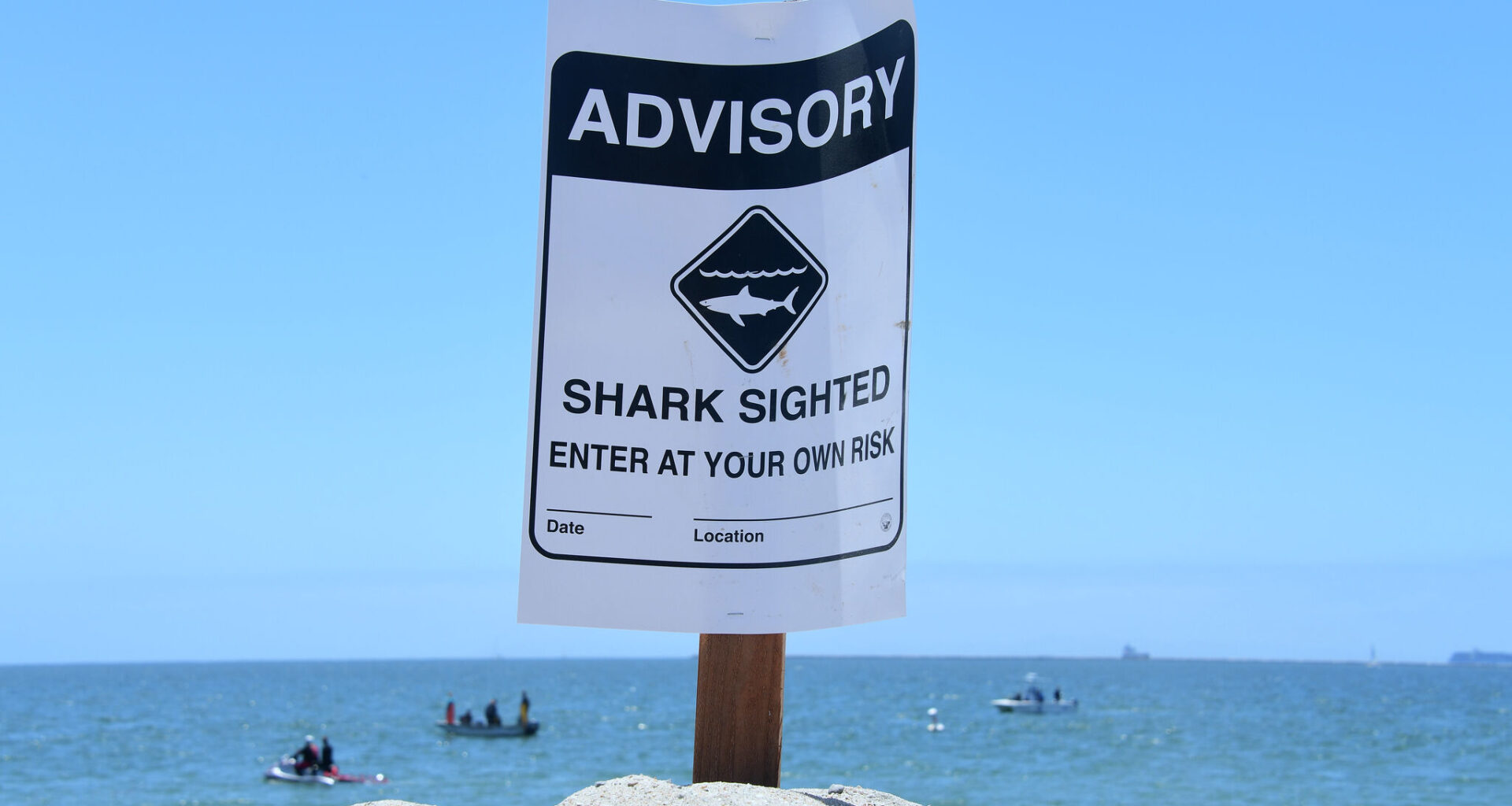
FILE: Warning signs for shark sightings stick in the sand in Long Beach on May 16, 2017.
FREDERIC J. BROWN/Frederic J. Brown/AFP/Getty Images
That’s a break from the past several years in Del Mar, where a high numbers of youngsters floated near shore, according to Brice Semmens, a marine biologist for Scripps Institution of Oceanography at UC San Diego. Semmens described that it’s a good spot for the sharks to eat stingrays — since they’re too young to eat mammals — enjoy the warm water and hide from predators like killer whales.
Article continues below this ad
“We might expect to see them showing up here, but instead, most of the nursery activity is happening more off LA,” Semmens told SFGATE. “We’re not seeing them right now. But in Del Mar, who knows what will happen as the spring and summer continues to evolve.”
The northeastern Pacific white shark population seems to be increasing overall. While juvenile sharks linger off Southern California, the bigger adults venture farther north to hunt bigger prey. In the Pacific, their full range includes the waters between Mexico, California, Alaska and Hawaii.
The warmer waters in Southern California this year might also attract greater numbers of other species, such as tiger, bull and hammerhead sharks.
For surfers, divers and anyone else spending significant time in the ocean, Lowe suggested abiding by basic best practices: avoid dawn and dusk, traveling alone, seal rookeries, murky water — and get out if you get a creepy feeling.
Article continues below this ad
Still, shark bites are pretty rare in California. There were fewer than 250 encounters from 1950 to 2022 between humans and all species of sharks, according to the California Department of Fish and Wildlife. Of those run-ins, fewer than 20 were fatal.
The Shark Lab, founded in 1966, formed a California shark beach safety program in 2018 to address growing white shark sightings. The lab has active transmitters on 240 sharks right now, tracking their movements along the coast. Based on how prevalent it turns out the sharks are in popular recreational waters, beaches now typically just post signs about shark activity instead of closing, Lowe said. A 2023 study from Shark Lab researchers using drones showed that 97% of the days sharks swam off a beach, people were there, too; yet, only one shark bite was reported over the two-year observation period.
“We have to put things in perspective,” Lowe said. “Despite the fact that there are more sharks and more people in the water, we don’t see an increase in bites. So for me, a biologist and a person who deals with statistics, we’re just not on the menu. Accidents might happen, but they are incredibly rare.”
Article continues below this ad