
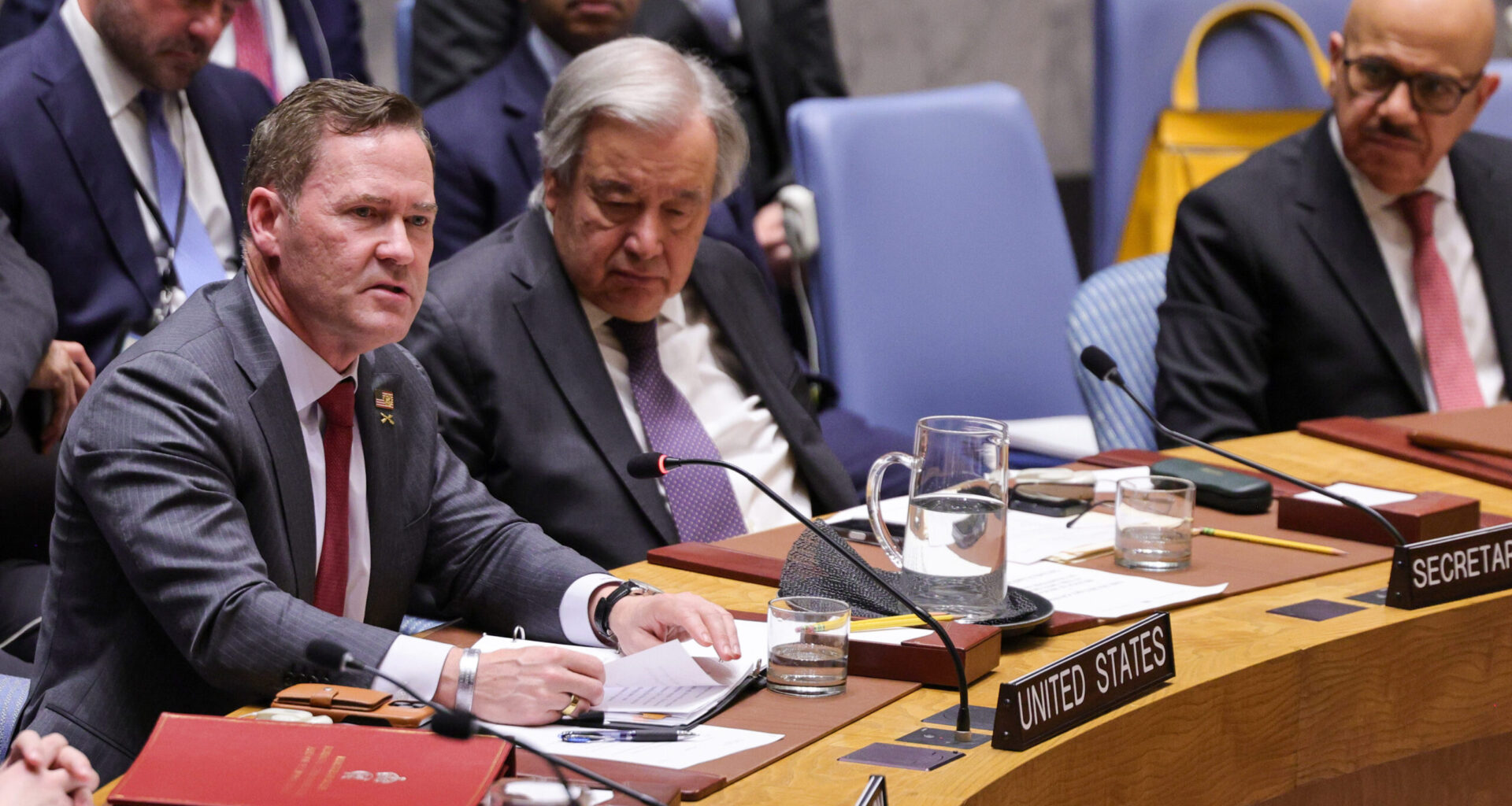
Ambassador Mike Waltz
U.S. Representative to the United Nations
New York, New York
AS DELIVERED
Thank you, Foreign Minister Al Zayani, for convening today’s critical debate. Thank you, Secretary-General, IMO Secretary-General Dominguez. Thank you, Mr. Childs for your briefings.
Colleagues, the world’s critical waterways are not bargaining chips that belong to any one country.
And, now, maritime transit routes which are truly the arteries of global commerce that roughly 80 percent of global trade by volume moves through such waterways. They are too vital, they are too important to all of us collectively as a global community to be choked off, to be mined, to be weaponized, to be attacked like two-bit pirates—because when they are, the entire world pays the price.
And the world is paying—most countries far more than the United States—they are paying for Iran’s hostage-taking gambit in the Strait of Hormuz.
So, let’s take a moment and look at the numbers. The Strait of Hormuz typically sees 20 million barrels of oil per day, 40,000 vessels per year. And whether they are bound to heat homes in East Asia or nourish crops in Central Africa, they have 20% of global oil and liquified natural gas (LNG)—15% of the world’s fertilizer, they all transit the Strait. And closer to home, it’s responsible for 75% of our Gulf states partners’ economic output and over 50% of the broader region’s food.
It is absolutely clear, it’s unambiguous, that as a matter of international law, this Strait is not—despite Iran’s Foreign Minister’s claims—this Strait is not Iran’s to wield like its own moat and drawbridge. It is not Iran’s hostage, it is not Iran’s bargaining chip, it is not Iran’s toll road. And that’s what over 100 countries right outside these doors just testified in one of the most supported press conferences in recent years—100 countries just said what I said. This is not for Iran to play with like some type of bargaining chip, because of its illegal nuclear aspirations.
Colleagues, less than three weeks ago, the world came together to counter this threat to maritime security. The Security Council adopted UN Security Council Resolution 2817 with a record-setting 136 co-sponsors, demanding that Iran cease its egregious attacks against its neighboring states—regardless of what you feel about the ongoing conflict it has chosen to shoot in all directions against its neighbors’ civilian infrastructures. And the entire world condemned the obstruction of freedom of navigation through the Strait of Hormuz.
Iran has done nothing but act in defiance of that resolution. Forty days and counting, they have laid sea mines, they have fired on civilian ships. We have worked to clear the sea mines and protect these ships. But it’s used the Strait also to launch thousands of missiles at Gulf capitals—their hospitals, their airports, their hotels, their neighborhoods. They have threatened to charge tolls—otherwise known as bribes—to allow ships to pass through the Strait. And, in true form, they have still tried to kill even more Americans than they have in the last 47 years.
And this is why President Trump has directed firm action against Iran’s threats in the maritime domain to safeguard the entire world’s economic security and prosperity.
And even while under this type of assault, this type of fire, thousands of drones and missiles pouring in, Bahrain and a coalition of Gulf states put forward another resolution to protect the freedom of navigation and maritime security in the Straits of Hormuz.
But unfortunately, two countries—China and Russia—vetoed this resolution and chose a radical religious regime for its partner, and ignored not only the plight of our Gulf countries, but the global economy. They chose to shield the Iranian regime from a commonsense measure. And they chose to turn a blind eye against Iran’s assault on the freedom of navigation—which is hard to make sense of given it’s the economies of East Asia, Southeast Asia, South Asia, and East Africa that are most affected by this illegal assault on shipping.
So, unfortunately these two countries have put their own economic interests ahead of international obligations. Their companies and citizens supported the Iran-backed Houthis in addition in waging a two-year campaign of terror against shipping in the Red Sea and the Gulf of Aden, which—before this crisis—was one of the most disruptive assaults on maritime commerce in recent history.
Ultimately, colleagues, this Council must hold the Iranian regime to account for this blatant and recurring violations of international law: violations of the UN Charter, violations of binding Security Council sanctions, and violations of other measures that were snapped back into place in September, violations of its own non-proliferation obligations—as we just had a non-proliferation gathering here in the General Assembly—violations of its obligations under the law of the sea, violations of the laws of war, violations of international humanitarian and human rights law.
But I want to particularly spend a moment on the sea mining and indiscriminate planting of mines in international waterways. That makes Iran an international criminal. Pirates of the Straits. Tehran admits to these crimes, but is so incompetent, it also admits to not knowing where the mines are. Thankfully, the U.S. military is stepping in to clear these mines and make it safe.
But colleagues we need to broaden this effort. Now is a time for a coalition of like-minded partners to step up and step in with real capabilities and help. We need for commercial shipping, for maritime finance and insurance, for humanitarian aid agencies, over 80 of which move their humanitarian supplies though this Strait for lifesaving aid—in addition to the military assets—to come together in a coalition for maritime freedom.
As the Permanent Representative of Pakistan just mentioned, we’ve come together before, we came together in CTF-151 to deal with piracy off East Africa in the Straits of Bab-el-Mandeb. The United Nations was built for times like this. We have been here before. We have allowed unchecked regimes and nonstate actors to loudly tiptoe towards horrors against their neighbors, while much of the rest of the world sat back and watched.
Colleagues, now is not the time for simple words. Now is the time to act. And we call upon the world to join us in maintaining and defending the freedom of navigation for the entire world’s economy. I thank you.
###