
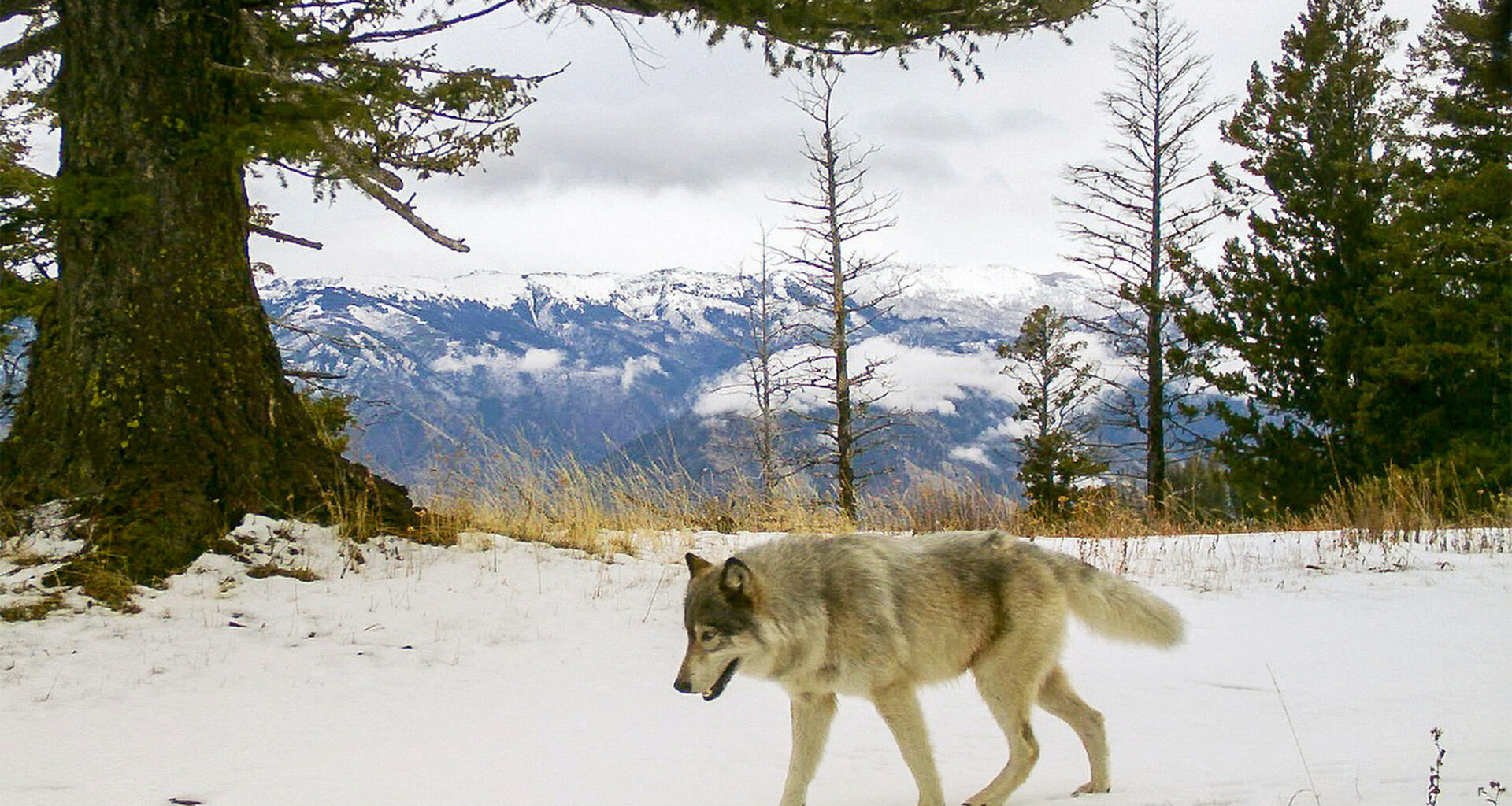
FILE: A wolf from the Snake River Pack passes by a remote camera in eastern Wallowa County, Ore., Dec. 4, 2014.
Oregon Department of Fish and Wildlife/AP
A new report from the Oregon Department of Fish and Wildlife reveals that two wolves were accidentally shot and killed by federal agents last year.

The 2025 annual report, published April 17, says “the incidental (accidental) take of two wolves” happened as two agents from the U.S. Department of Agriculture Wildlife Services were carrying out an order to kill coyotes in July.
Article continues below this ad
Michelle Dennehy, a spokesperson for Oregon Fish and Wildlife, told SFGATE that the killings happened in Southern Oregon, an area of the state where wolves are federally endangered and protected. USDA is investigating the killings but the department is unable to provide further information, Tanya Espinosa, a spokesperson for USDA, told SFGATE.
USDA Wildlife Services’ job is to “resolve wildlife conflicts to allow people and wildlife to coexist,” according to its website, but some experts are raising concerns after last year’s accidental killings.
“Wildlife Services is a very secretive agency. It’s hard to find a lot of information about them online,” Regan Downey, the director of education and advocacy for the Wolf Conservation Center, a nonprofit organization, told SFGATE. “They are basically a killing agency that’s employed by the Department of Agriculture and they do kill millions of native animals every year.”
Make SFGATE a preferred source so your search results prioritize writing by actual people, not AI.
Add Preferred Source
Downey said the killings are “very upsetting,” especially because the wolves in that area are protected under the Endangered Species Act.
Article continues below this ad
“Unfortunately, we’re always surprised when we hear stories like this, but it has happened before,” Downey told SFGATE.
She added that although the agents were out to remove coyotes, the conservation center doesn’t believe that killing predators is an effective way to preserve livestock.
“Science shows us that non-lethal deterrents are much better at protecting livestock and protecting wolves and coyotes as well,” Downey said. “So this, in our minds, was not a science-based decision anyway, to send out to kill coyotes. But it is very important because we look to these federal agents as being the experts on what they’re shooting at.”
Amaroq Weiss, a senior wolf advocate with the Center for Biological Diversity, said she is also skeptical about how the federal agency operates.
Article continues below this ad
Weiss said one of her main concerns about last year’s killings is that wildlife staff are expected to be able to clearly tell the difference in size between coyotes and wolves.
“They have to be trained to know the difference in species appearance. Wolves are almost twice the size of coyotes. Out here in the Western U.S., coyotes weigh on average, maybe 25 to 45 pounds or so and a full adult size wolf is going to weigh closer to 80 to maybe 110 pounds,” Weiss told SFGATE. “Weight alone is a staggering difference.”
She also said wolves are noticeably larger than coyotes, with broader foreheads and snouts, shorter, more triangular ears and bigger paws. One of the wolves also had a radio collar, a GPS tracking device from wildlife officials, she said, which should’ve made it easier to spot, especially with its shorter fur coat in the summer.
Weiss said she is concerned about why the ongoing investigation is taking so long, and hopes the USDA Wildlife Services agents involved are not currently in the field working with wildlife.
Article continues below this ad
“Information isn’t being released, it makes no sense. The usual reason when wolves are illegally killed is that an investigation is taking a long time because the authorities investigating don’t know who the perpetrator is,” Weiss said. “… That’s not the case in this.”
At the end of 2025, wildlife officials counted at least 230 wolves in Oregon, according to the report, which also shows deaths rose to 42 that year, up from 26 in 2024. Of those, 39 were caused by humans, including vehicle collisions, authorized killings tied to livestock conflicts, law enforcement cases and other government actions.