
United States Industrial Valves Market Size, Growth, and Forecast (2026–2034)
The United States industrial valves market is witnessing steady growth as industries continue to expand and modernize their operations. In 2026, the market reflects increasing demand for reliable flow control solutions across key industrial sectors.
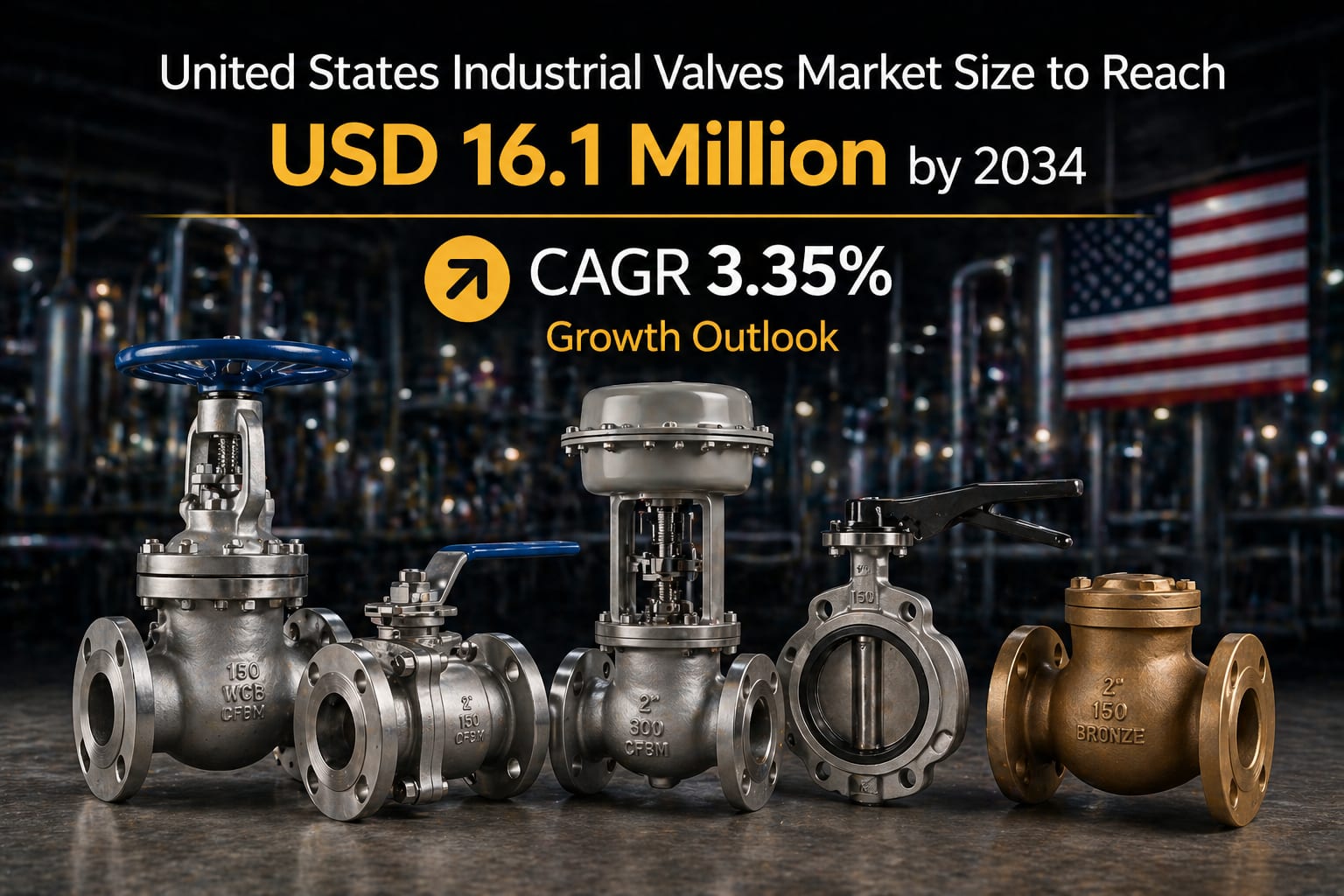
The market reached a value of USD 11.8 Million in 2025 and is projected to grow to USD 16.1 Million by 2034, expanding at a compound annual growth rate (CAGR) of 3.35% during 2026–2034. This steady growth highlights the essential role of industrial valves in maintaining operational efficiency and safety.
Industrial valves are mechanical devices used to control the flow of liquids, gases, and slurries within systems. They are widely used in industries such as oil and gas, chemicals, power generation, and water and wastewater treatment.
Key Trends Shaping the United States Industrial Valves Market
Several important trends are influencing the development of the industrial valves industry:
• Increasing demand for automated and smart valve systems
• Growing focus on energy efficiency and operational reliability
• Expansion of infrastructure and industrial projects
• Rising adoption of advanced materials and corrosion-resistant designs
• Increasing integration of digital monitoring and control technologies
These trends reflect a shift toward more efficient and technologically advanced industrial systems.
Major Growth Drivers in the United States Industrial Valves Industry
The growth of the market is supported by several key factors.
One of the primary drivers is the ongoing process of industrialization, which is increasing demand for industrial valves across multiple sectors.
Another important factor is the expansion of industries such as oil and gas, chemicals, and power generation, which rely heavily on flow control systems.
The growth of water and wastewater treatment infrastructure is also contributing to market demand.
Additionally, the need for safe and efficient operations in industrial processes is encouraging the adoption of advanced valve technologies.
Infrastructure development and modernization projects further support market growth.
Role of Technology in Industrial Valve Systems
Technology is playing a central role in transforming the industrial valves market.
Smart valves equipped with sensors and digital controls are enabling real-time monitoring and improved system performance.
Automation is enhancing efficiency and reducing manual intervention in industrial operations.
Advanced materials are improving durability and resistance to extreme conditions.
Digital platforms are supporting predictive maintenance and reducing downtime.
These technological advancements are making industrial systems more reliable and efficient.
Investment Opportunities in the United States Industrial Valves Market
The steady growth of the market is creating various investment opportunities.
Companies are investing in advanced manufacturing, smart technologies, and product innovation to remain competitive. There is also growing interest in automation and digital solutions.
Investments in infrastructure and industrial development projects are further supporting market expansion.
Collaborations between manufacturers, technology providers, and industrial operators are driving innovation.
With continued growth expected through 2034, the market offers stable long-term potential.
Challenges Impacting the United States Industrial Valves Industry
Despite steady growth, the market faces several challenges.
One of the key issues is fluctuating raw material costs, which can impact production and pricing.
Another challenge is intense competition among manufacturers, affecting market positioning.
Regulatory standards and compliance requirements can also influence product development.
Additionally, supply chain disruptions may affect availability and delivery timelines.
Future Outlook (2026–2034)
Looking ahead, the United States industrial valves market is expected to continue its steady expansion as industrial activities increase.
Between 2026 and 2034, the demand for efficient, durable, and technologically advanced valve systems is likely to grow. Industries will continue to invest in solutions that enhance performance and safety.
Technological advancements will further shape the market. The integration of automation, digital monitoring, and advanced materials will improve efficiency and reliability.
Infrastructure development and industrial modernization will continue to support market growth.
Overall, the market is poised for stable expansion, driven by industrial demand, innovation, and infrastructure investment.
Conclusion
The United States industrial valves market is evolving steadily, supported by industrial growth, technological advancements, and infrastructure development. With projected growth from 2026 to 2034, the market is expected to remain an essential part of the industrial sector.
While challenges such as cost fluctuations and competition persist, ongoing innovation and investment are likely to support long-term growth. As industries continue to modernize, industrial valves will play a critical role in ensuring efficiency and reliability.