
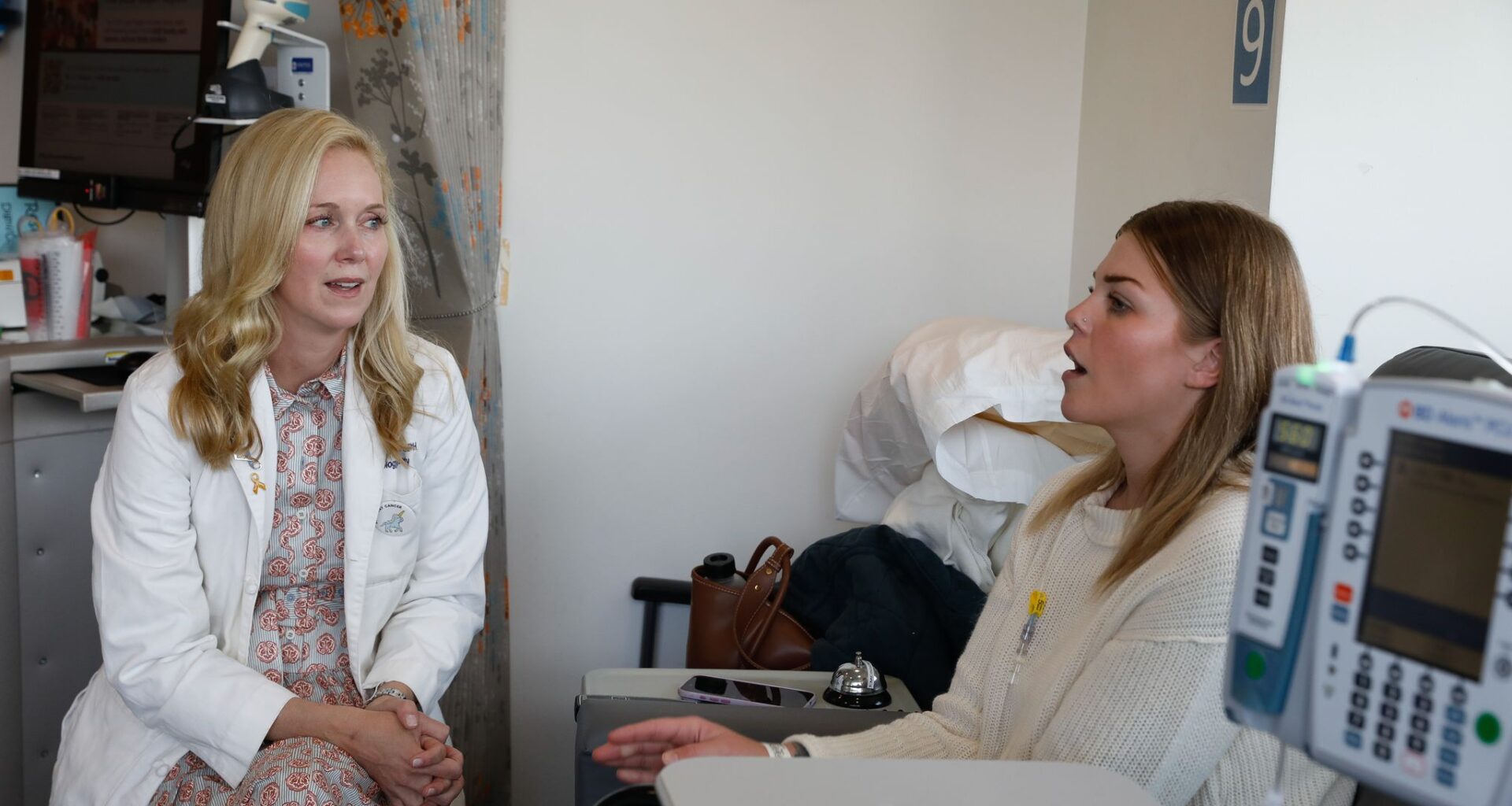
Dr. Katherine Van Loon, left, a UCSF oncologist, visits with her patient Megan McNair, a Sacramento-area resident diagnosed with Stage 4 colon cancer, during an infusion for Crohn’s disease at UCSF on April 20 in San Francisco.
Lea Suzuki/S.F. Chronicle
Dr. Katherine Van Loon, right, visits with Megan McNair during an infusion at UCSF on April 20 in San Francisco. Doctors say younger colon cancer patients like McNair often face distinct challenges, from parenting to long-term care.
Lea Suzuki/S.F. Chronicle
Dr. Katherine Van Loon, a UCSF oncologist, is seeing the rise in colorectal cancer among younger adults: “My patient population keeps getting younger and younger.”
Lea Suzuki/S.F. Chronicle
Megan McNair was 29 and had just given birth to her second child last July when she learned she had Stage 4 colon cancer.
Doctors initially told her she had five years to live.
“My first thought was, ‘I’m dead. This is it,’” said McNair, who is from Alameda and now lives in Pollock Pines, about an hour outside Tahoe. “I just prayed for my health.”
Article continues below this ad
Rates of colorectal cancer in young adults like McNair are rising at an alarming clip, prompting UCSF, where McNair received cancer treatment, to open a new colorectal cancer clinic specifically for young adults. It is the first such program on the West Coast, according to UCSF. A handful of other U.S. cancer centers have groups specializing in early-onset colorectal cancer, including the Mayo Clinic and MD Anderson.
The UCSF program, led by gastrointestinal oncologists Dr. Katherine Van Loon — McNair’s doctor — and Dr. Chloe Atreya, is not a separate physical clinic, but seeks to provide support tailored to a younger population.
San Francisco Chronicle Logo
Make us a Preferred Source to get more of our news when you search.
Add Preferred Source
Young adults with colorectal cancer often experience the disease and its impacts differently than older adults, facing such challenges as loss of work, parenting, childcare, financial planning and long-term effects, Van Loon said. Discussions around certain parts of treatment, such as whether to get an ostomy bag — a surgically-created pouch that helps the body get rid of waste — can be more complicated.
Dr. Katherine Van Loon, a UCSF oncologist, wears a “Not Today Cancer” button as she visits with her patient Megan McNair.
Lea Suzuki/S.F. Chronicle
Rates of colorectal cancer in adults in McNair’s demographic — 20 to 49 years old — have jumped from 9.8 cases per 100,000 people to 15.2 per 100,000 between 2000 and 2021, according to the American Society of Clinical Oncology. As of 2023, colorectal cancer was the leading cause of cancer deaths in adults under 50, surpassing breast and lung cancer, according to a large study published in JAMA this year.
Article continues below this ad
“All other leading cancer killers are on the decline while this particular cancer is increasing,” Van Loon said. “So something is changing. My patient population keeps getting younger and younger.”
It’s not clear why colorectal cancer is rising in young adults, but doctors and researchers say there are likely several factors at play.
Americans are eating more ultra-processed foods, which are usually high in sugar and low in fiber. Many Americans, including younger adults, are increasingly living a sedentary lifestyle, a major risk factor for cancer. Rates of obesity and diabetes, which also increase cancer risk, have risen over the same period. And some studies suggest that environmental exposures such as microplastics and antimicrobial compounds in some soaps and toothpastes may also increase risk.
McNair was stunned to learn of her diagnosis, and in hindsight it may have helped explain some of the harrowing symptoms she experienced during her pregnancy: fatigue, extreme nausea and vomiting, no appetite for days, weight loss and gut-wrenching abdominal pain.
She began chemotherapy at UCSF last summer while she was still postpartum, making the three-hour drive to the UCSF infusion clinic every other week. She lost at least half her hair, developed hives, had swollen hands and often felt fatigued from the chemo — all while trying to care for a newborn and toddler at home.
Article continues below this ad
It was “a nightmare couple of months figuring out life again,” she said.
She completed chemo in January and is cancer-free. She will have to get scans every three months for the next five years to monitor for recurrence.
Oncologist Katherine Van Loon hugs her patient Megan McNair after an infusion at UCSF in San Francisco. McNair was diagnosed with Stage 4 colon cancer at age 29.
Lea Suzuki/S.F. Chronicle
Life now “is so boring in the best way,” she said. “I feel the most normal I’ve felt. I’m not afraid to eat food anymore. I’m taking care of my kids.”
She is gradually reestablishing her daily routines, working out again and getting the yard in shape so the kids can play in it this summer.
Article continues below this ad
McNair is now urging other young adults not to ignore symptoms of colon cancer.
She started noticing signs dating back to middle school, including incontinence, severe gas and cramping, but chalked it up to having an upset stomach. As a young adult, she developed pulsing pain in her sides. Still, she brushed it off, and it wasn’t until 2023 that she was diagnosed with Crohn’s disease. Crohn’s is a chronic condition that affects the digestive tract and, if untreated for a long time, raises the risk for colorectal cancer.
“I went a long time being untreated,” she said. “I thought it was just an upset stomach. You never think it’ll happen to you. You never think you’re going to be an unhealthy person.”
Routine screening begins at age 45 for healthy adults, but if you have symptoms at any age, don’t wait to get a diagnostic colonoscopy, Van Loon said. The signs to look out for are bowel changes, blood in the stool, unexplained weight loss and iron deficiency.
Article continues below this ad
“Pay attention to your body,” Van Loon said. “Know how to seek care and advocate for yourself.”