
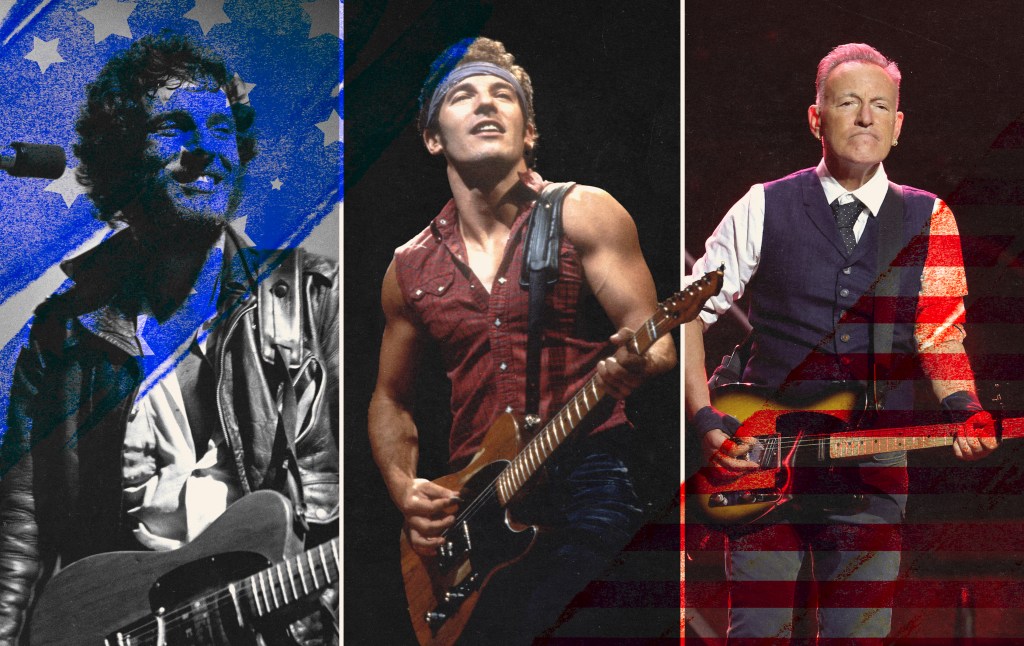
Last week, I attended a No Kings rally in Newark, New Jersey. Technically, it was the seventh leg of Bruce Springsteen’s latest tour, a series of concerts that he told the audience he had not been expecting to mount. “We never planned this tour,” he said, “but we came out because I needed to feel your hope, your strength, and I needed to hear your voices.”
It must be nice, when feeling a bit disconnected, to be able to assemble an arena’s worth of worshipful acolytes singing along to the thoughts you had when you were 25. Some men seek out connection via OnlyFans, Bruce Springsteen connected with only 20,000 fans because the venues couldn’t hold more. It’s okay, he has earned that affirmation.
What was driving Springsteen to get out on the road were the events weighing on so many of us. This winter Springsteen wrote about the shootings of Renee Good and Alex Pretti in a song titled “Streets of Minneapolis.” At the concert, pictures of the two were shown on the screens. Springsteen quoted Good’s apparent last words, “I’m not mad at you,” in one of his signature stretches of stage banter.
Springsteen is often a subtle songwriter, but his assessments of institutional good and evil do not walk the same nuanced edge as his portraits of people in blue-collar jobs. And that’s fine. Bob Dylan is the gimlet-eyed poet we have for that kind of songwriting. Springsteen seems to imagine himself more in the Woody Guthrie mold, where there is the clear dyad of the powerful versus the little guy.
All of this said, the new song itself isn’t very good. It has a dashed-off quality, possibly reflecting on the fact that, per Springsteen, he wrote it in about a day. A protest song derives its power not just from its sentiment but from lyrical specificity, and Springsteen does not show the rigor in “Streets of Minneapolis” that he has shown in so many of his earlier compositions. He rhymes “singing through the bloody mist” with “and the stranger in our midst.” He sings “King Trump’s private army from the DHS / Guns belted to their coats / Came to Minneapolis to enforce the law / or so their story goes.” I don’t mind the slant rhymes of “coats” with “goes,” but law enforcement officers’ guns were not belted to their coats. Is this meant to evoke Pinkertons, some sort of generalized nefariously cloaked figures, or, more likely, did he just need a rhyme for “or so their story goes”?
Springsteen seems to sense that however important the sentiment, the composition doesn’t quite meet the circumstance. Three times during the song’s performance the arena lights flicked on as Springsteen goaded the crowd into chanting, “ICE OUT NOW!” not trusting the power of the moment to take care of itself.
But I forgive Bruce Springsteen. This one song was a misfire, especially when contrasted with his 2001 song “American Skin (41 Shots),” which also concerns a tragic real-life police shooting and uses genuinely deft lyrics and musicality to elevate sentiment above the sloganeering of “Street of Minneapolis.”
But the song is heartfelt and imbued with that quality Springsteen has always exuded: earnestness. Springsteen is and always has been earnest. His fans, earnestly, love him back, some taking from Springsteen whatever elements of fist-pumping energy he gives off and leaving the politics for others.
As the 76-year-old strutted and fretted his way across the Newark stage, I began to think about the Boss’ politics versus those of younger generations.
One example of a politicized, somewhat younger musician right there on the stage with him was 61-year-old Tom Morello of Rage Against the Machine. Morello, a Springsteen collaborator for over 20 years, is a committed leftist who sports a hammer and sickle on his “Arm the Homeless” guitar. Springsteen never came close to striking me as adopting this sort of extreme political commitment. He always just seems like an FDR Democrat who is shaking his head at what his country has become. In fact, he and former Sen. Sherrod Brown, the politician I think he’s most like, have a similar gravelly vocal quality and a soft spot for Youngstown, Ohio, with its blast furnace that “made the cannon balls/ That helped the Union win the war.”
If Springsteen’s catalog were an infrastructure bill it would bring down unemployment to the Fed’s target of 2 percent.
The youngest generation of musicians includes Billie Eilish, who recently invoked the trendy notion of America being built on stolen land. Springsteen has written about Native Americans often and with deep sensitivity. But he embraces the supposedly passé concept of the melting pot in the song, singing, in “American Land” that “The McNicholases, the Posalskis, the Smiths, Zerillis too/ The blacks, the Irish, Italians, the Germans and the Jews … Their hands that built the country we’re always trying to keep down.”
In fact, and this is what I like about Springsteen and will miss about his generation of baby boomers. They were raised in what a Billie Eilish type might regard as the stew of propaganda of American exceptionalism. And while the Vietnam War opened Springsteen’s and his cohorts’ eyes, nothing could permanently undo the idea of America as the land of opportunity, or dislodge its place, to quote a song played at the Newark concert, as “The Promised Land.”
The disappointment in not reaching our national ideals is, to baby boomers, a promise unmet, a dream that, though not currently coming true, is nonetheless not a lie. Still, Springsteen builds. He does so, in the figurative sense through his music, through the conscious construction of his backup band as a community, and through the connection with his fans. But I also mean that Springsteen has a commitment to building and to physical buildings. The people of Springsteen’s generation believed in building. They believed in structures. Their landscape is one of edifices, their monuments were of the concrete and steel variety, not the conceptual or the electronic. This is why Springsteen has sung about: towers, churches, jails, tunnels, skylines, reservoirs, bridges, trestles, risings, mansions (of glory, of fear, on the hill), sidewalks, roads, streets, avenues, boulevards, girders, promenades, railroad tracks, rafters, and in at least three different songs, refineries. If Springsteen’s catalog were an infrastructure bill it would bring down unemployment to the Fed’s target of 2 percent. This is a performer who has mentioned “highways” more often in song lyrics (406 times according to SpringsteenLyrics.com) than there are highways in New Jersey (117 active state highways according to Wikipedia).
The people who built our country, according to Springsteen, are to be praised for their industry rather than decried as despoilers or thieves of stolen land. Springsteen himself is a sometimes disappointed but never cynical citizen of an America that builds. He is a steady purveyor of a message that might not always be uplifting, but is always, sometimes literally, constructive. He is an artist whose function is not to convince you to tear it all down, but to craft the case that there is a reason to believe.
Correction, April 29, 2026: This article has been updated to remove a reference to Springsteen’s guitar, which was misidentified.