
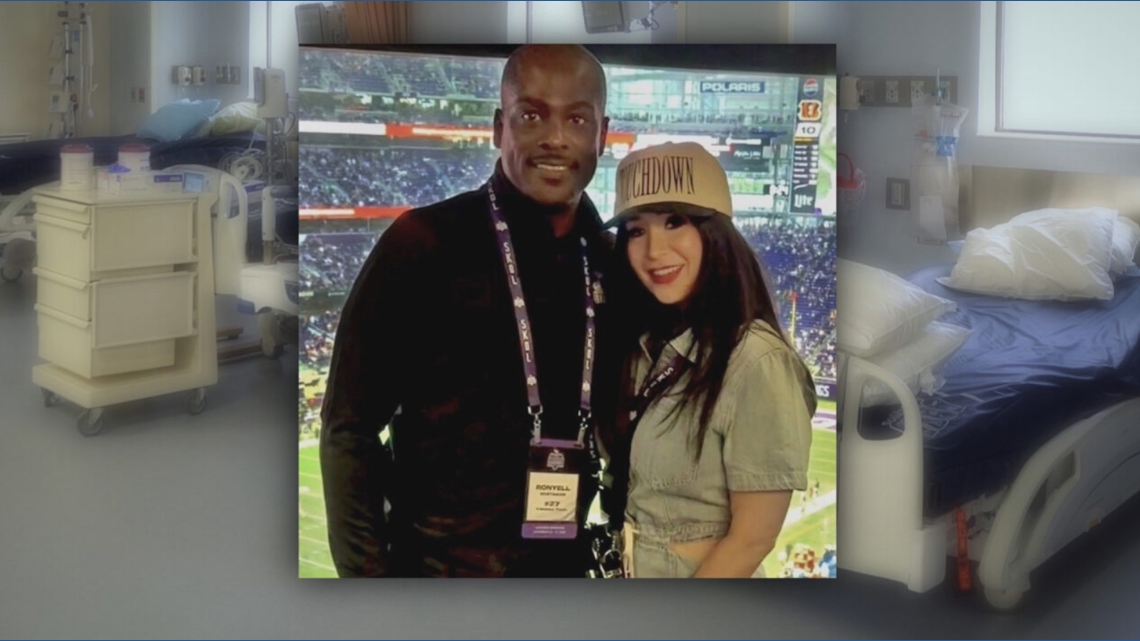
M Health Fairview and LifeSource teamed up to help former Vikings cornerback Ronyell Whitaker, fulfill his final wish, and the partnership continues.
MINNEAPOLIS — Even if you don’t remember Ronyell Whitaker’s football career, the one-time Minnesota Vikings cornerback just ensured that his legacy will love on long after his untimely death.
After suffering a sudden, catastrophic brain aneurysm in February, Whitaker saved four lives through organ donation.
“He would be very excited to know that his, his life continued on,” said Laurie Charboneau, Whitaker’s partner of four years.
Whitaker played cornerback for the Vikings from 2006 to 2007, but remained in Minnesota after retiring from the game.
“He was extremely passionate about football and the Vikings,” Charboneau said. “He also loved his family deeply and he loved this community.”
Whitaker’s decision to be an organ and tissue donor was another reflection of that love for others, which is where a special team from M Health Fairview and LifeSource stepped in.
“Ultimately, our goal is we wanna honor the donor and their families and that means maximizing the gift,” said Erin Schaden, Nurse Manager for the M Health Fairview Donor Care Unit, which just marked its first year as the very first, free-standing donor care unit in Minnesota.
Kent Erdahl: “What does having a dedicated (donor care unit) mean?”
Erin Schaden: “I think for us, one of the biggest aspects is what we can offer to families. With this setting, they’re not dealing with the hustle and bustle of an ICU.”
Neither are the care teams, and thanks to the partnership with LifeSource, specialty care teams have more time and space to ensure successful donations. According to M Health Fairview, that is exactly what has happened. In year one, the unit helped 38 donors save 142 lives through organ donation. That translates to 4.1 organs per donor.
“The national average is 3.2 organs per donor,” Schaden said.
There’s been an even greater success story with delicate lung transplants thanks to more individualized care and diagnostic testing.
Schaden: “We have our own mobile x-ray machine to keep up with those timely lung x-rays, and right now we are at 65% lung utilization recovery, compared to a national average of 20%. So we’re really proud of that.”
Erdahl: “Wow, and that’s because you can have dedicated teams that can address it?”
Schaden: “We feel that that’s a big part of it, yes.”
Whitaker’s lungs were among the life-saving gifts he gave to four recipients who were in desperate need.
Charboneau: “I do think about them. I think about their families and I think about how their health is now, hoping that they’re feeling better. He would have been so proud and happy to have helped them. He donated his heart to science as well. So that’s pretty amazing.”
Erdahl: “That could save many more lives.”
Charboneau: “It could. Just knowing research, it’s so important.”
And she’s beyond grateful it all happened here.
“There was a sense of relief when I knew that I could visit him here at any time,” she said. “Which I did every day until the end. It was so great to be able to physically hold his hand and touch him and they were so empathetic and sympathetic and kind to me.”
Laurie Charboneau says she has been so moved by the donation process, and the work inside the unit that she instantly became an advocate for organ and tissue donation. She hopes that sharing Ronyell’s story will help save even more lives.
For more information on becoming a donor, click here.