
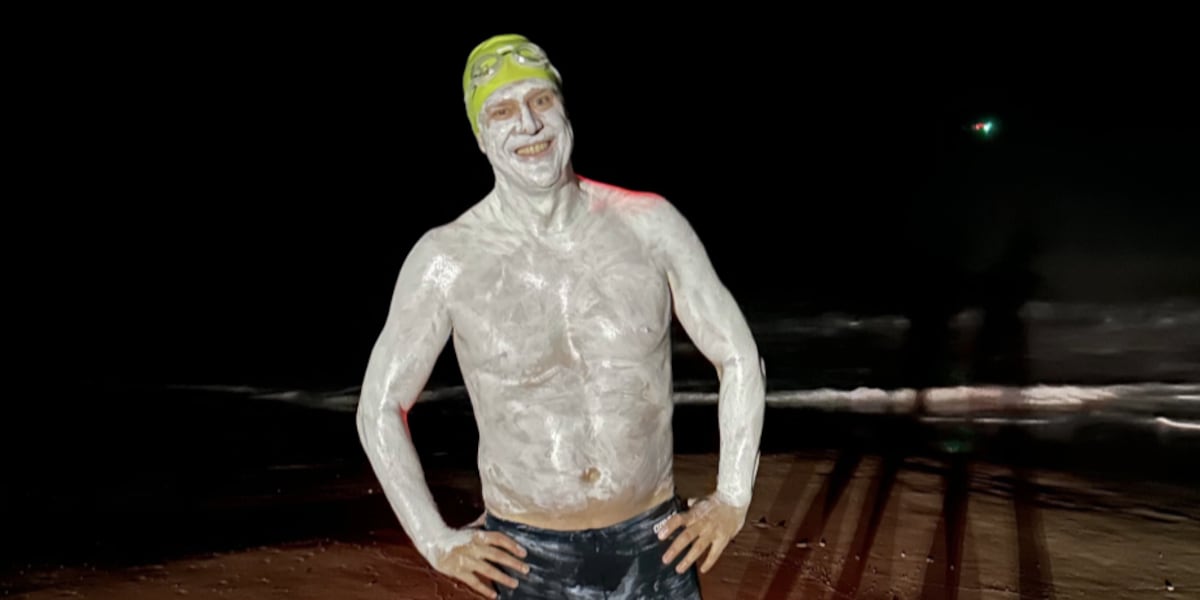
HONOLULU (HawaiiNewsNow) – With a thin layer of sunscreen still clinging to his skin, Loren King raised his arms in celebration as he officially etched his name into Hawaii swimming history.
It took 13 hours, 18 minutes and 55 seconds for the 57-year-old philosophy and political science professor from Canada to cross the Kaiwi Channel; the fastest time ever for an Oahu-to-Molokai route.
“I feel very sore. Your mouth tastes of salt, your tongue is mangled by the seawater, and you and your crew really just want to crash and sleep for 12 hours,” said King
The more than 26-mile journey started with stars still in the sky along the shore of Sandy Beach on April 21 at 4 a.m.
Beginning on Oahu was an unconventional choice but made based on preparation and scientific research gathered by Dr. Steven Minaglia.
“Crews will run swimmers into really strong currents, grind them down, you know, basically wear them out, all for the sake of landing at a predestined spot,” said Minaglia.
Minaglia, who works with the Hawaiian Channel Swim Association, coordinated logistics with Captain Jamie Barlow for more than a year. They began planning shortly after King failed his first Kaiwi Crossing attempt.
“The motto of this swim in particular was ‘the current giveth and the current taketh.’ We knew a forecasted current, speed, and angle, and then recognizing how to try to provide a favorable course,” Barlow said.
Another focus of the swim was ensuring King reached deep waters by daylight, a strategy to avoid Cookie-Cutter Sharks, which are known for taking chunks out of Kaiwi crossers.
Dr. Minaglia took us through his reasoning and dialogue with the King and the crew.
“When do you start the swimmer in the dark so that the sun’s up when they’re in the deep part? And that was all about choosing that location and timing. And then you need a swimmer who’s totally down for anything and competent and capable. If you don’t have that, you can’t pull it off,” he said.
But even the best laid plans can go awry.
King was able to avoid ‘Cookie Cutters’, but about nine miles into the swim, he was surprised by a Silky Shark.
Thankfully, the encounter was brief, and King was able keep his distance and continue on unscathed.
Helping keep King calm and on pace was his training partner, Lynn Rodgers, an intermediary, relaying messages from the water to the boat.
“I’m also assessing his sort of mental state as we’re going along, I could tell by his voice if he’s unsure of something,” Rodgers said.
With the help of many hands, King accomplished his goal.
And even though it’s his name in the record books, King wants the world to know he doesn’t consider his feat a solo swim.
“You’re never alone, and you’re never really doing this on your own. It’s always the team. None of this happens without this extraordinarily dedicated and experienced group of people,” King said.
Watch the full interview here:
Copyright 2026 Hawaii News Now. All rights reserved.