
We have a good idea of what the Detroit Red Wings feel they need this summer. Now, where can they find it?
When general manager Steve Yzerman addressed the media last week, he highlighted two key areas for improvement: five-on-five scoring and being harder to play against.
When you look at what’s in place for next season — nearly their entire blue line is under contract — the likeliest way to try to address both is by adding to their forward mix.
Because of that, I didn’t include any defensemen on this first offseason targets board. That doesn’t mean a blue-line move is impossible, but considering forward requires more immediate attention, that’s the focus here.
Before we start, let’s examine the Red Wings’ forwards via the same metrics I’m using to assess potential targets: points per game, five-on-five points per 60, on-ice goals per 60 and on-ice expected goals per 60 at five-on-five, and expected goals share at five-on-five. For the players whose main function is supposed to be heaviness and jam, we’ll also look at hits per 60.
(Note: Depending on your device, you may need to scroll or swipe horizontally to see all of the chart’s columns.)
2025-26 Detroit Red Wings
Player
Points / game
5v5 points / 60
5v5 on-ice GF/60
5v5 on-ice xGF/60
5v5 xGF%
Hits / game
0.91
1.45
2.12
2.64
47.75%
0.62
1.04
2.35
3.1
3.11
53.75%
0.46
0.95
1.98
2.61
2.74
49.68%
0.54
0.85
2.03
2.84
3.09
52.81%
0.31
0.54
1.52
2.5
2.77
51.58%
0.56
0.37
1.13
2.13
2.76
49.51%
1.6
0.23
0.93
1.64
2.9
51.71%
2.3
0.34
1.49
2.33
2.59
46.49%
0.27
0.43
1.74
2.05
2.66
48.34%
0.21
0.43
1.62
2.62
2.72
57.73%
1.38
0.22
0.79
1.31
2.48
47.20%
1
0.22
0.93
1.61
2.19
42.95%
1.37
None of these is a perfect metric (especially hits), but they’re all meant to give an overview of what a player brings. This view mostly reinforces Detroit’s key needs. You can see, for example, how much the Red Wings have relied upon the line of Alex DeBrincat, Patrick Kane and Andrew Copp for five-on-five scoring. Lucas Raymond isn’t far off from Kane and DeBrincat, but No. 1 center Dylan Larkin lagged considerably behind that trio — and behind his own previous five-on-five scoring rates.
Part of that will be on Larkin to improve this summer. But, notably, the Red Wings’ five-on-five expected goals per 60 with Larkin on the ice stayed fairly consistent from the prior three seasons. This year, that number was 2.64; it was 2.66 last season, 2.59 in 2023-23 and 2.62 in 2022-23. Regardless, the Red Wings have a need for a top-line left wing to play alongside Larkin and Raymond. They take the toughest matchups on the team, and if they’re going to produce at a top-line level while facing that competition, they’ll need more help.
Meanwhile, physicality was lacking from the bottom six, at least as measured by hits. Two young players, Marco Kasper and Emmitt Finnie, led all forwards in that department, and it wasn’t particularly close. Hits don’t measure every element of physicality, or the nastiness behind them, but when the numbers are this low up and down a roster, it’s an issue.
So, that’s where Detroit is starting from. Now, here are 16 potential targets to help the Red Wings improve in both elements, via free agency and trade.
Free-agent targets
PlayerAgePts/game5v5 pts/605v5 on-ice gf/605v5 on-ice xgf/605v5 xgf%Hits/game
30
0.84
2.55
3.68
2.95
51.81%
1.04
31
0.66
2.25
2.89
2.8
51.92%
1.24
36
0.51
1.66
2.73
3.52
53.15%
1.11
33
0.78
3.06
3.92
2.73
47.48%
0.35
33
0.57
2.16
2.76
3.17
52.97%
2.19
34
0.71
2.29
2.96
3.08
55%
1.35
32
0.31
1.22
1.77
2.35
49%
1.89
30
0.59
1.8
2.69
2.43
45.10%
2.12
31
0.22
0.94
1.36
2.73
52.20%
2.59
29
0.41
1.85
3.21
2.74
52.32%
2.6
(Note: Player ages are as of Nov. 1, 2026; stats are for the 2025-26 regular season. Data via Evolving Hockey and Hockey-Reference.com.)
Alex Tuch
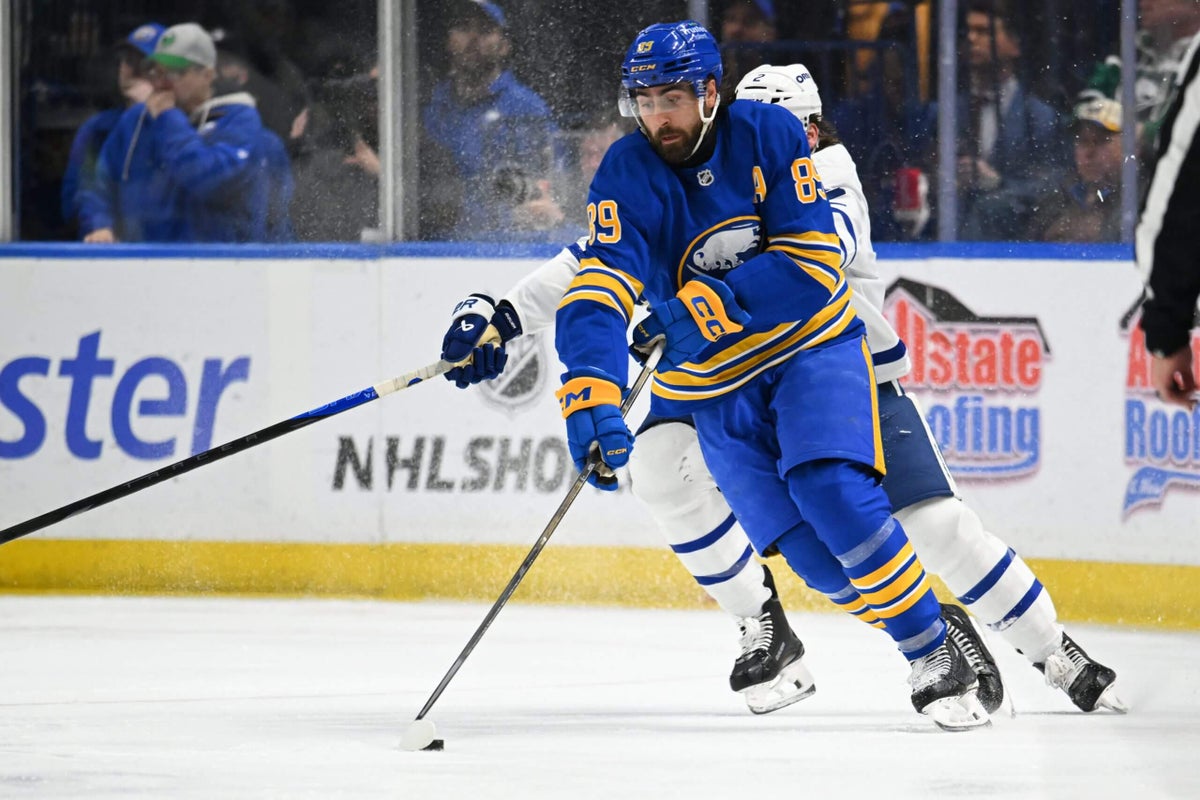
The top free-agent forward on the market, Tuch has to be on this list. The big questions: Will the Sabres really let him walk right as they’ve returned to contention? And if they don’t, are the Red Wings willing to pay a top-of-the-market free-agent contract for the big-bodied, 30-year-old forward, knowing the second half of that deal may not age well?
If they are, Tuch could be a natural fit in the top six. It may require some flexibility from Raymond, who would potentially move to the left side, but he’s capable of that, and Tuch would provide offense, size and an ability to play against top opponents. His five-on-five scoring rate would have led the Red Wings this season, and the underlying numbers back it up.
It’s the priciest option, and there would be steep competition. But if Tuch is available come July 1, Detroit will have to strongly consider it.
Mason Marchment
Marchment stood out as a potential trade target last summer, and now he could hit the free-agent market at age 31. His season didn’t start well in Seattle, but he was a strong producer (including at five-on-five) when he was traded to Columbus midseason, and he has an edge to his game in addition to offense. He’d likely be best cast on a second line rather than a first, but he could nonetheless be an upgrade for Detroit on the right contract. The big question would likely come down to contract length.
Anders Lee
We’ll see if Lee actually leaves Long Island, where he is the captain of a team in a similar spot as the Red Wings. But as of now, he doesn’t have a contract extension, and he brings size, leadership and plenty of playoff experience to the fold. His own five-on-five production is lacking, but notably, the Islanders’ five-on-five expected goals (and actual goals) with Lee on the ice are quite strong.
Lee will soon be 36, though, and in addition to any fall-off risk with his age, there’s also the likelihood he’d choose an immediate contender over Detroit to chase a Stanley Cup. Still, if he makes it to free agency, he merits a call because of his on-ice numbers and pedigree.
Viktor Arvidsson
Arvidsson jumps off the page because of his five-on-five production this season, both individually and for the Bruins when he’s on the ice. His 54 points in 69 games this season are comparable to Kane’s totals, and Arvidsson did most of that damage at five-on-five. That is immediately intriguing for Detroit.
The issue is the rate of even-strength production is an outlier for him; his gaudy 3.06 five-on-five points per 60 this year came after posting 1.36, 2.1 and 1.51 the previous three seasons. He did have higher numbers in that category earlier in his career (above 2.2 four times between 2016 and 2022), and Arvidsson is certainly a good player. His expected goals share, funnily enough, shows the opposite trend: oddly low this season despite being consistently strong in most other seasons. But it’s something Detroit will have to be conscious of, especially in another smaller winger.
Charlie Coyle
Coyle had a huge season in Columbus, and his 58 points were the second most of his career. Forty of those points came at five-on-five, more than any Red Wing besides DeBrincat. Coyle’s five-on-five scoring rate wasn’t as high earlier in his career, but he’s been at or above this level in three of his last four seasons, with three different teams. That is compelling, even before getting to his size (6 feet, 3 inches) and ability to play center with a strong defensive impact.
The issue is his age at 34, but if Coyle could be had on a two- or three-year deal, there’s potential here for a player who could add even-strength production and matchup ability somewhere in a top nine.
Boone Jenner
The third Blue Jacket on this list might actually be the least likely to make it to free agency. But with head coach Rick Bowness pledging culture changes, who knows who could shake loose in Columbus? Jenner is the captain, and although he wouldn’t solve the top-line issue for the Red Wings, he could bring physicality with some production to the bottom six, and would be another seasoned veteran addition to the room.
As with the Islanders and Lee, though, I’m skeptical the Blue Jackets will let their captain walk, and Marchment and Coyle might be more suited to Detroit’s needs regardless.
Scott Laughton
I went into this exercise expecting to see a more compelling case for Laughton, who always plays the Red Wings tough. He has seven goals and eight points in eight games against Detroit the last three seasons, including a four-goal game in 2024-25. The five-on-five numbers haven’t been as compelling the last two seasons, though, despite rebounding a bit in Los Angeles after the trade deadline. He’s still a notable name for the bottom six, but perhaps not the needle-mover I’d have guessed going into this.
Bobby McMann
McMann had a breakout season, scoring 29 goals between the Maple Leafs and Kraken. He’s a big-bodied forward and willing to lay some hits, and perhaps that would play next to Larkin and Raymond. The question is the contract, as teams interested in McMann will have to decide if they think this year’s performance was an outlier or a breakout season. But McMann does fit the profile.

The Wild’s Michael McCarron would be an under-the-radar yet fitting addition to the Red Wings this offseason. (David Berding / Getty Images)
Michael McCarron
Being harder to play against can take many forms. But under Yzerman, the Red Wings have largely ignored the most basic version: more big bruisers down the lineup. McCarron can play that role as a 6-6 force who throws his body around and wins faceoffs at a strong clip. He’s not a major producer, but his teams’ expected goal rates with him on the ice are respectable, and offense won’t be his core function, anyway. He’s also a local product, as a Grosse Pointe native, which could give the Red Wings an in.
He’d be a targeted addition for the fourth line. But if Detroit wants an identity overhaul there, McCarron is an obvious candidate.
AJ Greer
Greer checks many of the same boxes as McCarron with size and physicality, albeit as a true winger. He also played on the Florida Panthers’ 2025 Stanley Cup team in a depth role.
The question with Greer is how much of his offensive surge in 2025-26 is repeatable. His 17 goals nearly tripled his previous career high, and while some of that could be due to more minutes, his 16 percent shooting suggests that bottom-line number will regress. Still, considering the scoring is more of a bonus, the outlier production is not a dealbreaker — though the contract his 17-goal platform season yields could be.
Trade targets
Player
Age
Points / game
5v5 pts / 60
5v5 on-ice GF/60
5v5 on-ice xGF/60
5v5 xGF%
Hits/60
27
0.77
2.33
3.91
3.14
54.21%
0.55
25
0.62
2.07
3.16
2.92
47.53%
0.63
24
0.29
1.28
2.33
2.71
49.75%
0.2
24
0.5
1.7
2.67
3
54.03%
0.96
27
0.69
1.27
1.8
2.66
44.64%
0.91
Josh Norris
If Tuch hits the free-agent Market, Norris would be a logical candidate to move up to Tuch’s spot on the top line wing in Buffalo. But if Tuch stays with the Sabres, their cap math gets tricky, and Norris could become an odd man out as a result. Young center Noah Östlund is cheap and looks ready for a full-time role in the top nine, and Peyton Krebs and Zach Benson both need new deals that should still come in cheaper than Norris’ $7.95 million. Could that put the high-scoring forward in play?
If so, he becomes a very interesting name. The big knock on Norris is his injury history, which is a real red flag. He’s played 60 games only once in his career. But if Detroit is willing to live with him missing some games, Norris would bring potent scoring and on-ice numbers at five-on-five, is fairly young at 27 and can play center. Buffalo traded Dylan Cozens for him, so cost could be a factor — but if the Sabres are in a cap jam, does the price become more reasonable? He’s an interesting sleeper name to watch.
Jack Quinn
Quinn had a bounce-back season, and my guess is Buffalo hangs onto him at his young age. But if Tuch stays put, and it’s not Norris on the way out, Quinn might be the next most obvious name for the Sabres to shop. He’s a right winger, which is less of a need than the left side, but he’s young and, especially in the event Kane moves on, there could be a logic to pursuing the 2020 top-10 pick. Defense is a question, but his on-ice offensive generation is intriguing at five-on-five.
Kent Johnson has enticing skills. (Jason Mowry / Getty Images)
Kent Johnson
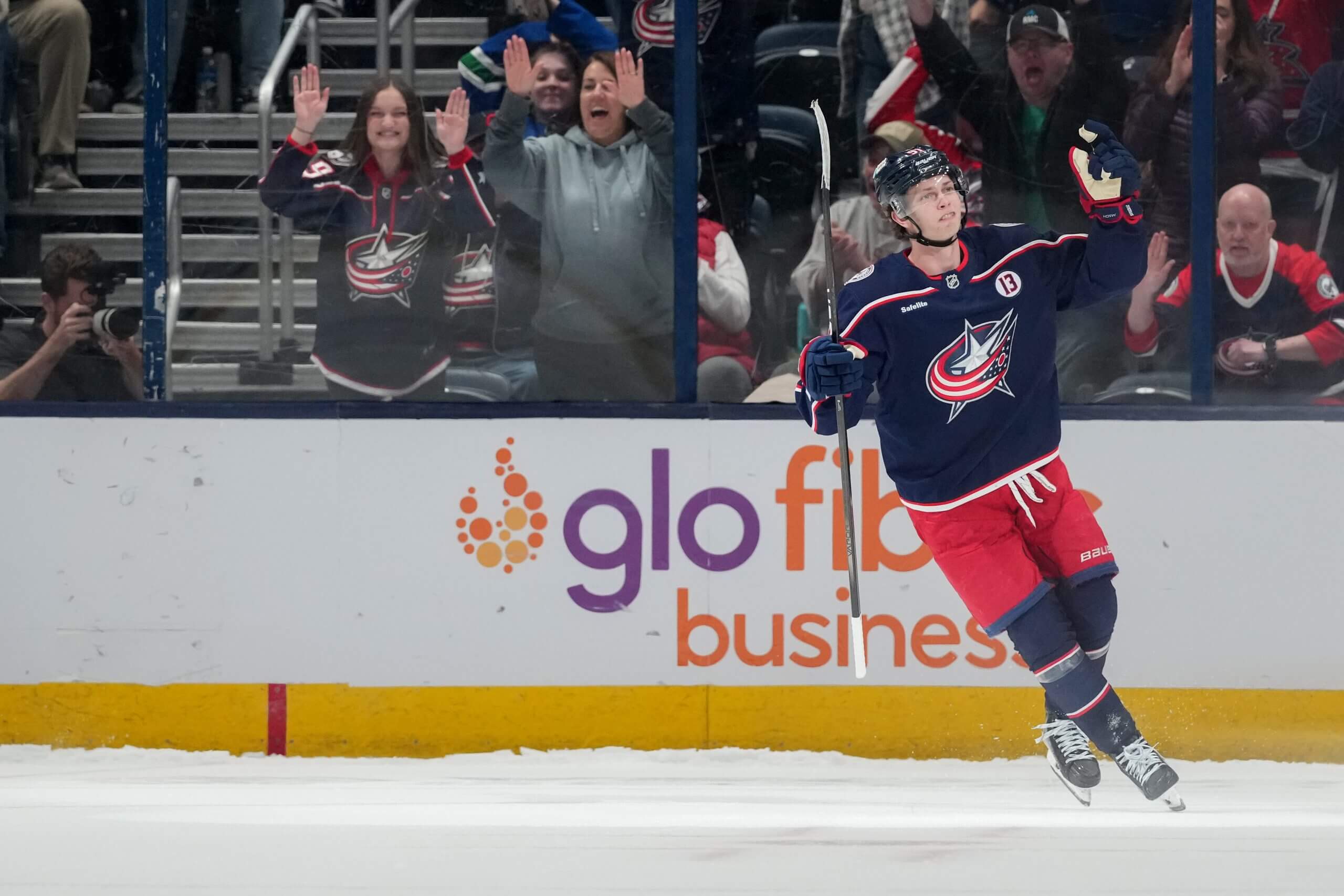
Could Johnson be this year’s Trevor Zegras — a highly skilled, creative forward who hit an offensive rut but could bounce back in a big way? Columbus GM Don Waddell doesn’t sound eager to move him, and wisely so. However, does that mean the Blue Jackets wouldn’t listen if called on the forward?
Johnson doesn’t address the hard-to-play-against issue, and his five-on-five production in 2025-26 was rough. It was much better the season prior, though, and for a player as talented as him, I’m betting he finds his stride in the coming years.
Mavrik Bourque
The splashy name in Dallas would be pending restricted free agent Jason Robertson. And hey, if he really becomes available, every team should be interested. But more likely, the Stars find a way to keep their 96-point forward, even if it means subtracting elsewhere in the lineup. Could that be Bourque, who is also a pending RFA? He doesn’t have Robertson’s monster point totals, and it’s unclear if he’d fit better in the top six or bottom six in Detroit. But the five-on-five numbers are solid across the board, and at his age, there’s room for another step. That makes him intriguing if he becomes available.
Elias Pettersson
Pettersson has a full no-move clause, which means he’ll have full say over whether he changes teams this summer. He very well may not. But if he decides it’s time for a fresh start, he has a level of upside that is almost impossible to find — though he has fallen well short of it the last two seasons. That, however, is the reason Vancouver could consider moving him, and it’s worth exploring if a change of scenery would help him. Would his experience with Raymond at the Olympics put Detroit on his radar?
Pettersson wouldn’t solve Detroit’s physicality questions, and you can debate if he helps the late-season woes. But the offense he showed before the last two seasons would be a major difference-maker for the Red Wings, if he can recapture it. He also has the ability to play center or left wing, giving Detroit flexibility in how to deploy him. His $11.6 million contract would be a big risk to take on, but there’s real payoff potential.
Correction: An earlier version of this story listed Michael Carcone as a free-agent target. He is not a pending free agent. He signed a two-year extension with Utah in March.