
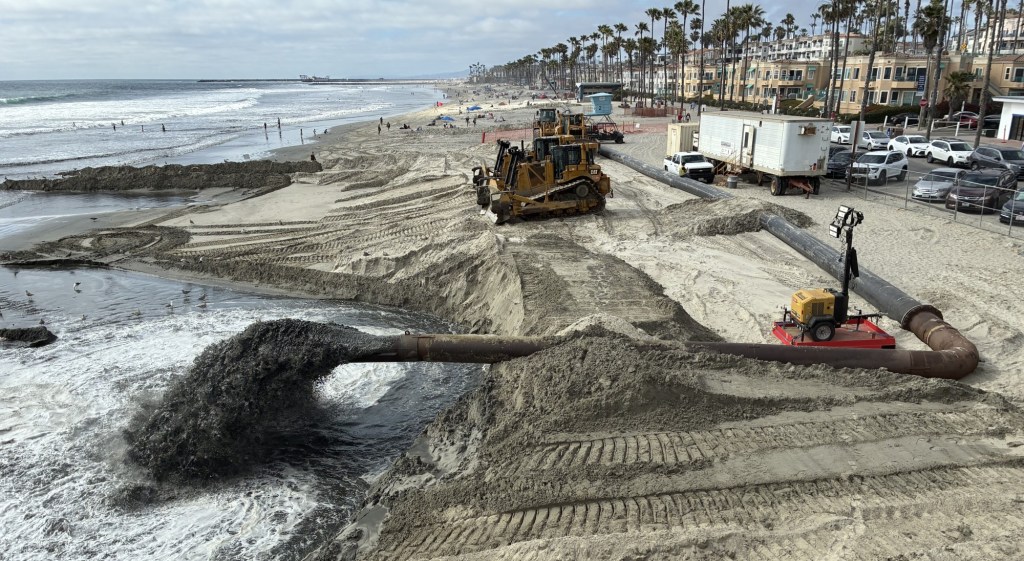
The Army Corps of Engineers will have placed 320,000 cubic yards of sand on Oceanside’s shoreline by the time the city’s harbor dredging is finished Friday.
That’s a significant haul of sand, equal to more than 20,000 dump truck loads, although it’s delivered in a more energy-efficient watery slurry through a pipe across the beach from a dredge in the harbor. Bulldozers spread out the wet, brownish sediment as it accumulates on the beach.
This year’s beach-widening deposit is the largest in several years, and the U.S. Army Corps of Engineers and its contractor Manson Construction is scheduled to do another one this fall, as the city transitions from spring to fall dredging.
“In previous years, the Corps usually removes 250,000 cubic yards,” said Jayme Timberlake, Oceanside’s coastal zone administrator.
“With all the rain and storm activity in 2023, the Corps removed approximately 400,000 cubic yards that year,” Timberlake said in an email. “So the quantity removed does vary depending on the conditions leading up to the dredge (and on federal funding).”
Crews will begin removing the pipes, fencing and other equipment on the beach and in nearby parking lots Monday, city officials said. That could take up to a week. The parking lot near the pier should reopen by May 8, and Lot 12 at the harbor beach should reopen by May 11.
This year the work was done a few weeks early because the accumulation of sand in the harbor channel had become a navigation hazard.
Normally the dredging takes about six weeks and is done once a year in the spring. It finishes in time to have fresh sand on the beach and a deeper entrance to the harbor for Memorial Day weekend and the unofficial start of the summer tourist season.
However, earlier this year, the Oceanside City Council approved a proposal by the Corps of Engineers to switch the annual harbor maintenance to the fall. Experts say studies show that dredging in the fall will slow the accumulation of sand in the channel and keep it on the beaches longer.
Rep. Mike Levin, D-San Juan Capistrano, announced in early April that $8.2 million was appropriated for the next dredging, scheduled to start in September.
The second dredging of 2026 will produce less sand, Timberlake said.
“Approximately 150,000 cubic yards are likely to infill the channel between May and September, due to south swells and sediment transport that brings sand back into the channel during the summer,” she said.
While a majority of the City Council and residents supported the change, some people had doubts. They worried that doing the work in the fall could mean smaller beaches over the summer, when tourism and recreational activities peak.
City officials said the schedule could revert to spring in a few years if the change proves unsuccessful.