
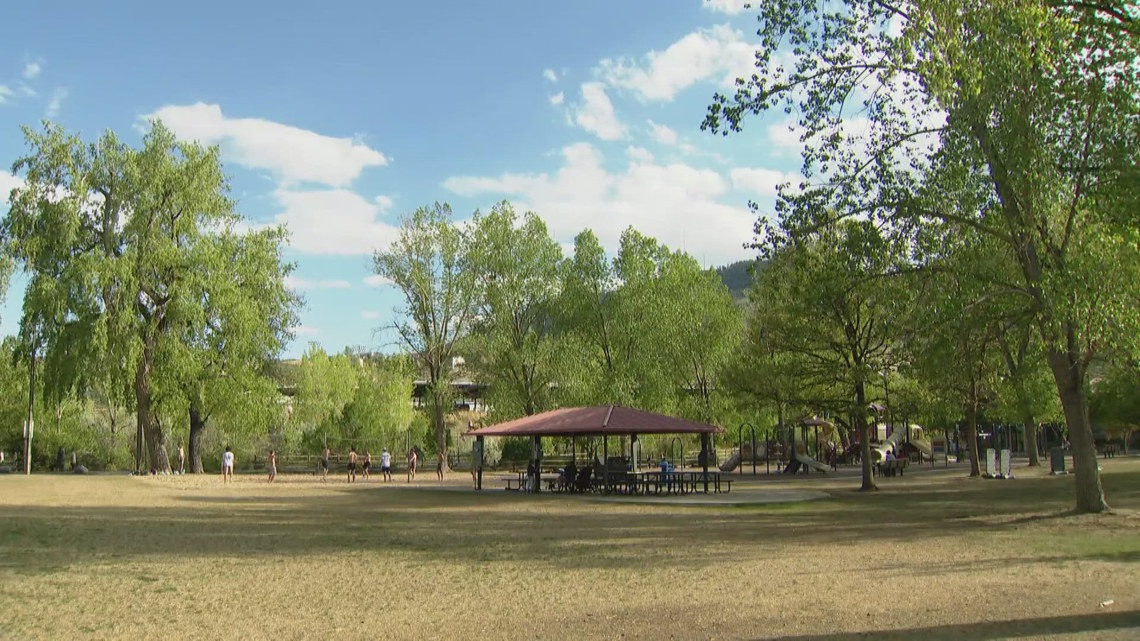
From backyards to golf courses, the same restrictions apply.
GOLDEN, Colo. — Golden is the latest city along Colorado’s Front Range to implement drought restrictions, with a Stage 1 response taking effect May 1 amid historically low snowpack and below-average stream flows.
Residents and businesses are now limited to watering lawns no more than two days per week, during overnight or early morning hours. Violations can bring escalating fines, from $100 for a first offense in single-family homes to as much as $500 for repeated violations among commercial users.
The restrictions come with a familiar question: whether the same expectations extend to the largest, most visible water users — the parks, golf courses, and expanses of grass that define much of the city’s landscape.
Brian Tracy, deputy director of the City of Golden Public Works, said that concern is one he hears often.
“We do get a lot of questions from residents and businesses, you know, saying you’re asking us to do these things and what are you doing in response,” he said.
The city’s answer, he said, is that it is cutting back as well. In some cases by allowing parts of the landscape to go brown.
“Our strategy is to curtail water use in some of the satellite parks, in some of the neighborhood community parks,” Tracy said. “Maybe let areas go dormant altogether and/or die off in certain spots in favor of watering high-value public spaces.”
Officials are targeting about a 15% reduction in outdoor water use this year, he said, by prioritizing areas like downtown parks and athletic fields while scaling back irrigation in places that see little use.
“There’s a lot of nonfunctional turf in front of buildings that people never walk on,” Tracy said. “We look at those areas as maybe an area to replace that landscaping from turf to more native, drought-tolerant types of species.”
Even the narrow strips of grass between sidewalks and streets, common across many neighborhoods, are being reconsidered.
“They’re not really high-value turf areas,” he said.
The drought, Tracy added, presents an opportunity to rethink long-term water use.
“I think this year is a good opportunity to identify what areas are important for communities and conversely what areas are not important,” he said. “It’s a call to action for sure. It also should act as a wake-up call.”
Golf courses, often viewed as some of the most water-intensive landscapes, say they are already adjusting. But he said that perception does not reflect what is happening behind the scenes.
“People drive by golf courses, and they see green grass and like, ‘Oh, they’re just watering like crazy,’” said Aaron Fankhauser, director of agronomy at The Club at Rolling Hills Golf Course.
“This year alone, you know, we’re not watering probably 25-30% of the normal areas that we would,” Fankhauser said. “We’re probably on a 30% reduction of what we normally would water.”
At Rolling Hills, that shift includes actively converting about 20 acres into native or mulched areas that require far less irrigation. Across the course, large stretches of rough, sometimes totaling 40 to 60 acres, are now being watered at roughly a third of their usual levels.
“We’re going to focus on the really important areas: greens, tees, fairways,” he said. “Outside of that, we’re going to reduce it as much as we can.”
The changes are not unique to one course, he added.
“Lots of courses around the state are in the same boat.”
Fankhauser described the approach as proactive, rather than reactive.
“When there’s water restrictions, we actively are trying to be ahead of those problems before they even start,” he said.
For both city officials and course managers, the challenge this year stands out.
In Golden, where outdoor spaces are central to daily life and identity, the result is a shift that may be visible across the landscape, from browning patches of grass to newly planted native areas.
“We’re all in this together and we can all make a difference,” Tracy said.