
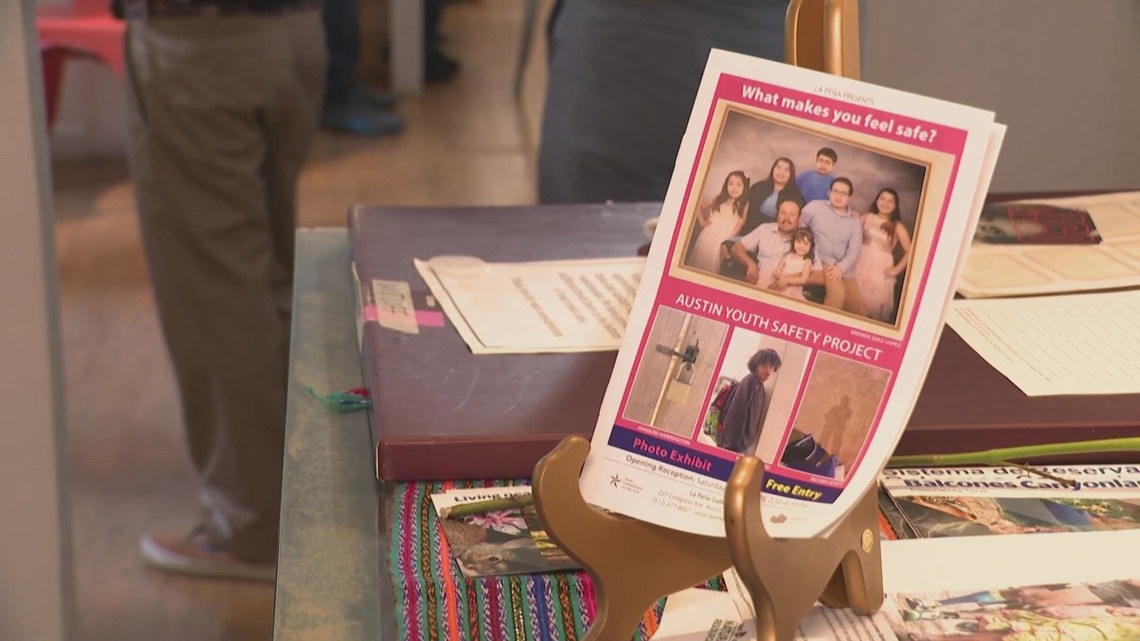
The Austin Youth Safety Project challenges teens to use personal photography to share their perspectives on security, which aims to influence local policy.
AUSTIN, Texas — A group of Austin teenagers is helping reshape how the city thinks about public safety — not through statistics or policy papers, but through their own lived experiences.
The effort, known as the Austin Youth Safety Project, is led by University of Texas at Austin professor Michael Hames-García and brings together young people from some of the city’s most underserved neighborhoods. The goal: to better understand what actually makes them feel safe — and use those insights to influence future policy.
At La Peña Art Gallery in Downtown Austin, those perspectives are now on display. The exhibit showcases photos taken by the teens, offering a deeply personal look at safety through their eyes.
“Basically just take a look at it, and look at one of us, and see what it’s doing to us — what it is doing to our families,” participant Jayden Martinez said.
Safety, seen through a different lens
Rather than focusing on policing or crime data, students were given a simple assignment: photograph with their phone what makes them feel safe.
The results were revealing.
“There were a lot of pictures of family members,” Hames-García said. “There were pictures of closed outdoor spaces. Pictures of trips out of town,” Hames-Garcia said.
For Bailee Martinez, that sense of safety came from an unexpected place — her first trip to New Orleans during Mardi Gras.
“Although I didn’t know anyone, I felt safe and I felt like I belonged,” she said. “Everybody needs someone, and everybody needs a break from whatever they have going on.”
Centering voices from high-risk communities
The project specifically engages teens living in ZIP codes with high incarceration rates, in partnership with organizations like Austin Justice Coalition, PODER and Tomorrow’s Promise Foundation.
“These are communities that have high rates of people being taken away to prison,” Hames-García said. “They’re low-income communities … where there’s a lot of food insecurity, where infrastructure might not be as strong.”
For some students, the project has also highlighted the impact of Austin’s rapid growth.
Jayden Martinez shared a photo of his childhood home in the Montopolis neighborhood — a place filled with memories, including agave plants his family once planted together. But rising housing costs forced his family out.
“From what I can remember, my parents were paying about $1,000 a month,” he said. “Before they turned it into this, they wanted about $3,000.”
The home has since been converted into an Airbnb rental, a shift Martinez said reflects broader changes across East Austin.
“I just wanted to choose something that more represented what’s going on all over Austin,” he said.
From photos to policy
The exhibit at La Peña will remain on display through the rest of the week, giving the public a chance to engage with the students’ work firsthand.
But the project doesn’t stop there.
The next phase will be to translate these personal insights into policy proposals that students can present directly to local leaders, including Austin City Council members and Travis County Commissioners.
Organizers hope those in power will take note — and that the voices of young people will help shape a safer, more inclusive future for Austin.