
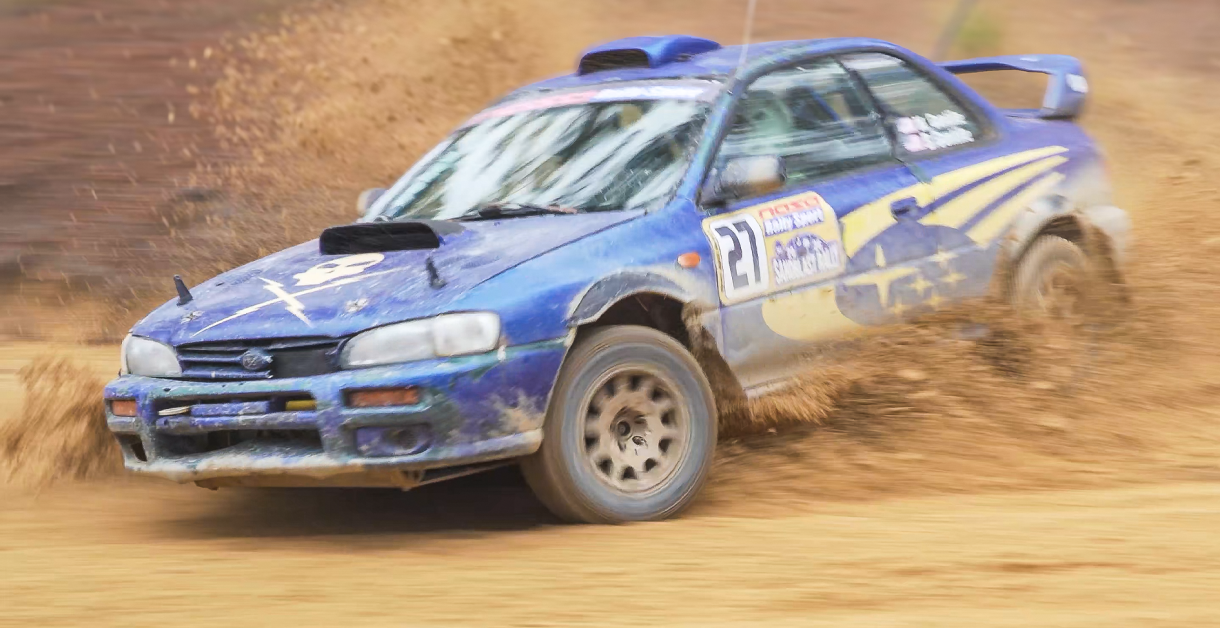
This variation is great for spectators, who are able to dart around the extremely short transits off the main highway to see a diverse assortment of action from the slow ‘Sandtrap Hairpin’, to the fast flowing double S on loose sand, or even the four-way junction at H Cooper Black to see some chaos as cars bounce over a hump and a ditch in the hard clay.
The spectator areas are never more than a mile or so away from the main highway, and that main highway gets you to essentially every stage of the event. Those directionally challenged among us, co-drivers included, will relish the event’s simple transits as well as the Jemba notes. Sandblast is not out to ‘get you’. Everything is straight forward, and everyone knows what to expect; therefore, you typically see a lot more relaxed faces at tech inspection and the service park the morning of the event.
The forest’s layout itself is central to the viewing experience. Replanted in orderly rows after early 20th-century over-farming and erosion, the pines stand in remarkably uniform rows, with little undergrowth thanks to the sandy, nutrient-poor soil. The result is rare for East Coast rally: clear sightlines in all directions. This is especially awesome during the night stages, where light pods pierce the pine tree branches and splinter into a million different rays of light coming around the corner. During the day, the pines provide a lovely backdrop as the sun sets behind them and the dust rises above them, showering the whole area with gold light.
Long-time volunteer Joseph Sturgill describes a “relaxed pace” shaped by the setting and the people, more akin to a family reunion than a traditional race weekend. It’s a sentiment that carries through to the award ceremony, where competitors, officials and media gather under one roof for a banquet to trade stories from the day’s action.