
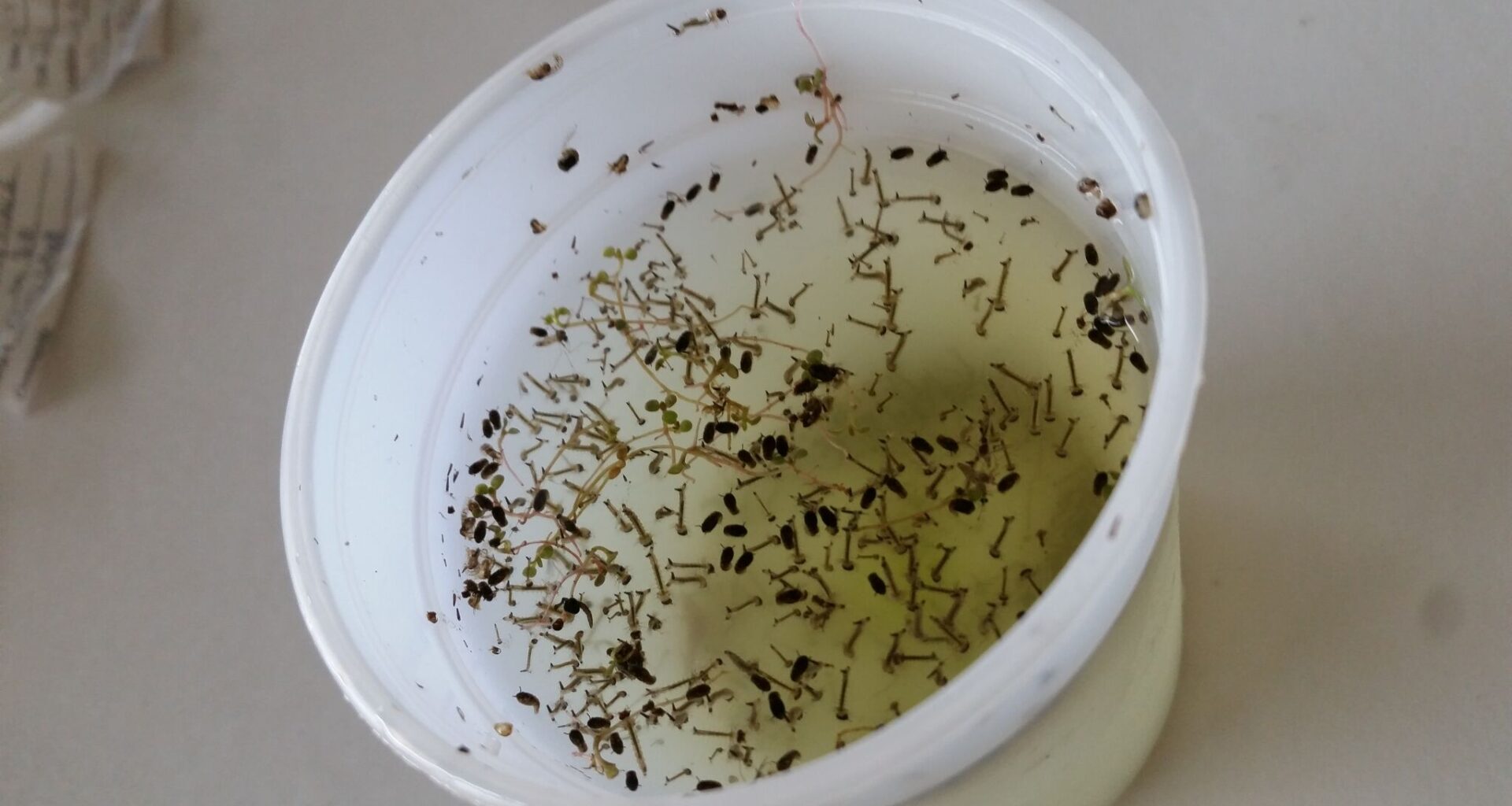
A sample taken by Marin/Sonoma Mosquito and Vector Control District workers from a neglected swimming pool yielded 1,000 mosquito larvae and 100 pupae.
Marin/Sonoma Mosquito and Vector Control District
Neglected swimming pools can produce tens of thousands of mosquitoes, according to the Marin/Sonoma Mosquito and Vector Control District.
Marin/Sonoma Mosquito and Vector Control District
A Marin/Sonoma Mosquito and Vector Control District worker sets a rotational trap that collects adult mosquitoes at different times of day, helping target control efforts.
Marin/Sonoma Mosquito and Vector Control District
The Bay Area could be in for an earlier and longer mosquito season this spring and summer — even as officials race to contain the potential explosion of a new invasive mosquito species that is already spreading in parts of the East and South Bay.
A mild winter, warm stretches of weather in February and March, and a rainy spring this year have created an ideal habitat for mosquito breeding, which means more mosquito production and more chances for the transmission of mosquito-borne diseases like West Nile, the main disease of concern in California.
Article continues below this ad
While West Nile typically causes mild flu-like symptoms in humans and is relatively rare, it can lead to severe neurological damage or death.
The number of “mosquito days” — days of the year where humidity and temperature are conducive to mosquitoes thriving — has been trending up over the last 40 years in many parts of the United States, including San Francisco, according to a 2023 analysis of mosquito trends by Climate Central, a nonprofit research group.
This year appears to be no exception.
San Francisco Chronicle Logo
Make us a Preferred Source to get more of our news when you search.
Add Preferred Source
“This year so far, we are seeing a lot of mosquitoes — high mosquito activity a little bit earlier than we did last year,” said Taylor Kelly, scientific technical services manager of Santa Clara County Mosquito Vector Control.
Article continues below this ad
The Bay Area has seen a high number of warm days this year, in particular when the overnight temperature is above 50 degrees — the threshold that speeds up mosquito production and disease transmission within the gut of the insect to levels that are considered concerning, said Peter Bonkrude, district manager of the Marin/Sonoma Mosquito and Vector Control District.
“Anytime we have overnight temperatures above 50 degrees, it provides an opportunity for mosquitoes to go through development faster, and we’ve had quite a few of those nights, in an unprecedented way this year,” Bonkrude said.
The warmer it is, the faster eggs hatch and the quicker larvae develop, which amplifies the mosquito population. When this starts earlier in the year, there are more generations of mosquitos in the area to further reproduce.
Mosquito season used to be roughly May to September, but can start as early as February now, Bonkrude said.
In some parts of Contra Costa County, officials were surprised to find one species of mosquito, Aedes aegypti, in February and March after unseasonably warm periods. They usually don’t see those mosquitoes until July or August, said Paula Macedo, district manager of the Contra Costa Mosquito and Vector Control District.
Article continues below this ad
• Read more: This mosquito can breed in a bottle cap — and it’s spreading in California, officials warn
The Aedes aegypti, or yellow fever mosquito, is of particular concern because it had been mostly pushed out of California many years ago but recently came back and can transmit serious diseases like dengue, Zika, yellow fever and chikungunya.
The invasive Aedes aegypti first reappeared in Southern California about 15 years ago and has since spread to 28 counties, including Contra Costa, Santa Clara, Alameda and Solano, according to the state public health department. It was first detected in the Bay Area around 2022, in San Jose and Martinez, and has also been found in Antioch and Livermore.
Mosquito control districts in Southern California that have been dealing with Aedes aegypti for longer report that the mosquito population stays relatively stable for the first two years, but then explodes — a scenario that local officials are working to prevent in Antioch, Macedo said.
To try to fend off such a surge, the Contra Costa mosquito and vector control district is considering a new strategy that would involve releasing thousands sterile male mosquitoes — which do not bite — to mate with females, which would produce non-viable eggs. This could start in July or August at a small scale, in a 20-acre residential area in Antioch, to get acquainted with the technique and see if it’s viable, Macedo said.
Article continues below this ad
Here’s what you can do to help protect yourself and your community:
Dump out any standing water
Check your yard for standing water — including in buckets, plant saucers and rain barrels — and dump it. Aedes aegypti can breed in very small containers, as small as a bottle cap or on plant leaves that collect water.
“Because these mosquitoes breed so well in residential backyard habitats, we need buy-in from the public to make sure they aren’t breeding in their backyard,” Kelly said.
If you have a fountain or pond, you can use mosquitofish, which eat mosquitoes that hatch in that container. Some districts, including Santa Clara County, breed mosquitofish and distribute them to residents.
Article continues below this ad
“They’re very hardy and can handle a wide range of temperatures and conditions,” Kelly said. “They’re an excellent biological control source for these residential potential breeding sources.”
Use mosquito repellent
Mosquito districts in California recommend repellants that contain EPA-registered active ingredients (DEET, picaridin, oil of lemon eucalyptus, IR3535). This EPA website can help you pick one if you have preferences for ingredient type.
Report dead birds
If you see dead birds, report them to your local mosquito district so they can be tested for West Nile virus. This is because mosquitoes carrying West Nile can bite birds, and bird species that are very susceptible to the disease — crows, California scrubjays and magpies — will live a short while, then die. In fact, birds that look like they may have gotten hit by a car may have had West Nile, Macedo said, because birds also experience neurological symptoms like confusion.
“One first indication of West Nile virus is when we find dead birds,” Macedo said.
If you’re not sure which district to report it to, you can call 1-877-WNV-BIRD (1-877-968-2473) from anywhere in California and they will distribute the report to the correct district.