
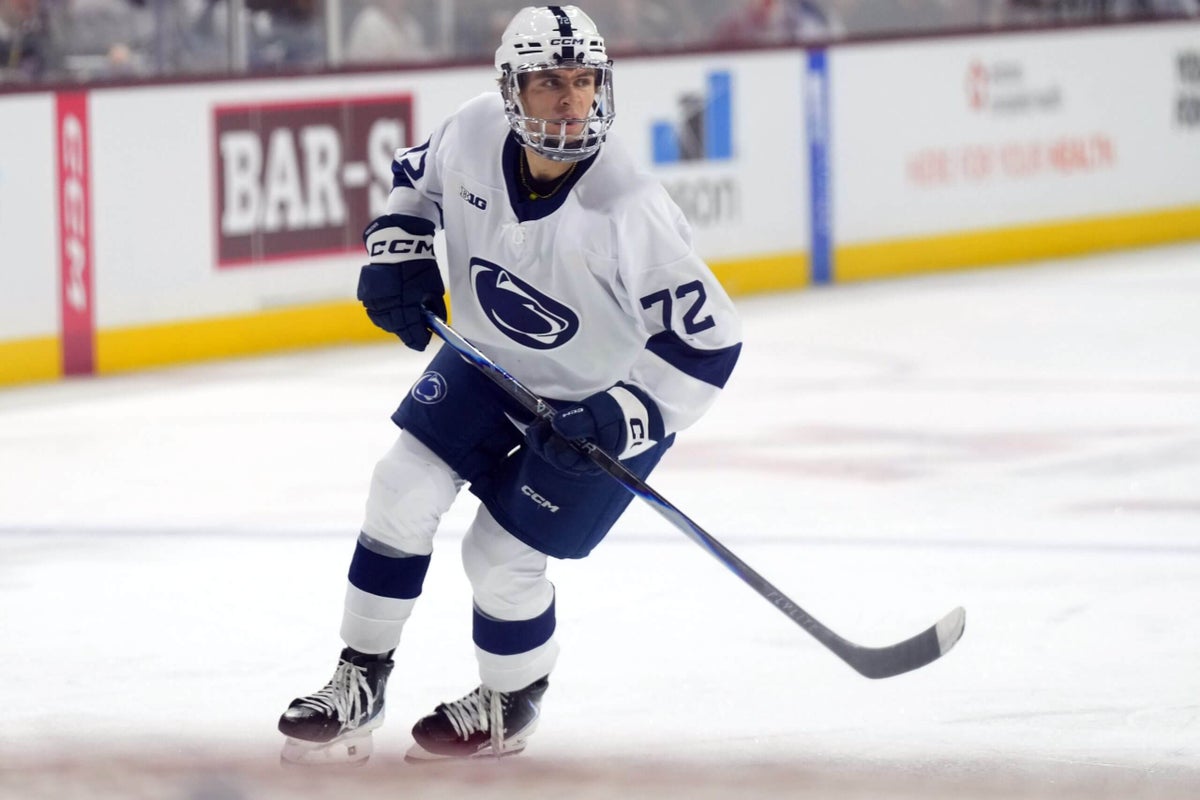
Gavin McKenna is a special prospect. No, that doesn’t mean he’s a “generational player,” a term that’s thrown around too loosely for projected No. 1 NHL Draft picks. Nor does it mean he’s going to immediately dominate as an 18-year-old NHL rookie as Matthew Schaefer did this year or Macklin Celebrini did last year. That said, McKenna is the kind of rare offensive talent who could one day become the face of an NHL franchise.
On May 5, the Vancouver Canucks will be hoping the lottery balls bounce their way and grant them the right to call McKenna’s name with the first pick in June. It’s not just that McKenna is the highest ceiling prospect of the 2026 draft, but he’s an optimal fit for the Canucks’ biggest organizational need in this rebuild.
Vancouver has an up-and-coming pipeline of young defenders led by Zeev Buium, Tom Willander, and Elias Pettersson, but the club doesn’t have a single forward with elite, game-breaking potential. None of the Canucks’ current top forwards — Elias Pettersson, Marco Rossi, Brock Boeser, and Jake DeBrusk — would be first-line players on Stanley Cup-contending teams. And as exciting as Braeden Cootes’ two-way potential is, he’s far more likely to develop into a well-rounded second or third-line centre rather than a star point producer.
McKenna wouldn’t transform the Canucks overnight — look no further than the Chicago Blackhawks, who finished 31st in Connor Bedard’s third NHL season — but he is gifted enough to possibly become a 100-point NHLer one day, which is one of the rarest assets a team can mine. Here’s why McKenna is such a tantalizing prospect.
Why McKenna’s statistical profile is rarer than you think
There are qualitative and stylistic parts of McKenna’s game that justify his elite offensive potential, but let’s start with some cold, hard facts.
McKenna scored an absurd 129 points in 56 games for the Medicine Hat Tigers of the WHL in his draft-minus-one season. That 2.3 points-per-game clip is the most of any CHL player in their draft-minus-one season in the last 20 years, putting him in elite company.
CHL Players With 1.5+ P/GP In D-1 Season
Rank
Player
Points Per Game
1
2.30
2
2.00
3
1.74
4
1.61
Since 2006
Connor McDavid is a generational player. Bedard is well on his way to becoming a franchise player. And John Tavares, the “weakest” NHL player on this list, has a chance to hit 1,300 career NHL points, along with his 2014 Olympic Gold medal, and a 2016 World Cup of Hockey championship.
McKenna was on a Bedard-like trajectory heading into this season. The hype has slowed for him after a strong-but-not-completely-dominant NCAA season, but we need to put it in context.
McKenna could have easily returned to the WHL for his draft year and scored 140-170 points, as Bedard did. He would have skated circles around his competition all season, everybody on the outside would have looked at him as a near-flawless prospect, and Ivar Stenberg would have never come close to challenging him as the No. 1 prospect of this draft class, like he briefly did in January following the World Juniors.
However, McKenna took the harder path by jumping to the NCAA as a 17-year-old. Everyone knows the NCAA is a tougher league than the WHL, but I don’t think fans fully grasp just how much of a step up it is in difficulty, especially for a smaller, slighter player like McKenna, who still needs to fill out his frame.
According to EliteProspects, the typical WHL team has an average age of 18.3; the Big-10 Conference that McKenna played in has an average age of 21.5.
In other words, McKenna was playing against competition that was mostly 3-5 years older than him. Three years may not sound like a huge difference, but it’s massive in the prospect world, where young players can take enormous leaps in a six-month span, let alone multiple years of extra development. Everyone is bigger, faster, and stronger. Teams are more structured defensively; there are far fewer freebie scoring chances and uncontested rushes.
Most NCAA Points By Draft-Eligible F
Despite that, McKenna still scored 51 points in 35 games for Penn State, which is the fourth-best points-per-game mark from a draft-eligible NCAA player in the last 30 years. As a side note, Adam Fantilli and Jack Eichel were born in October, meaning they were older in their respective draft classes, whereas Macklin Celebrini was a 17-year-old throughout his entire NCAA campaign because of his June birthday, which explains why the latter became a superior player despite less impressive draft-year production on paper.
It took McKenna about half a season to adjust to the NCAA, which is understandable since he’s a slight forward. From that point onward, though, he was back to his superstar ways: McKenna racked up 33 points in his last 18 games. He generated a whopping 92 shots on goal in those 18 games despite being a playmaker first and foremost.
For reference, McKenna’s full-season production was basically identical to the 50 points in 35 games that Porter Martone, who’s more than a year older, scored at Michigan State in his draft-plus-one season this year. At the World Juniors, McKenna scored six more points as well. Martone has been an instant star for the Philadelphia Flyers since turning pro, scoring 13 points in his first 15 NHL games.
They’re obviously completely different players stylistically, and Martone is a 6-foot-3 power forward, so you’d expect his game to translate quickly to the NHL, but McKenna is clearly doing something right if he’s got a glitzier statistical profile than Martone while being 14 months younger.
Lack of help around McKenna at Penn State
McKenna’s NCAA production is even more impressive when you consider a couple of additional factors. Firstly, the NCAA is tougher than ever, especially as the best CHL players keep flocking there. Secondly, McKenna’s Penn State team wasn’t exactly a juggernaut. In fact, you could argue he didn’t have enough talented teammates who could keep up, especially relative to other recent, high-profile draft-eligible NCAA players.
Penn State’s roster only featured four skaters who’ve been drafted by NHL teams, and only two of them were picked in the first three rounds.
Penn State 2025-26 NHL Drafted Skaters
PlayerDraft Slot
Jackson Smith
2025 1st round pick (CBJ)
Charlie Cerrato
2025 2nd round pick (CAR)
Reese Laubach
2022 7th round pick (SJ)
Luke Misa
2024 4th round pick (CGY)
For comparison, the Boston University team that Celebrini played on in 2023 featured 12 skaters already drafted by NHL teams, eight of whom were selected in the first three rounds, including Lane Hutson, Tom Willander, and Ryan Greene.
Celebrini’s NHL Drafted Help at BU 2023
PlayerDraft Slot
Tom Willander
2023 1st round pick (VAN)
Lane Hutson
2022 2nd round pick (MTL)
Ryan Greene
2022 2nd round pick (CHI)
Jack Hughes
2022 2nd round pick (LAK)
Luke Tuch
2020 2nd round pick (MTL)
Dylan Peterson
2020 3rd round pick (STL)
Gavin McCarthy
2023 3rd round pick (BUF)
Devin Kaplan
2022 3rd round pick (PHI)
Cade Webber
2019 4th round pick (CAR)
Shane LaChance
2021 6th round pick (EDM)
Jack Harvey
2023 7th round pick (TB)
Aiden Celebrini
2023 6th round pick (VAN)
Fantilli’s 2023 University of Michigan team, meanwhile, had eight NHL draftees. This included four very high-pedigree first-round picks in Luke Hughes, Frank Nazar, Mackie Samoskevich, and Rutger McGroarty. That doesn’t even include Gavin Brindley, who ended up becoming a second-round pick after the end of the season.
Fantilli’s NHL Drafted Help at BU 2024
PlayerDraft Slot
Luke Hughes
2021 1st round pick (NJ)
Frank Nazar
2022 1st round pick (CHI)
Mackie Samoskevich
2021 1st round pick (FLA)
Rutger McGroarty
2022 1st round pick (WPG)
Seamus Casey
2022 2nd round pick (NJ)
Dylan Duke
2021 4th round pick (TB)
Ethan Edwards
2020 4th round (NJ)
Jacob Truscott
2020 5th round (VAN)
Having other high-end weapons to play with isn’t just an advantage on the power-play or at five-on-five; it provides insulation by preventing opposing teams from focusing their entire defensive game plan on one player. McKenna simply didn’t have that luxury.
Watching Penn State play, I noticed numerous shifts where the environment around McKenna was suboptimal. He had Aiden Fink, a Predators seventh-round pick, to play with for stretches on his opposite wing, but he also cycled through different linemates who were quite limited offensively. During some of McKenna’s shifts, the other four players on the ice struggled to connect routine breakout plays to get out of their own zone. Below, you’ll see an example of that — McKenna’s shift was wasted because a relatively simple breakout on the opposite side of the ice was badly flubbed twice.
McKenna also led several rushes in which only one other forward joined him, with Penn State’s defenders too slow to activate as secondary options. This left McKenna in positions where he looked like he was stranded on an island and didn’t have dangerous enough passing options after creative cutbacks or stopups upon gaining the blue line on zone entries.
What are McKenna’s weaknesses?
McKenna isn’t a perfect prospect; there are valid questions and weaknesses to his game.
He has lackadaisical and careless moments defensively. He doesn’t compete very hard without the puck, is mostly a perimeter player, and doesn’t have blazing straight-line speed despite his average size. A player as creative, daring, and adventurous as McKenna will also, of course, be prone to turnovers from time to time.
Earlier this year, though, I asked Hockey Prospect Radio’s Shane Malloy about some of those weaknesses, and Malloy pointed out that scouts had the exact same question marks about Patrick Kane in his draft year.
Sure enough, the way Kane is described in some 2007 scouting reports is eerily similar to McKenna. Here’s an excerpt on Kane from DobberHockey’s 2007 draft preview, for example:
“As with all players in this mold, the slight forward is at his best on the power play, capable of single-handedly generating goals. Even strength is the problem, with backchecking the furthest thing from Kane’s mind.”
Sounds a lot like McKenna, doesn’t it? To be clear, the point of bringing Kane up isn’t to excuse or dismiss McKenna’s weaknesses. They’re real, and he’ll need to improve on them over time. But the point is that if you’re a truly elite, game-breaking offensive talent, the defensive end of the rink isn’t the biggest deal in the world. Kane’s defensive metrics ranked near the bottom of the league almost every year of his career, but that didn’t stop him from becoming one of his generation’s best players.
McKenna’s offensive toolkit is so off-the-charts — he has elite IQ, stickhandling, and playmaking vision — that I struggle to envision a scenario where he doesn’t eventually become a big-time NHL point producer.
A blend of Kane and Nikita Kucherov is probably the absolute best-case scenario for what McKenna could eventually turn into. Artemi Panarin, who has long been a top-10 winger in the NHL, is a slight notch below those two but represents another success story for a player with a similar build and perimeter-oriented attacking style as McKenna.
It’s also worth remembering that most top forward prospects have defensive holes when they’re 17 and 18 anyway; the extremely well-rounded Celebrini-types are extremely rare. Even Bedard had a reputation among NHL scouts for coasting defensively and not working very hard without the puck in his draft year. It wasn’t as pronounced as McKenna’s, but there were many shifts I watched during Bedard’s draft year where his off-puck effort left a lot more to be desired.
Put it all together, and while the hype around McKenna isn’t as over-the-top as it was 12 months ago, he’s exactly the kind of elite forward prospect that the Canucks desperately need to add to their pipeline.